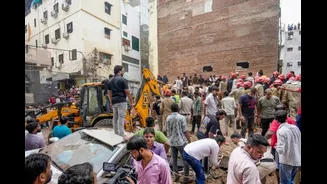

New Delhi, Sep 7 (PTI) The Delhi government’s plan to bring in a new safety policy for paying-guest accommodation may have been prompted by the Satya Niketan building collapse, but attempts to regulate
PGs in the city go back more than three decades.
Chief Minister Rekha Gupta on Monday said her government is drafting a policy under which the owners of old buildings will have to submit structural audit reports and certify their safety before they can be used to accommodate paying guests or as nursing homes, schools and other commercial establishments.
The announcement came after the collapse of a building housing a PG in south Delhi’s Satya Niketan.
But records show that attempts to regulate paying-guest accommodation in Delhi go back to at least 1993, followed over the years by fresh schemes, surveys, committees and proposals for registration and licensing.
A 2006 Delhi High Court judgment records that a “Paying Guest Residential Accommodation” scheme framed by the Centre was already in operation in the capital in 1993.
“With a view to provide affordable and hygienic accommodation to foreign and domestic tourists, the central government formulated a scheme as per which residential buildings could be used for providing boarding and lodging to tourists,” the court said.
“It was a term of the scheme that the person availing benefit of the scheme should have his/her residence in the building. The scheme was called ‘Paying Guest Residential Accommodation’,” it added.
The judgment referred to a South Extension Part-I property that was given permission in December 1993 to keep paying guests under the scheme.
The responsibility for regulating the scheme was subsequently transferred to the Delhi government, which — then led by the Congress’s Sheila Dikshit — approved its own Paying Guest Residential Accommodation Scheme in 2000.
Under the scheme, house owners could register with the Delhi Tourism to keep paying guests. No more than half the bedrooms could be used for the purpose, with an upper limit of four rooms or eight beds.
The scheme, however, was designed largely to provide tourists with affordable accommodation in homes where the owners themselves lived. It did not address the kind of large commercial PGs that later mushroomed around Delhi’s universities, coaching hubs and employment centres.
And as the nature and scale of the PG business changed, regulation struggled to keep pace.
Nearly two decades later, a Delhi Assembly committee examining problems faced by students around the Delhi University (DU) was still asking basic questions about which rules applied to PGs and who was responsible for enforcing those.
At a meeting in August 2019, the Assembly’s Committee on Petitions asked authorities to prepare a list of PGs and other establishments operating around the DU.
More significantly, it sought a document spelling out the rules governing them and identifying “problems/grey areas in terms of regulation” relating to fire safety, building norms and health licences.
Officials were given 15 days to provide the information.
“However, no such documentation was received till date,” the committee subsequently recorded in its report.
The exercise was followed by more attempts at surveys and regulation.
In 2021, the erstwhile North Delhi Municipal Corporation proposed surveying PGs, particularly around the DU’s North Campus, and registering establishments being run as commercial businesses.
In 2022, following meetings involving the city government’s home department, the Delhi Police and civic agencies, authorities proposed bringing around 700 private hostels and PGs used by college students under a Delhi Police licensing regime.
Officials acknowledged then that there was no statutory body specifically regulating such establishments. The proposed rules were to cover occupancy, kitchens, elevators, fire clearances and other facilities.
Yet, a year later, the regulatory gaps were evident again.
After a fire at a women’s PG in Mukherjee Nagar in September 2023, the Municipal Corporation of Delhi (MCD) ordered another survey. Civic officials said there were no specific norms for operating a PG in a residential area and that the corporation did not issue licences for PGs, even though building, land-use and fire-safety rules applied.
The survey subsequently found more than 100 PG establishments allegedly violating building bylaws.
Three decades after the first scheme, and after several surveys, committees and proposals in between, the Satya Niketan tragedy has brought the issue back into focus, with the promise of yet another policy. PTI SBR RC