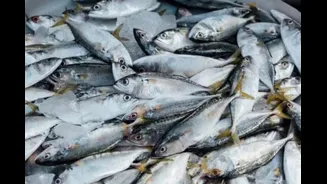

India’s fish production rose to 197.75 lakh tonnes in FY 2024–25, up from 95.79 lakh tonnes in FY 2013–14, marking a sharp 106% increase. Average aquaculture productivity has also improved to 4.77 tonnes per
hectare, reflecting better technology adoption and farm practices.
India is now the world’s second-largest fish producer, contributing nearly 8% of global output, and leads in shrimp production and exports.
According to PIB, Seafood exports touched 16.98 lakh tonnes worth Rs 62,408 crore in 2023–24.
Big Push Through Government Schemes
Since 2014–15, the Government of India has approved projects worth Rs 32,723 crore under schemes like PMMSY, PMMKSSY, FIDF and Blue Revolution, with total investments announced at Rs 38,572 crore. These initiatives focus on production, infrastructure, value addition, and fisher welfare.
74.66 Lakh Employment Opportunities Generated
Under various fisheries schemes, 74.66 lakh direct and indirect jobs have been created since 2014–15, as per PIB report. The sector now supports livelihoods of around 3 crore fishers and fish farmers across the value chain.
Strong Welfare and Financial Support
The government has expanded social security and credit access for fishers. 34.71 lakh fishers are covered under group accident insurance, 4.49 lakh Kisan Credit Cards worth Rs 3,569.60 crore have been issued, and 4.33 lakh fisher families receive nutritional support during lean fishing periods.
Infrastructure, Clusters and Blue Economy Focus
Major investments in fishing harbours, cold chains, aquaparks, seaweed farming, and deep-sea fishing are strengthening India’s Blue Economy. New cluster-based development and EEZ rules aim to boost exports, sustainability, and incomes in the coming years.