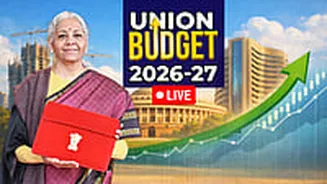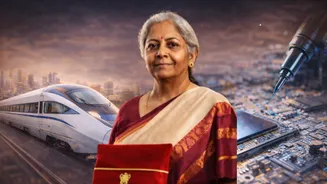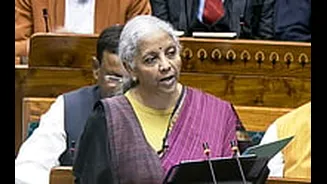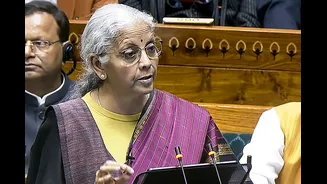






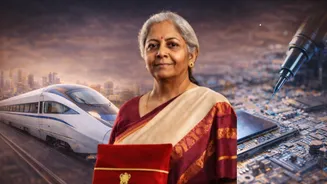


Union Budget 2026 Speech Highlights: Union Finance Minister Nirmala Sitharaman on Sunday presented her ninth Union Budget for the year 2026, noting that the government had chosen reforms over rhetoric.
Sitharaman, who chose a Kanjeevaram sari for the occasion in what is being considered a nod to Tamil Nadu ahead of the assembly elections this year, said India’s economic trajectory was marked by stability, growth and moderate inflation. “We have pursued far-reaching structural reforms. The government has decisively chosen action over ambivalence, reform over rhetoric. Steps taken by the government have delivered high growth rate of around 7 per cent,” she said.
Here are the highlights from the finance minister’s Budget 2026 speech:
• Sitharaman termed the Budget “Yuva Shakti-driven”, saying the focus was on the poor, underprivileged, and disadvantaged sections. “The duty is to fulfill the aspirations of the people. This three-fold approach needs a supportive ecosystem,” she said.
• Focus On Textiles: The FM mulled a textile expansion and employment scheme to modernise textile clusters. She proposed setting up mega textile parks in challenge mode and launching Mahatma Gandhi Gram Samaj initiative to support Khadi and handicrafts. She also proposed a National Fibre Scheme for self-sufficiency.
• India Semiconductor Mission 2.0: The focus will be on industry-led research and training centres for semiconductors. The minister proposed increasing the outlay to Rs 40,000 crore to capitalise on the momentum of the semiconductor mission. She also pushed for supporting mineral-rich states of Odisha, Kerala, Andhra Pradesh, and Tamil Nadu.
• Waterways: Sitharaman proposed setting up training institutes to train youth for waterways. She also pushed to connect mineral-rich areas in Odisha via waterways and to operationalise 20 new waterways over next five years.
• Medical Infra: She called for upgrade of Ayush pharmacies and drug-testing labs and said the government would set up five medical tourism regional hubs with the private sector. The minister said the medical tourism hubs will have Ayush centres and 1.5 lakh caregivers will be trained in the coming years.
• MSME Sector: The Budget signalled a renewed thrust on strengthening India’s MSME ecosystem, with a mix of fresh funding, cluster revival and improved credit access aimed at shoring up the sector’s foundations. The government plans to rejuvenate 200 traditional industrial clusters hit by financial stress and obsolete technology, introduce a Rs 10,000 crore SME Growth Fund to help promising firms scale up under performance-linked incentives, and inject an additional Rs 2,000 crore into the Self-Reliant India Fund to support micro enterprises still struggling to secure capital.
• Restructuring & Strengthening: Sitharaman proposed incentives of Rs 100 crore for single bond issuance by municipal corporations of more than Rs 1,000 crore. She also announced restructuring of REC Ltd (formerly Rural Electrification Corporation) and Power Finance Corporation (PFC) as part of the government’s public sector financial institution strengthening. Apart from this, the minister proposed setting up high-level committee on ‘Banking for Viksit Bharat’.
• Connectivity Push: Sitharaman on Sunday announced that India will develop seven high-speed rail corridors between key cities that will serve as ‘growth connectors’ to promote environmentally sustainable passenger systems. The corridors will connect Mumbai and Pune, Hyderabad and Pune, Hyderabad and Bengaluru, Hyderabad and Chennai, Chennai and Bengaluru, Delhi and Varanasi, and Varanasi and Siliguri. The minister also announced a new dedicated east-west freight corridor connecting Dankuni in the east with Surat in the west.
• Individuals living abroad can now invest in Indian stocks through the Portfolio Investment Scheme, the finance minister announced. The Portfolio Investment Scheme enables non-resident Indians and foreign investors to trade Indian equities via a designated bank account sanctioned by the RBI. The scheme imposes investment caps—typically 5% for an individual investor and 10% collectively per company—while ensuring all transactions comply with regulatory norms. Investments made under this route can be repatriated.
• Income Tax: Sitharaman announced that simplified income tax rules and forms will be notified shortly in an attempt to ease compliance for taxpayers and reduce the procedural burden associated with filing returns. Sitharaman emphasised that overhauling the tax structure is crucial for creating a more taxpayer-friendly and approachable system. By clarifying rules and rolling out simpler forms, the government aims to make compliance easier for salaried employees, small enterprises, and other taxpayers, while minimising mistakes and enhancing the efficiency of tax administration.
• Tax Holiday: Sitharaman proposed to provide tax holiday till 2047 to any foreign company that provides cloud services to customers globally by using data center services. However, it will need to provide services to Indian customers through an Indian reseller entity. She also introduced a six-month foreign asset disclosure scheme for taxpayers and proposed that the deadline for filing ITR-1 and ITR-2 will continue to be July 31. The TCS on medical and education has also been reduced from 5 per cent to 2 per cent.
• Focus On Women: Focusing on women, Sitharaman announced that self-help entrepreneurs will be set up as community-owned retail outlets for women. The FM, while speaking about the successful foundation laid by previous initiatives, specifically noted that she intends to “build on the success of ‘Lakhpati Didi Programme’ which has already helped millions of women find their footing through self-help groups”. The budget also introduced the concept of ‘SHE’, a dedicated branding and infrastructure project.