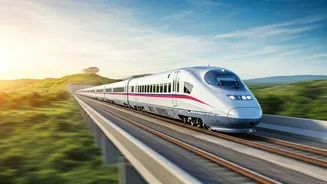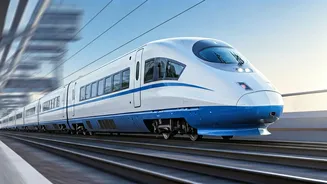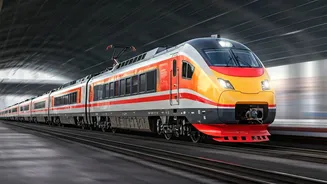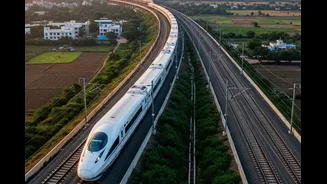








Telangana has moved a step further in its push for high-speed rail, with Hyderabad emerging as the focal point of an ambitious network proposed to connect major cities across southern and western India.
At a high-level review meeting at the Secretariat, Roads and Buildings Minister Komatireddy Venkat Reddy said the proposed Hyderabad-Pune-Mumbai high-speed rail corridor has reached a significant milestone, with the Detailed Project Report (DPR) now completed.
Calling the project a potential game changer, the minister said the corridor could dramatically reduce travel time between Hyderabad and Mumbai to under three hours while opening new avenues for trade, mobility and regional economic growth.
761-Km Corridor Planned Between Hyderabad And Mumbai
According to officials, the proposed corridor will stretch about 761 km and is being designed for trains capable of operating at speeds of 320-330 kmph.
The project envisions around 10 to 12 stations along the route and would feature a combination of elevated sections, at-grade stretches and underground segments.
According to a report in NDTV, a tunnel of roughly 4-5 km has also been proposed near Vikarabad as part of the alignment.
If executed as planned, the corridor would mark one of India’s most significant high-speed rail projects outside the Ahmedabad-Mumbai bullet train network.
Project Cost Estimated At Around Rs 2 Lakh Crore
Initial DPR estimates and comparisons with other high-speed rail projects place the likely cost of the corridor at around Rs 2 lakh crore. Officials, however, said the final project cost will be determined after approvals, funding arrangements and further technical assessments are completed.
The scale of investment underlines the ambition of the project, which is being positioned not only as a transport upgrade but also as long-term economic infrastructure.
Construction Could Begin By 2027-28
With the DPR now completed, the focus is shifting towards approvals from the Centre and coordination with Maharashtra and other stakeholders. Officials indicated that if statutory clearances and funding fall into place on schedule, construction could begin by late 2027 or early 2028.
The execution timeline is estimated at around six to eight years, which could place the corridor’s commissioning in the early to mid-2030s.
Long-Term Execution Seen In Phases
Given the project’s scale, officials expect implementation to move in phases, with alignment approvals, financing structures and inter-state coordination likely to shape the pace of execution.
Coordination with central agencies, particularly the National High Speed Rail Corporation Limited, is expected to play a critical role in taking the project from planning to construction.
Corridor Expected To Boost Trade And Business Travel
Beyond faster passenger movement, the project is being projected as an economic growth catalyst.
Officials believe the corridor could support trade flows, reduce travel time for business movement and strengthen industrial development along the route.
Minister of Roads and Buildings of Telangana Komatireddy Venkat Reddy said Hyderabad’s strategic location positions it as a natural connector between multiple growth regions, and high-speed rail could reinforce that role.
Analysts say such a corridor could also help integrate emerging industrial and logistics hubs across Telangana, Maharashtra and adjoining regions.
Hyderabad At Centre Of Wider High-Speed Rail Network Plans
The Mumbai corridor is only part of a larger high-speed rail vision the state is pursuing.
Officials said Telangana is also working on proposed bullet train links:
- Hyderabad to Chennai via Amaravati
- Hyderabad to Bengaluru
Discussions with neighbouring states are reportedly underway to finalise alignments and move these proposals forward.
Taken together, the projects point to a broader effort to place Hyderabad at the centre of a future fast-rail network spanning multiple economic corridors.
Focus On Inter-State And Central Coordination
Officials said collaboration with neighbouring states and central agencies will be crucial in moving the projects beyond the proposal stage.
Much of the next phase will depend on funding models, technical approvals and coordination across jurisdictions, often among the most complex aspects of large infrastructure projects.
The role of the National High Speed Rail Corporation Limited is expected to be particularly important as planning advances.
What The Project Could Mean For Regional Connectivity
If implemented as envisioned, the proposed high-speed network could significantly alter how people and goods move across southern and western India.
For Telangana, the plan is being framed not merely as a transport project, but as a strategic infrastructure bet that could strengthen Hyderabad’s role in trade, mobility and regional integration.
With a Hyderabad-Pune-Mumbai corridor taking shape and other routes under discussion, the broader ambition is clear: to place Hyderabad at the heart of a new high-speed rail grid that could redefine connectivity in the decades ahead.