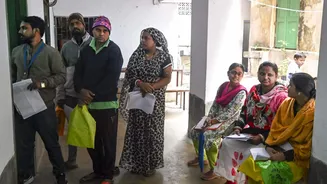

Kolkata, Dec 28 (PTI) Hearings under the Special Intensive Revision (SIR) of electoral rolls were underway in West Bengal for the second day on Sunday with people queuing up in front of 3,234 centres across
the state, a senior official said.
Around 32 lakh “unmapped” voters, those who are unable to establish linkage with the 2002 electoral roll, are being called for hearings in the first phase, he said.
Seventy-five-year-old Sabita Manna, afflicted by polio, was waiting for her turn in an ambulance at the Sankrail block office in Howrah district, anxiety writ large on her face over reports of discrepancies in her details as an electorate.
Her nephew Tapas Manna said, “My aunt, who has no child, could not find her name in the 2002 electoral roll. She cannot properly walk as she had been afflicted by polio at a very young age.” “While on earlier occasions she was visited by polling personnel and representatives of political parties at home and only had to come to the polling station on the day of the vote, this time they have made her physical presence mandatory,” he said.
Sabita said from inside the ambulance, “It hurts when, at this age, you have to prove your citizenship all over again.” Nirufa Khatoon, a woman voter in Barasat Kazipara area, is distraught, being called for hearing unable to prove her father had voted in the 2002 polls.
“I am an Indian citizen born in the Kamarhati area of North 24 Parganas. After marriage, I came to Kazipara in Barasat. However, my father had died and his name does not figure in the electoral roll, while my mother had died shortly after my birth. The BLO had assured me that things will be sorted out after the hearing. I am literally on the edge,” she said with her husband standing by her side.
“NIrufa has brought the school leaving certificate, birth certificate and aadhaar card, ration card and existing voter ID card. We hope things will be sorted as promised by the BLO earlier. Hope the AERO and micro observer will accept,” her husband said, adding he has asked his wife to properly explain all these things during the hearing.
In faraway Midnapore town, around 100 residents of a cluster, known as ‘Hatath colony’ among locals, came to the nearby camp.
“Only two out of ten in a house find their names in the draft roll. The rest have been called for hearing. Yes, I was born in Bangladesh, but I came here in the late 80s and have voted regularly. I have many of the 11 documents as records. Keeping my fingers crossed. I am a Hindu married to a family who have its ancestral property here. They won’t allow me to be deported to any camp,” a woman, refusing to be named, said.
A 26-year-old woman in Bardhaman town could not attend the hearing in the camp in Baranilpur area during the day with her 3-year-old daughter, currently under treatment at Tata Memorial Hospital in Mumbai, her father-in-law told reporters at the camp.
“I am carrying the mailed medical record of my grand daughter’s hospitalisation. I am also carrying all her documents. Let’s see what the AERO and microobserver say,” he said, refusing to be identified.
At the Chetla High School camp in south Kolkata, local MLA and Kolkata Mayor Firhad Hakim said, “Many people – who are unmapped due to technical difficulties in linking despite giving all relevant data – don’t have to attend the hearing any more as the onus falls on the ECI. I have been told by the CEO personnel that they don’t have to attend hearing any more till the EC fixes the glitches and link their name properly with the 2002 electoral roll data.
The Election Commission (EC) had, on December 16, published the state’s draft electoral rolls following SIR, deleting the names of more than 58 lakh voters on various grounds, including death, migration and non-submission of enumeration forms. PTI SUS RG