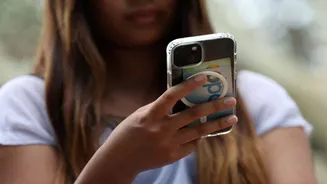

France has become the first country in the European Union to approve a blanket ban on social media access for children under the age of 15, with Parliament passing landmark legislation aimed at protecting
children from the harmful effects of excessive online exposure.
The law, strongly backed by President Emmanuel Macron, will prohibit children under 15 from creating social media accounts and require platforms to verify users’ ages.
The French Senate approved the legislation on Tuesday before the National Assembly passed it by 279 votes to 81, making France one of the first countries globally to adopt such sweeping restrictions on children’s access to social media platforms.
MACRON CALLS IT A MAJOR STEP TO PROTECT CHILDREN
President Emmanuel Macron welcomed Parliament’s approval, describing it as a significant milestone in safeguarding children and teenagers online.
“France is leading the way in Europe when it comes to protecting our children and teenagers,” Macron said in a video posted on social media after the vote.
He added that the Constitutional Council must now review the legislation before it can take effect.
“The Constitutional Council must now rule on it, and then it will be time to take action to make this measure a reality and protect our children online,” Macron said.
Macron wants the law implemented from September 1, in time for the beginning of France’s new academic year.
HOW THE LAW WILL BE IMPLEMENTED
Under the legislation, children below the age of 15 will be prevented from opening new accounts on social media platforms from September, while existing accounts belonging to under-15 users will be shut down from January 2027.
French Digital Minister Anne Le Henanff said the implementation timeline is achievable because age-verification technology is already available, while additional tools are still being developed.
“For four months, all of us in France will have to prove our age,” she told journalists. “If someone is under 15, the account will be closed.”
She also stressed that the responsibility for enforcing the law rests with social media companies and assured that users’ personal data would remain protected.
The legislation exempts educational websites, online encyclopaedias and scientific platforms. It also does not prescribe penalties for children or their parents.
The legislation comes amid increasing concerns over the impact of social media on young users.
France’s public health watchdog warned last year that platforms such as TikTok, Snapchat and Instagram have harmful effects on adolescents, particularly girls.
According to the watchdog, around 90 per cent of children aged 12 to 17 use smartphones daily to access the internet, while one in two teenagers spends between two and five hours each day on a smartphone.
The report linked excessive social media use to reduced self-esteem and increased exposure to content promoting self-harm, suicide, drug use and other risky behaviours.
AP also reported that several French families have filed lawsuits against TikTok, alleging that harmful content on the platform contributed to teenage suicides.
PRIVACY AND ENFORCEMENT QUESTIONS REMAIN
While lawmakers broadly agreed on the need to strengthen online protections for children, the legislation faced criticism from some opposition lawmakers, particularly from the left.
Critics argued that large-scale age verification could undermine online anonymity, raise privacy concerns and prove difficult to enforce, especially for users who already have existing accounts.
Legal experts also noted that identifying and suspending current accounts belonging to children under 15 would be one of the biggest implementation challenges.
France’s decision is expected to shape the European debate on regulating children’s access to social media.
According to AFP, the European Union has been considering stricter rules after France, Greece and Spain pushed for tougher restrictions.
European Commission President Ursula von der Leyen recently said children should have “phased and gradual access” to social media, while the European Commission has begun testing an age-verification application across member states.
France’s law will also prohibit the use of mobile phones in high schools, with the government aiming to implement both measures from the start of the new school year.
Globally, Australia became the first country last year to require major social media platforms to remove accounts belonging to children under 16 or face heavy financial penalties.
ALSO READ | Canada Weighs Social Media Ban For Under-16s In Major Digital Safety Overhaul