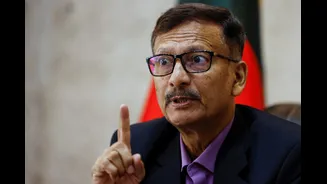

Bangladesh’s Foreign Affairs Adviser Touhid Hossain on Tuesday said it was difficult to say at this stage whether ties between Dhaka and New Delhi had entered a “new phase”, while acknowledging that relations
remain under strain.
Hossain said India’s decision to summon Bangladesh’s High Commissioner over provocative remarks made by a Bangladeshi politician was “not unexpected” and should be seen as a routine diplomatic step.
His remarks come days after Hasnat Abdullah of the National Citizen Party issued statements threatening India’s territorial integrity. Abdullah had said Bangladesh could shelter forces hostile to India and allow separatist groups to use Bangladeshi soil.
“We will sever the seven sisters from India,” Abdullah had said, referring to India’s northeastern states of Tripura, Mizoram, Manipur, Meghalaya, Assam, Nagaland and Arunachal Pradesh. Of these, Tripura, Mizoram, Meghalaya and Assam share borders with Bangladesh.
Addressing the fallout, Hossain said the diplomatic response from India was predictable.
“This is not unexpected. The real question is whether our relations have entered a new phase. It is difficult to say that at this point. We must accept reality,” he said.
Hossain admitted that ties with India remain stressed and said the strain has persisted since the current interim administration took charge.
“Relations with India are stressed. In a way, they were stressed earlier as well, including since the onset of the new interim administration,” he said.
“We knew there was stress, which is why we called for good relations. Now, ties have to be restored through efforts from both sides. Perhaps both sides were unable to move forward, which is why the strain continues,” he said.
Hossain also acknowledged that differences remain between the two neighbours.
“We have some disagreements, and they also have their own positions,” he added.