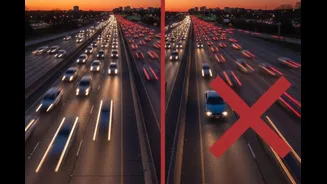








Driving on the wrong side has emerged as one of the most persistent and dangerous traffic violations in India, with official data and media reports indicating that more than 70,000 challans are issued
every year for the offence. Cities such as Delhi, Gurugram and Mumbai alone account for lakhs of such fines annually, underlining how routine the violation has become and how heavily it contributes to road accidents.
According to the Ministry of Road Transport and Highways’ 2023-24 report, wrong-side driving remains a major cause of crashes across the country. In response, traffic enforcement has hardened. By 2025–26, police in cities like Delhi and Gurugram began registering criminal cases against offenders.
While the standard fine under the Motor Vehicles Act is Rs 5,000, it can rise to Rs 5,500 or more when clubbed with dangerous driving. In several jurisdictions, wrong-side driving is now treated as a criminal offence, allowing police to register an FIR, seize vehicles and initiate court proceedings. Conviction can even lead to imprisonment of up to six months.
Globally, unsafe driving practices are not limited to India. South Africa is often cited as one of the world’s most dangerous countries for motorists, where traffic rules are routinely ignored. Wrong-direction driving, reckless overtaking and speeding are common, contributing to an estimated 10,000 to 12,000 road accident deaths every year. Studies show that driver error accounts for the majority of crashes, with drunk driving rates as high as 57-58%. Pedestrians are the worst affected, forming around 41-43% of road fatalities.
In Southeast Asia, Thailand records a high number of accidents, particularly involving motorcyclists riding in the wrong lane. Indonesia faces similar problems, where congestion and poor infrastructure push drivers to take illegal shortcuts. Russia and Georgia are also considered high-risk due to frequent violations related to lane discipline and wrong-hand driving.
Europe presents a different picture, one of strict enforcement and staggering penalties. Belgium, despite its small population, recorded more than 9.2 million traffic violations in 2024, including 7.6 million speeding offences. Per capita, countries such as Belgium, the Netherlands and France rank among those issuing the highest number of speeding fines.
Switzerland stands apart for imposing some of the world’s costliest penalties. In a widely cited case, a wealthy businessman was fined around 90,000 Swiss francs (nearly Rs 90 lakh) for speeding. The country follows a “day-fine system”, under which penalties are linked to an offender’s income. Courts assess both the seriousness of the offence and the individual’s daily earnings, ensuring that fines are, in the words of Swiss law, “equally painful” for rich and poor alike. Norway, Iceland and Estonia also impose relatively high fines, though Switzerland’s income-based model remains the most stringent.
The philosophy behind such laws is simple; personal freedom ends where another person’s life is put at risk. Speed limits, especially near schools and residential areas, are enforced with zero tolerance, and any harm to pedestrians is treated as a grave offence.
When it comes to discipline and road safety, Sweden is widely regarded as the global benchmark. With just two road accident deaths per 1,00,000 people, it consistently ranks as the safest country to drive in, followed by Switzerland, Japan, Germany and the United Kingdom.
Sweden’s success is rooted in its 1997 ‘Vision Zero’ policy, which declared that no loss of life on the road is acceptable. While human error is inevitable, the system, from road design and speed limits to vehicle safety standards and pedestrian priority, is built to ensure that mistakes do not turn fatal.
As a result, Swedish driving culture reflects restraint and responsibility. Vehicles stop automatically at zebra crossings, honking is frowned upon, and speeding carries social stigma. Obtaining a driving licence is a long and expensive process, while losing it is relatively easy. Only those who fully grasp the responsibility of driving are allowed on the road. Remarkably, even in harsh conditions of snow, darkness and icy surfaces, serious accidents remain rare.