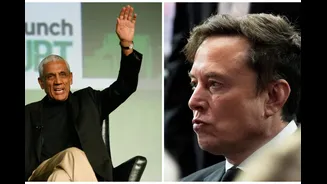






The public feud between Silicon Valley billionaires Vinod Khosla and Elon Musk has once again erupted into full view on X. The latest clash is not an isolated exchange but part of a layered, years-long
conflict between two figures who sit at opposite ends of Silicon Valley’s ideological spectrum.
Understanding why their exchanges have become so fraught requires examining who Khosla is, what triggered the current fight, and how their relationship deteriorated over time.
Who Is Vinod Khosla?
Khosla is one of the most influential Indian-American entrepreneurs in the global technology ecosystem, though he often maintains a quieter public profile compared to the personalities who dominate social media feeds.
Born in Pune in 1955 and raised in a Punjabi family, Khosla grew up in an environment shaped by discipline and public service. His father served in the Indian Army, and for a time it seemed expected that Khosla might follow a similar path. Yet from his teenage years, he nurtured a different vision. He was captivated by the nascent world of computing and made it a personal goal to launch a Silicon Valley company before turning 20.
After graduating with a degree in electrical engineering from IIT Delhi in 1976, Khosla initially tried establishing ventures in India, including an early experiment with soy milk production. The stringent regulatory environment of the time, however, made it difficult to build the kind of technology-centric enterprise he envisioned.
This pushed him towards the United States, where he pursued postgraduate studies in biomedical engineering at Carnegie Mellon University, followed by an MBA at Stanford. Those academic years placed him at the centre of the innovation wave that would soon define the modern tech landscape.
Khosla first entered the entrepreneurial arena through Daisy Systems in 1981, but his career reached a defining moment the following year when he co-founded Sun Microsystems with Scott McNealy, Andy Bechtolsheim and Bill Joy. Sun would go on to become one of the most consequential technology companies of the internet era, powering servers, software and computing architecture across the world.
Khosla rose through the company’s leadership ranks, eventually becoming CEO. By 2000, Sun had reached a market capitalisation of around $150 billion, making it one of the largest Indian-founded corporations in history.
Though he left Sun in 1986, Khosla’s next chapter proved equally transformative. After working in venture capital for nearly two decades, he founded Khosla Ventures in 2004, a firm known for its willingness to back ambitious, high-risk scientific and technological ideas.
The company became one of the earliest investors in OpenAI and has remained focused on frontier innovation in climate tech, healthcare, computing and high-science ventures. Today, according to Forbes, Khosla’s net worth is around $13.4 billion, placing him among the world’s wealthiest Indian-origin entrepreneurs.
What Triggered The Latest Clash With Musk?
The newest flashpoint between Khosla and Musk was ignited when Khosla resurfaced a months-old post written by Musk in 2025. In that post, Musk had claimed that white people were becoming “a rapidly diminishing minority of global population,” a remark that drew backlash at the time for its framing of demographic change.
Khosla reposted the comment on X and criticised it for promoting what he described as a racialised worldview. He argued that such remarks, even if framed as demographic observations, had the effect of normalising divisive ideas about identity and population shifts.
Khosla went further, accusing Musk of advancing something akin to a racial ideology and coined the term “WAGA”—“white America great again”—as a contrast to US President Donald Trump’s MAGA slogan. Khosla even urged non-white employees and what he termed “decent whites” to leave Musk’s companies and instead join firms backed by his investment portfolio.
.@elonmusk doesn’t want MAGA, he wants WAGA or “white America great again” as a racism is great and desirable” paradigm. All non-whites in @tesla, @SpaceX @X etc and all decent whites should quit and join our portfolio. Email us your linkedin! https://t.co/NmbM19AnnC
— Vinod Khosla (@vkhosla) January 27, 2026
Musk responded by dismissing Khosla’s criticism, noting that his partner, Shivon Alice Zilis, is half Indian and that one of his children has been named in honour of renowned Indian-American physicist Subrahmanyan Chandrasekhar.
“Vinod, you’re not just such a pompous a**hole that you tried to stop the public from using a public beach near your house, you’ve also gone full retard. My partner, Shivon, is half Indian and my eldest son with her is named in honor of the great Indian physicist Chandrasekhar,” Mush wrote in response.
Vinod, you’re not just such a pompous asshole that you tried to stop the public from using a public beach near your house, you’ve also gone full retard.
My partner, Shivon, is half Indian and my eldest son with her is named in honor of the great Indian physicist Chandrasekhar.
— Elon Musk (@elonmusk) January 27, 2026
For years, Khosla has been embroiled in a legal battle over public access to Martins Beach, a scenic spot situated through land he owns in San Mateo County. Musk accused him of attempting to block public use of the beach, though Khosla has long maintained that the issue concerns property rights and the limits of regulatory authority in California. He argues that historical access to the area was never truly free and that he has faced inconsistent decisions from the state’s coastal regulators and courts.
You owe me an apology for spreading falsehoods. I think this post of yours needs a community comment for being a fraudulent photo. I have never put up this sign or anything even remotely like this. I presume it is AI generated but you can verify that. It will help X if we can… https://t.co/5PVE8uxDpH
— Vinod Khosla (@vkhosla) September 22, 2024
Why The Fight Spiralled Further
Khosla criticised Musk for invoking his family rather than addressing the substance of the allegation, arguing that the focus should remain on the content and impact of Musk’s public remarks.
“Instead of bringing your family into it, maybe try not tweeting ‘seemingly’ racist stuff next time?” Khosla wrote, adding that many would appreciate Musk clarifying that he was not trying to “establish a white society in America”.
Instead of bringing your family into it, maybe try not tweeting “SEEMINGLY” racist stuff next time? Many would appreciate it if you acknowledge you are not trying to establish a white society in America, and are not WAGA, and racism isn’t behind your many laments around white… https://t.co/0beAe5tDUN
— Vinod Khosla (@vkhosla) January 28, 2026
A Long-Running Feud Rooted In Ideology
Although the latest confrontation has drawn widespread attention, it is only one chapter in a rivalry that has simmered for years. The tensions became especially visible during the 2024 US presidential race.
When Joe Biden withdrew from the contest, Khosla publicly suggested that the Democratic Party should replace him with a centrist figure. Musk instead encouraged Khosla to support Donald Trump.
Khosla rejected the idea, saying it was “hard for me to support someone with no values, lies, cheats, rapes, demeans women, hates immigrants like me.” Musk replied by arguing that Trump was a defender of individual freedoms, prompting Khosla to counter that Musk’s own companies had benefited from the very government support he criticised.
Beyond politics, the two have clashed over artificial intelligence. Khosla Ventures was one of the early backers of OpenAI, a company Musk co-founded but later left. Musk has since pursued his own AI ventures and advocated for open-source development. Khosla, by contrast, supports stricter regulation and argues that certain AI capabilities require guardrails. Their disputes have spanned immigration, the role of government in innovation, and the ethics of rapid technological advancement, with each accusing the other of inconsistency and exaggeration.
Why This Confrontation Matters
In the United States, debates about race and immigration remain deeply polarised, and when influential figures weigh in, their words carry far-reaching implications. Khosla’s criticism reflects concerns that Musk’s expansive audience lends undue legitimacy to narratives that can distort public discourse, while Musk sees such criticism as an attack on free expression and individual perspective.