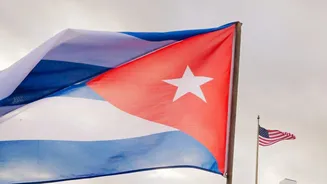







The Donald Trump administration has drastically intensified military deployments and aggressive rhetoric against Cuba, causing global intelligence analysts to warn that a direct military conflict or strike
is a distinct possibility. Internal intelligence sources maintain that Washington is not looking at an “imminent” ground invasion, but rather preparing for a potential total collapse of the Cuban regime by this summer. Why this could be disastrous for the world already grappling with the oil shock from Iran war, News18 explains.
WHAT US IS DOING
Military Mobilisation: The U.S. has stationedthe USS Nimitz aircraft carrier strike group, along with multiple guided-missile cruisers and destroyers, in the southern Caribbean Sea directly off Cuba’s coast. There is a massive spike in U.S. military intelligence and surveillance flights monitoring the island. Aircraft are purposefully leaving their transponders turned on to signal a deliberate show of monitoring and force to Havana.
Legal and Diplomatic Escalation: The U.S. Department of Justice issued an unprecedented criminal indictment against Cuba’s former leader, Raúl Castro, in connection to the 1996 downing of civilian planes. Experts see this legal framing as a direct precursor to justifying regime change, mimicking the strategies used before the recent U.S. ouster of Nicolás Maduro in Venezuela.
The White House has officially declared Cuba an “extraordinary threat” to national security. U.S. intelligence alleges that Cuba has over 300 drones capable of attacking localized American targets like Guantánamo Bay, while heavily criticising the alleged presence of Iranian and Chinese military advisers in Havana.
Crippling Economic Blockade: The U.S. implemented a near-total oil embargo on Cuba. After the U.S. removed Maduro from Venezuela (Cuba’s primary energy patron), the Trump administration threatened crippling tariffs on any other nation trying to supply oil to Havana—leaving Russia as Cuba’s only outside oil supplier. This blockade has devastated the Cuban economy, leaving hospitals, food production, and basic utilities under catastrophic, near-permanent blackouts.
WHAT HAS TRUMP SAID ON CUBA?
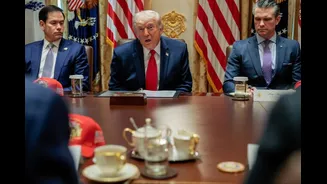
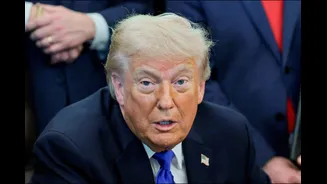
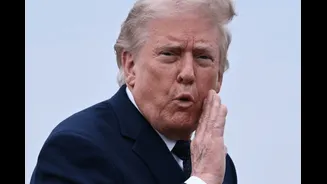
Trump has aggressively escalated his rhetoric against Cuba, declaring it a “failing nation” that will “soon fall” under the weight of his administration’s “maximum pressure” campaign. Trump explicitly predicted the collapse of Cuba’s 67-year-old communist government during media interviews, noting that the island’s deepening economic crisis has pushed it to the brink. Speaking to reporters in the Oval Office, Trump classified Cuba as a “failed nation” that is “begging for help” amid catastrophic energy, food, and fuel shortages.
In early 2026, Trump threatened a “friendly takeover” of the island, asserting that the country is in “deep trouble”.
Trump has boasted that while thirteen previous U.S. presidents failed to resolve the Cuba issue, “it looks like I’ll be the one that does it, so I would be happy to do it.”
“Make a deal, before it is too late”: Following U.S. operations to confiscate and block Venezuelan oil tankers destined for Havana, Trump warned Cuba on Truth Social that “there will be no more oil or money going to Cuba—zero!”
Despite his aggressive posture, Trump has simultaneously claimed that Cuba is desperate to negotiate with Washington, hinting that his Secretary of State, Marco Rubio, may eventually lead talks if Havana is ready to make deep concessions.
In late March, Trump asserted immense presidential authority over the situation, stating, “Whether I free it, take it—I think I can do anything I want with it.”
WHAT NEXT?
According to reports from Axios via The Statesman,U.S. officials believe the current economic strangulation could cause the Cuban government to spiral out of control and fall as early as this summer.
The current military positioning is primarily intended to enforce the oil blockade, deter Cuba’s foreign allies, and ensure U.S. military forces are in place to directly control the chaos or intervene if the government collapses. In response, Cuban officials have rejected the U.S. claims as a “fraudulent case” to justify an unprovoked war, warning that any active U.S. strike will result in a domestic “bloodbath”, say reports.
WHY IT WOULD BE DISASTROUS FOR THE WORLD
An escalation of US military action or a structural collapse in Cuba would trigger severe ripples across global energy markets, international law, and regional security. Following the recent US removal of Nicolás Maduro in Venezuela, the current blockade on Havana has already fundamentally shifted Latin American geopolitics.
A direct conflict or government collapse would impact the world across several critical dimensions, according to experts:
Reason 1: Disruption to Global Shipping and Maritime Trade
Cuba sits directly adjacent to vital global shipping lanes. Any active conflict involving sea mines, swarms of small vessels, or defensive anti-ship operations would choke commercial traffic moving through the Florida Straits and the Gulf of Mexico.
maritime insurers would immediately label the Caribbean a high-risk war zone. This would exponentially spike freight costs, delaying goods traveling between North America, Europe, and the Panama Canal, say experts.
Reason 2: Compounding Pressure on Global Energy and Tariff Markets
Under Executive Order 14380, the U.S. has threatened punitive tariffs on any nation supplying oil to Cuba. Active military enforcement of this blockade directly penalizes major global energy exporters—like Mexico—straining U.S. trade relations with key allies.
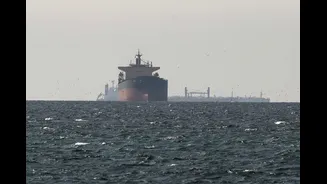
With Venezuela out of the picture, Russia remains Cuba’sprimary lifeline, recently sending major crude tankers to the island. Active U.S. naval interdictions of these vessels risk a direct, volatile confrontation with Moscow on the high seas, according to experts.
Reason 3: A Flashpoint for Great Power Confrontation
Cuba is a strategic partner for both Moscow and Beijing. While the U.S. aims to permanently sever Russian and Chinese intelligence and military footprints from the Western Hemisphere, a heavy-handed U.S. invasion could prompt these superpowers to retaliate symmetrically in other global theaters, such as Eastern Europe or the South China Sea.
The United Nations has historically opposed the U.S. embargo on Cuba. A unilateral U.S. invasion or forced regime change would deeply fracture Washington’s diplomatic standing with the European Union and Latin American states, who view the current oil blockade as a driver of humanitarian catastrophe, say experts.
Reason 4: Regional Humanitarian and Migration Crisis
Experts warn that a full state collapse or kinetic war would instantly trigger a massive refugee crisis. Hundreds of thousands of desperate Cubans would attempt to cross the 150 km strait to U.S. shores, forcing neighboring Caribbean nations andthe U.S.Coast Guard into an overwhelming, costly humanitarian emergency.
The total economic failure of Cuba would destabilise the Caribbean economy, shattering regional tourism, shifting illegal trafficking routes, and putting intense pressure on the resources of nearby island nations, according to experts.
KEY FAQS
Is the US actually planning to strike Cuba?
There is no official confirmation of a planned US attack on Cuba, but recent military movements and tough rhetoric from Donald Trump have fueled speculation.
Why could a strike on Havana become globally dangerous?
A conflict involving Havana could trigger refugee crises, disrupt Caribbean trade routes, and sharply raise tensions between the US and countries backing Cuba diplomatically, including rivals like China and Russia.
Why is Cuba strategically important to the US?
Cuba sits just 145 km from Florida, making it geopolitically crucial for US security, migration control, shipping lanes, and regional influence in the Caribbean.
With agency inputs