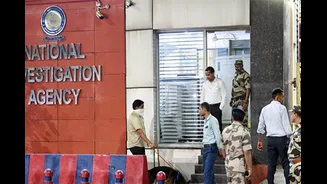










The National Investigation Agency has flagged a Pakistan-run sleeper cell that allegedly recruited Indian juveniles and financially vulnerable individuals to carry out espionage activities targeting sensitive
installations, particularly railway and strategic locations in Uttar Pradesh, according to an investigation report submitted before the Juvenile Justice Board.
The findings, accessed by CNN-News18, point to a targeted intelligence-gathering network in which five juveniles, among 21 accused arrested so far, allegedly collaborated with other co-accused to assist suspected Pakistan-based terrorists and handlers.
According to the NIA report, the juveniles’ primary role was to collect and transmit sensitive visual and geospatial intelligence, including photographs and videos with geo-tags and precise GPS coordinates of critical installations.
Investigators said the information was intended to compromise India’s sovereignty, unity, integrity and national security.
The probe revealed that the minors provided active on-ground support by illegally accessing prohibited areas and assisting in the installation of solar-powered spy cameras to enable live feeds.
The accused allegedly relied on low-cost and easily accessible tools, such as smartphones, GPS applications and covert cameras, to carry out what officials described as “high-impact espionage”.
The report further said the juveniles facilitated the procurement and use of Indian SIM cards for terror-linked communications, including forwarding one-time passwords and operating WhatsApp accounts on behalf of handlers.
Security agencies said the case exposes a Pakistan-linked espionage module in which juveniles were deliberately targeted for recruitment.
The handlers allegedly paid small sums, ranging from Rs 500 to Rs 15,000, for sensitive information, investigators said, adding that the approach reflects a shift towards low-cost, decentralised operations.
Top intelligence sources said the findings underline a serious national security concern, demonstrating Pakistan’s evolving “hybrid threat” strategy that exploits social media, financial inducements and vulnerable youth to build detailed targeting dossiers that could be used for sabotage, drone attacks or terror strikes.
The involvement of juveniles, sources said, indicates a deliberate strategy of radicalisation followed by recruitment.
Uttar Pradesh has emerged as a major focus of Pakistan’s digital radicalisation and sleeper-cell recruitment efforts, officials said.
Recent arrests by the state Anti-Terrorism Squad and multi-district investigations have exposed an expanding network allegedly operated through social media by Pakistan-based gangster Shahzad Bhatti and handlers linked to the Inter-Services Intelligence.
Agencies described the network as part of a new-age hybrid threat model in which online radicalisation, espionage, organised crime and covert anti-India activities are increasingly merged through decentralised, civilian-embedded modules that are harder to detect.
The revelations follow one of the largest coordinated crackdowns in recent years, with central agencies and anti-terror units conducting simultaneous raids across Uttar Pradesh, Delhi, Haryana, Punjab, Rajasthan and Madhya Pradesh earlier this week.
Around 300 suspects were detained for questioning and digital scrutiny.
Investigators believe Bhatti acted as a proxy digital recruiter, using platforms such as Instagram, YouTube and encrypted communication applications to identify and influence vulnerable Indian youths, particularly in northern states.