




What is the story about?
As the United States and Iran blockade the Strait of Hormuz, Asean member states have called for 'unimpeded' navigation through the waterway.
The Association of Southeast Asian Nations member-states majorly depend on energy products and fertilisers that are routed through the Strait, with the Philippines importing 95 per cent of its crude oil from Gulf countries and Vietnam importing nearly 70 per cent of its gas from the region.
In a statement on Monday, they called for the "restoration of the safe, unimpeded, and continuous transit passage of vessels and aircraft in the Strait of Hormuz" in line with the international law.
They also urged the United States and Iran to end the war with restore peace in the region through negotiations.
"We urge all parties involved to maintain conducive conditions for the full and effective implementation of the ceasefire, including by adhering strictly to its terms, exercising utmost restraint, ceasing all hostilities, acting responsibly, avoiding any acts that may aggravate the situation and working collectively towards a comprehensive and enduring resolution in accordance with international law, the UN Charter and relevant UNSC resolutions," the statement added.
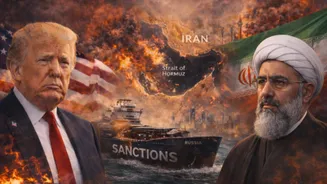
The statement has come at a time when US President Donald Trump's announcement of the blockade of Iran has raised worsened the ongoing energy crisis.
Under the Iran-imposed blockade, selected ships were transiting through the waterway and Iranian oil was freely flowing, but that is now bound to be stopped, adding to the world's supply crunch.
Up to 20-25 per cent of the world's oil and gas supply is routed through the Strait of Hormuz, which has been cut off in its entirety from the Iran-imposed blockade. Iran's strikes on Gulf countries' oil and gas facilities have shut down another 10-12 per cent of supplies.
And, with the American blockade, Iran's oil exports —around 2 per cent of the global supply— are bound to come down to zero.
If Iran's oil exports come down to zero, world's oil supply would be cut by at around 37-40 per cent, and oil prices could rise by around 10-15 per cent, meaning Brent crude could touch $108-118 barrel.
The Association of Southeast Asian Nations member-states majorly depend on energy products and fertilisers that are routed through the Strait, with the Philippines importing 95 per cent of its crude oil from Gulf countries and Vietnam importing nearly 70 per cent of its gas from the region.
In a statement on Monday, they called for the "restoration of the safe, unimpeded, and continuous transit passage of vessels and aircraft in the Strait of Hormuz" in line with the international law.
They also urged the United States and Iran to end the war with restore peace in the region through negotiations.
"We urge all parties involved to maintain conducive conditions for the full and effective implementation of the ceasefire, including by adhering strictly to its terms, exercising utmost restraint, ceasing all hostilities, acting responsibly, avoiding any acts that may aggravate the situation and working collectively towards a comprehensive and enduring resolution in accordance with international law, the UN Charter and relevant UNSC resolutions," the statement added.
The statement has come at a time when US President Donald Trump's announcement of the blockade of Iran has raised worsened the ongoing energy crisis.
We, the Member States of the Association of Southeast Asian Nations (ASEAN), welcome the two-week ceasefire between the United States of America and the Islamic Republic of Iran, announced on 8 April 2026.
We reaffirm the importance of maintaining maritime safety and security,… pic.twitter.com/iatp7Q3aP9
— ASEAN (@ASEAN) April 13, 2026
Under the Iran-imposed blockade, selected ships were transiting through the waterway and Iranian oil was freely flowing, but that is now bound to be stopped, adding to the world's supply crunch.
Up to 20-25 per cent of the world's oil and gas supply is routed through the Strait of Hormuz, which has been cut off in its entirety from the Iran-imposed blockade. Iran's strikes on Gulf countries' oil and gas facilities have shut down another 10-12 per cent of supplies.
And, with the American blockade, Iran's oil exports —around 2 per cent of the global supply— are bound to come down to zero.
If Iran's oil exports come down to zero, world's oil supply would be cut by at around 37-40 per cent, and oil prices could rise by around 10-15 per cent, meaning Brent crude could touch $108-118 barrel.