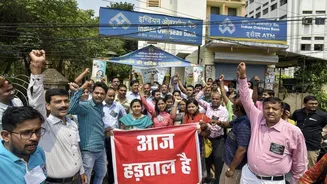

The strike has been called by the United Forum of Bank Unions (UFBU), an umbrella body of nine unions representing officers and employees. As banks were shut on January 25 (Sunday) and January 26 (Republic Day), the strike on Tuesday will lead to a three-day disruption of branch services.
Here is all you need to know about the bank strike.
Why is the bank shut on Tuesday?
The United Forum of Bank Unions has called for a nationwide strike to press for the implementation of a five-day workweek. Earlier, a wage revision agreement was signed in March 2024 between the Indian Banks’ Association (IBA) and the UFBU, in which both sides agreed to make all Saturdays holidays. The decision, however, has yet to be implemented, prompting unions to step up pressure.
At present, banks remain open on the first, third, and fifth Saturdays of every month while getting an off on the second and fourth Saturdays, apart from Sundays. The UFBU said productivity would remain unaffected under a five-day workweek, with employees agreeing to work an additional 40 minutes each day on weekdays.
The UFBU served a strike notice to the IBA, the Chief Labour Commissioner, and the Department of Financial Services (DFS) under the provisions of the Industrial Disputes Act, 1947. "It is unfortunate that the government is not responding to our genuine demand. There would be no loss of man-hours as we have agreed to work an extra 40 minutes daily from Monday to Friday," All India Bank Officers' Confederation (AIBOC) General Secretary Rupam Roy told the
Following this, the Chief Labour Commissioner held conciliation meetings on Wednesday (January 21) and Thursday (January 22) in a bid to resolve the issue. But even after the discussion, unions said that there was no progress.
“Despite detailed discussions during the conciliation proceedings, there was no assurance on our demand. Hence, we have been compelled to proceed with the strike action,” C H Venkatachalam, General Secretary of the All India Bank Employees Association (AIBEA), a UFBU constituent, told
Their demand was posted on social media platform X, with the caption, "Bank employees power India’s financial stability, inclusion, and growth, often at the cost of their own well-being. A 5-day work week is not a concession; it’s a long-pending reform. The commitment is on record. It must be implemented."
Bank employees power India’s financial stability, inclusion, and growth,often at the cost of their own well-being. A 5-day work week is not a concession; it’s a long-pending reform. The commitment is on record. It must be implemented.#BankersDemand5DayWeek @DFS_India pic.twitter.com/YgtcAKgTOJ
— United Forum of Bank Unions (@UFBUIndia) January 25, 2026
What are the demands of banks?
Union leaders stressed that the strike is meant to strengthen the banking system, not disrupt customer services.
“This movement is not against customers, but for a sustainable, humane, and efficient banking system. A rested banker serves the nation better. A balanced workforce strengthens financial stability. Five-day banking is not a luxury; it is an economic and human necessity,” L Chandrasekhar, General Secretary of the National Confederation of Bank Employees (NCBE), told the
Which bank services can you still use?
Some bank services are bound to be impacted, but with the use of technology, multiple alternatives exist. Services like cash deposits and withdrawals, KYC, doorstep banking, cheque clearances, and routine administrative work are expected to be hit at public sector banks.
However, customers can use digital channels for various needs, like the use of an Automated Deposit cum Withdrawal Machine (ATM/ADWM) for cash needs. UPI, bank apps, and mobile banking services are expected to remain operational during the strike.
The strike will impact major government-owned lenders like State Bank of India (SBI), Bank of Baroda (BoB), Punjab National Bank (PNB), and other public sector banks. Notably, several major institutions, including the Reserve Bank of India, LIC, stock exchanges, and government offices, already work on a five-day schedule.
However, the strike is not expected to impact private sector banks, including HDFC Bank, ICICI Bank, and Kotak Mahindra Bank, among others.
With inputs from agencies