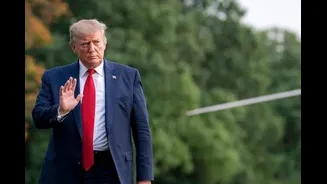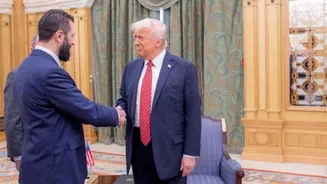





US President Donald Trump and Syrian President Ahmed al-Sharaa held a telephone call on Sunday evening to discuss the lifting of remaining American economic sanctions and the coordination of international efforts for Syria's reconstruction.
According to official statements released by the Syrian presidency, al-Sharaa communicated that removing the lingering sanctions is an "essential step" toward reviving the battle-scarred Syrian economy, boosting public morale, and creating a stable environment capable of attracting massive foreign development projects.
For his part, President Trump stressed the importance of preserving regional stability and voiced Washington's support for ongoing recovery efforts. In a parallel move signaling deeper commitment to the diplomatic track, Trump announced that US Special Envoy for Syria Tom Barrack will remain in his post to advance strategic cooperation with Damascus.
What were the key discussion points?
The conversation between the two leaders highlighted a shared interest in moving Syria past its era of isolation and toward regional normalization.
President al-Sharaa emphasised that formal and permanent removal of US restrictions, including what remains of the restrictive Caesar Act measures, would act as an economic catalyst, enabling the country to rebuild vital infrastructure, stabilise its currency, and incentivise private investment.
The leaders reviewed progress on rebuilding critical sectors destroyed during the 13-year civil war. Trump indicated a willingness to support recovery efforts, while al-Sharaa said that international help is critical to improving baseline living conditions for the Syrian populace.
Against the backdrop of escalating tensions in the West Asia, both leaders affirmed the need for continuous dialogue and diplomatic avenues to strengthen regional security and prevent further geopolitical flare-ups.
Why this dialogue is significant
This phone call is far more than a routine diplomatic exchange. It represents a major turning point in Middle Eastern geopolitics and underscores how dramatically US policy toward Syria has changed in a relatively short period.
To understand why, consider who Ahmed al-Sharaa is. Better known in the past by his militant nom de guerre Abu Mohammad al-Julani, he once led the Islamist group Hay'at Tahrir al-Sham (HTS) and was even imprisoned by US forces in Iraq. Today, however, he is being treated by Washington as Syria's legitimate leader. By speaking with him directly—and after previously welcoming him to the White House—the Trump administration has effectively completed his transformation from former insurgent commander to recognised head of state.
But the significance goes beyond symbolism.
For decades, Syria under Bashar al-Assad was Iran's closest Arab ally and a crucial link in Tehran's regional network, helping move weapons and support to Hezbollah in Lebanon. Now, by engaging directly with al-Sharaa's government, the US and regional partners such as Saudi Arabia are trying to pull Damascus away from Tehran's sphere of influence. If successful, it would deal a major blow to Iran's regional "Axis of Resistance" and reshape the balance of power across West Asia.
There's also a huge economic dimension to this shift.
After more than a decade of war, Syria needs hundreds of billions of dollars to rebuild its infrastructure, economy and public services. The country simply cannot fund that effort on its own. While Trump has already eased several sanctions imposed during the civil war, removing the remaining restrictions would clear the way for Gulf states, multinational companies and international institutions such as the World Bank to invest in Syria. In practical terms, that could open the door to the largest reconstruction effort the country has seen in decades.