






What is the story about?
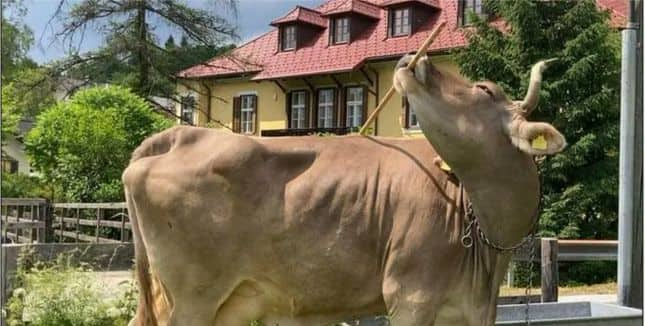
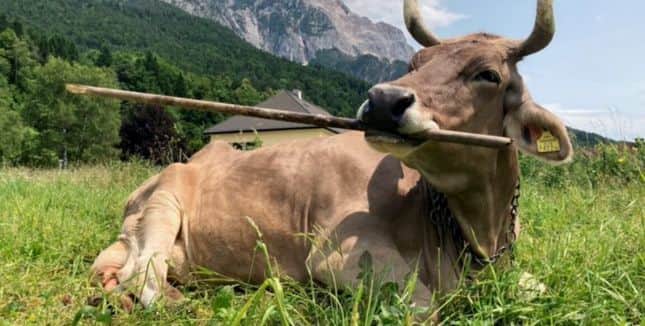
The list of smart animals just got an unexpected addition, and this one will indeed surprise you. Meet Veronika, a pet cow from Austria who cleverly grabs sticks with her mouth and uses them to scratch her body.
A team at the University of Veterinary Medicine, Vienna, in Austria, thinks that this is a tool used, rarely observed in the animal kingdom. Chimpanzees use sticks to extract insects and honey, and crows employ sticks to reach concealed food. Now, Veronika, using this tool in a surprisingly sophisticated way, has shocked scientists. The pet cow's remarkable scratching is now detailed in a study published in Current Biology on Monday (January 19).
She is a 13-year-old Swiss Brown cow that is not used for meat or milk production. An organic farmer and baker from a small town in Carinthia, Witgar Wiegele, keeps Veronika as a pet, reported
BBC Science Focus. Wiegele noticed that Veronika would occasionally grab sticks and use them to scratch her body.
According to Wiegele, Veronika started playing with pieces of wood several years ago. She then figured out how to scratch herself with sticks. He also pointed out that Veronika recognised the family members' voices and rushed over when they called her.
“I was naturally amazed by her extraordinary intelligence and thought how much we could learn from animals: patience, calmness, contentment, and gentleness,” he said as quoted by the
Guardian. A long video of Veronika reportedly shared by Wiegele reached biologists in Vienna.
“It was a cow using an actual tool,” said Dr Antonio Osuna Mascaro at the city’s University of Veterinary Medicine, after seeing Veronika's viral video. Mascaro, his colleague, Dr Alice Auersperg, then led the study into the pet cow's tool use, which was recently published in Current Biology. Both reached Veronika's place, which, as per them, was "the most idyllic place imaginable for an Austrian cow." Mascaro and Auersperg considered testing Veronika’s skills.
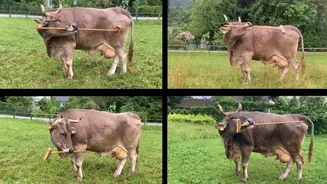
Initially, the team offered her a broom brush, assuming she would use only the bristled side. Instead, Veronika changed how she handled the tool based on where she needed to scratch.
For larger areas like her back that required a firm scratch, she used the bristles. But when tending to more sensitive spots, such as her underbelly, she turned the brush around and used the smooth handle for a gentler touch, according to the study in Current Biology.
“We thought at the beginning that perhaps Veronika was not careful enough when choosing which end to use against her body,” said Mascaró as quoted by
The Washington Post. Adding, “However, after a while, we started to observe a pattern. Veronika indeed had a preference for using the broom end..."
"She was using a way more careful approach. It wasn’t an error. It was a meaningful use of the handle end of the tool," the media publication quoted Mascaro as saying.
Mascaro also told BBC Science Focus, “The only well-documented case of something comparable comes from chimpanzees, on those – also rare – occasions when they fish for termites by combining the functions of the two opposite ends of the same stick."
One thing that the study points out is that Veronika, the pet cow, is not special; however, the circumstances have been in her favour. She has been given access to large, open spaces, daily human interaction, and the freedom to explore and experiment in her surroundings.
The findings also indicate that perceptions of livestock and animal intelligence may depend less on the animals’ abilities and more on whether they are given the chance to explore their intelligence. Researchers also note that most cows don't live as long as 13 years, and they don't even live in such a stimulating environment. Therefore, their intelligence is rarely seen.
"Other clever cows have come to light. We don’t believe that Veronika is the Einstein of cows,” said Mascaro, the Guardian reported. "What this tells us is that cows have the potential to innovate tool use, and we have ignored this fact for thousands of years,” he added.
With inputs from agencies
A team at the University of Veterinary Medicine, Vienna, in Austria, thinks that this is a tool used, rarely observed in the animal kingdom. Chimpanzees use sticks to extract insects and honey, and crows employ sticks to reach concealed food. Now, Veronika, using this tool in a surprisingly sophisticated way, has shocked scientists. The pet cow's remarkable scratching is now detailed in a study published in Current Biology on Monday (January 19).
Meet Veronika, a much-loved cow
She is a 13-year-old Swiss Brown cow that is not used for meat or milk production. An organic farmer and baker from a small town in Carinthia, Witgar Wiegele, keeps Veronika as a pet, reported
Veronika, a Swiss Brown cow in the Austrian Alps, has long been seen picking up sticks and brushes to deliberately scratch an itch
This is not quirky behaviour it’s the first documented case of a cow using a tool
pic.twitter.com/B8baL7gnjK
— Science girl (@sciencegirl) January 20, 2026
According to Wiegele, Veronika started playing with pieces of wood several years ago. She then figured out how to scratch herself with sticks. He also pointed out that Veronika recognised the family members' voices and rushed over when they called her.
“I was naturally amazed by her extraordinary intelligence and thought how much we could learn from animals: patience, calmness, contentment, and gentleness,” he said as quoted by the
The Testing of Veronika’s skills
“It was a cow using an actual tool,” said Dr Antonio Osuna Mascaro at the city’s University of Veterinary Medicine, after seeing Veronika's viral video. Mascaro, his colleague, Dr Alice Auersperg, then led the study into the pet cow's tool use, which was recently published in Current Biology. Both reached Veronika's place, which, as per them, was "the most idyllic place imaginable for an Austrian cow." Mascaro and Auersperg considered testing Veronika’s skills.
Initially, the team offered her a broom brush, assuming she would use only the bristled side. Instead, Veronika changed how she handled the tool based on where she needed to scratch.
For larger areas like her back that required a firm scratch, she used the bristles. But when tending to more sensitive spots, such as her underbelly, she turned the brush around and used the smooth handle for a gentler touch, according to the study in Current Biology.
A pet cow named Veronika uses tools in a surprisingly sophisticated way. Image courtesy: @JungereCato/X
“We thought at the beginning that perhaps Veronika was not careful enough when choosing which end to use against her body,” said Mascaró as quoted by
"She was using a way more careful approach. It wasn’t an error. It was a meaningful use of the handle end of the tool," the media publication quoted Mascaro as saying.
Mascaro also told BBC Science Focus, “The only well-documented case of something comparable comes from chimpanzees, on those – also rare – occasions when they fish for termites by combining the functions of the two opposite ends of the same stick."
"Veronika isn’t special, but her circumstances are"
One thing that the study points out is that Veronika, the pet cow, is not special; however, the circumstances have been in her favour. She has been given access to large, open spaces, daily human interaction, and the freedom to explore and experiment in her surroundings.
The findings also indicate that perceptions of livestock and animal intelligence may depend less on the animals’ abilities and more on whether they are given the chance to explore their intelligence. Researchers also note that most cows don't live as long as 13 years, and they don't even live in such a stimulating environment. Therefore, their intelligence is rarely seen.
Veronika and her ground-breaking scratching are detailed in a study published today in Current Biology. Image courtesy: @SciVigil/X
"Other clever cows have come to light. We don’t believe that Veronika is the Einstein of cows,” said Mascaro, the Guardian reported. "What this tells us is that cows have the potential to innovate tool use, and we have ignored this fact for thousands of years,” he added.
With inputs from agencies