









What is the story about?
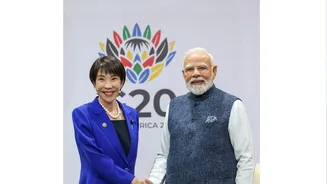
Prime Minister Narendra Modi and Japanese Prime Minister Sanae Takaichi are expected to focus on economic security, resilient semiconductor supply chains, defence cooperation, energy security and artificial intelligence during the annual India-Japan Summit on July 2, as both countries seek to expand their strategic partnership amid a changing geopolitical landscape.
Takaichi will visit India from July 1 to 3, accompanied by a delegation of more than 100 business leaders. During the visit, she will hold bilateral talks with Modi, participate in a joint economic forum and attend the annual India-Japan Summit, which was launched two decades ago.
ANI cited people familiar with the matter who said the two sides are expected to issue a joint declaration on economic security cooperation and a separate joint statement on cooperation in artificial intelligence.
They are also expected to conclude about 10 agreements and understandings covering upstream oil and gas development, exploration of critical minerals, pharmaceuticals and next-generation mobility systems.
The visit will be Takaichi's first to India since taking office as Prime Minister last October and comes as Japan seeks to strengthen ties with regional partners, including India, Australia, South Korea and Asean member states, amid growing geopolitical uncertainty.
According to people familiar with the discussions, Japan considers India an "indispensable partner" in advancing Takaichi's updated vision for a "Free and Open Indo-Pacific".
The two countries are expected to reinforce their commitment to a free and open global order based on the rule of law while promoting economic growth through greater investment, innovation and closer cooperation on economic security. Particular emphasis is expected to be placed on building resilient supply chains in sectors such as semiconductors and critical minerals.
The summit is also expected to advance strategic coordination by aligning Japan's updated Free and Open Indo-Pacific vision with India's MAHASAGAR vision.
According to the agency, both sides aim to expand defence and security cooperation with a focus on maritime security, maritime domain awareness, and collaboration in defence equipment and technology.
Japan is also exploring the possibility of using Indian naval facilities for the maintenance, repair and overhaul (MRO) of vessels operated by its Self-Defense Forces.
In April, the Takaichi administration eased restrictions on the export of defence equipment and technology, benefiting India, which is among the 17 countries that have signed Equipment and Technology Transfer Agreements with Tokyo and are eligible to receive Japanese weapon systems.
The two countries are also continuing negotiations on the "Unicorn" project for a "unified complex radio antenna", or a common radar mast for Indian warships, involving the transfer of both equipment and technology.
On energy security, discussions are expected to centre on diversifying energy sources in response to challenges arising from the West Asia conflict, expanding cooperation on biogas, and developing a large-scale green ammonia production project in Odisha.
The proposed agreements on upstream oil and gas development and the exploration of critical minerals are expected to involve the Japan Organization for Metals and Energy Security, a state-run organisation active across Asia and Africa, the people said.
Takaichi will visit India from July 1 to 3, accompanied by a delegation of more than 100 business leaders. During the visit, she will hold bilateral talks with Modi, participate in a joint economic forum and attend the annual India-Japan Summit, which was launched two decades ago.
ANI cited people familiar with the matter who said the two sides are expected to issue a joint declaration on economic security cooperation and a separate joint statement on cooperation in artificial intelligence.
They are also expected to conclude about 10 agreements and understandings covering upstream oil and gas development, exploration of critical minerals, pharmaceuticals and next-generation mobility systems.
Strategic partnership expected to deepen
The visit will be Takaichi's first to India since taking office as Prime Minister last October and comes as Japan seeks to strengthen ties with regional partners, including India, Australia, South Korea and Asean member states, amid growing geopolitical uncertainty.
According to people familiar with the discussions, Japan considers India an "indispensable partner" in advancing Takaichi's updated vision for a "Free and Open Indo-Pacific".
The two countries are expected to reinforce their commitment to a free and open global order based on the rule of law while promoting economic growth through greater investment, innovation and closer cooperation on economic security. Particular emphasis is expected to be placed on building resilient supply chains in sectors such as semiconductors and critical minerals.
Defence and maritime cooperation in focus
The summit is also expected to advance strategic coordination by aligning Japan's updated Free and Open Indo-Pacific vision with India's MAHASAGAR vision.
According to the agency, both sides aim to expand defence and security cooperation with a focus on maritime security, maritime domain awareness, and collaboration in defence equipment and technology.
Japan is also exploring the possibility of using Indian naval facilities for the maintenance, repair and overhaul (MRO) of vessels operated by its Self-Defense Forces.
Energy security and critical minerals on agenda
In April, the Takaichi administration eased restrictions on the export of defence equipment and technology, benefiting India, which is among the 17 countries that have signed Equipment and Technology Transfer Agreements with Tokyo and are eligible to receive Japanese weapon systems.
The two countries are also continuing negotiations on the "Unicorn" project for a "unified complex radio antenna", or a common radar mast for Indian warships, involving the transfer of both equipment and technology.
On energy security, discussions are expected to centre on diversifying energy sources in response to challenges arising from the West Asia conflict, expanding cooperation on biogas, and developing a large-scale green ammonia production project in Odisha.
The proposed agreements on upstream oil and gas development and the exploration of critical minerals are expected to involve the Japan Organization for Metals and Energy Security, a state-run organisation active across Asia and Africa, the people said.