








What is the story about?
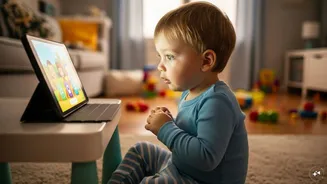
The modern childhood soundtrack often begins with a catchy tune playing from a glowing screen. A toddler sits in a pram, transfixed by animated sharks singing repetitive lyrics. A parent, exhausted after a long workday, hands over a smartphone during dinner for a few precious minutes of silence. In homes across the world, screens have quietly become companions, babysitters and pacifiers for children barely old enough to speak.
And the numbers reveal just how deeply this shift has taken hold. Five of the 10 most-viewed videos in YouTube history are aimed at very young children. Not pop stars or blockbuster trailers, but nursery rhymes, dancing buses and brightly coloured cartoons designed to keep toddlers watching.
The digital takeover of childhood now begins long before Instagram, TikTok or even school.
Concerns about children and technology are hardly new, but researchers say the scale and intensity of screen exposure is changing childhood itself.
Rates of anxiety and depression among adolescents rose sharply during those years, prompting governments worldwide to rethink the role of technology in children’s lives. At least 79 countries have already banned mobile phones in schools.
Yet much of that debate centres on teenagers. Increasingly, researchers are turning their attention to children aged between zero and five, many of whom spend hours every day watching videos on phones or tablets before they can even read.
That question lies at the heart of Screen Time in Early Childhood Education report. The findings paint a troubling global picture.
The World Health Organization (WHO) recommends no more than one hour of screen time daily for children aged two to five. But in many countries, the majority of preschoolers exceed that limit. Studies cited in the report found that 91 per cent of preschool children in Malaysia spend more time on screens than recommended. The figure stands at 69 per cent in Brazil, 67 per cent in China and 50 per cent in Colombia.
Why does this matter? Because the first five years of life are a period of extraordinary brain development. During this stage, children form roughly one million neural connections every second. Those connections are shaped not by passive viewing, but through conversation, play, touch and exploration.
Experts say the real issue is not screens themselves, but the experiences they displace.
Research increasingly links excessive screen exposure to developmental concerns. A large meta-analysis by researcher Sheri Madigan, examining 42 studies involving nearly 19,000 children, found a clear association between increased screen time and reduced vocabulary development.
Other studies suggest children exposed to more than two hours of daily screen use are significantly more likely to experience attention difficulties. Research by sleep scientist Loubna Akacem also found that blue light exposure suppresses melatonin production in preschool children, disrupting sleep patterns.
Yet parents are not simply choosing screens out of convenience or neglect.
In Latin America and the Caribbean, only 15 per cent of children under two attend daycare, compared with 43 per cent in OECD countries. Long commutes, inflexible work schedules and uneven childcare quality create conditions where smartphones become an easy solution during stressful moments.
Technology companies, critics argue, have also designed platforms to be irresistibly engaging. Bright colours, autoplay features and recommendation algorithms are engineered to hold children’s attention in ways traditional toys simply cannot compete with.
Experts are not calling for a total ban on screens. Instead, they are advocating balance and intentional use.
Behavioural science suggests habits can be reshaped gradually. Parents can replace screen routines with small alternatives, such as carrying crayons during travel, introducing screen-free meals or creating spaces at home where books and toys are easier to reach than tablets.
Simple practices can make a measurable difference. Studies show “dialogic reading”, where adults actively engage children with questions while reading, significantly improves vocabulary and communication skills.
Educators and policymakers also have a role to play. Claudia Lago argues that adults, not children, control screen exposure and therefore carry responsibility for setting boundaries.
The challenge now is not eliminating screens entirely, but ensuring they do not replace the human interactions children need most. Baby Shark may remain unavoidable, but childhood itself does not have to become an endless autoplay loop.
And the numbers reveal just how deeply this shift has taken hold. Five of the 10 most-viewed videos in YouTube history are aimed at very young children. Not pop stars or blockbuster trailers, but nursery rhymes, dancing buses and brightly coloured cartoons designed to keep toddlers watching.
The digital takeover of childhood now begins long before Instagram, TikTok or even school.
A generation raised on screens
Concerns about children and technology are hardly new, but researchers say the scale and intensity of screen exposure is changing childhood itself.
Rates of anxiety and depression among adolescents rose sharply during those years, prompting governments worldwide to rethink the role of technology in children’s lives. At least 79 countries have already banned mobile phones in schools.
Yet much of that debate centres on teenagers. Increasingly, researchers are turning their attention to children aged between zero and five, many of whom spend hours every day watching videos on phones or tablets before they can even read.
That question lies at the heart of Screen Time in Early Childhood Education report. The findings paint a troubling global picture.
The World Health Organization (WHO) recommends no more than one hour of screen time daily for children aged two to five. But in many countries, the majority of preschoolers exceed that limit. Studies cited in the report found that 91 per cent of preschool children in Malaysia spend more time on screens than recommended. The figure stands at 69 per cent in Brazil, 67 per cent in China and 50 per cent in Colombia.
Why does this matter? Because the first five years of life are a period of extraordinary brain development. During this stage, children form roughly one million neural connections every second. Those connections are shaped not by passive viewing, but through conversation, play, touch and exploration.
Experts say the real issue is not screens themselves, but the experiences they displace.
Why screens became the modern babysitter
Research increasingly links excessive screen exposure to developmental concerns. A large meta-analysis by researcher Sheri Madigan, examining 42 studies involving nearly 19,000 children, found a clear association between increased screen time and reduced vocabulary development.
Other studies suggest children exposed to more than two hours of daily screen use are significantly more likely to experience attention difficulties. Research by sleep scientist Loubna Akacem also found that blue light exposure suppresses melatonin production in preschool children, disrupting sleep patterns.
Yet parents are not simply choosing screens out of convenience or neglect.
In Latin America and the Caribbean, only 15 per cent of children under two attend daycare, compared with 43 per cent in OECD countries. Long commutes, inflexible work schedules and uneven childcare quality create conditions where smartphones become an easy solution during stressful moments.
Technology companies, critics argue, have also designed platforms to be irresistibly engaging. Bright colours, autoplay features and recommendation algorithms are engineered to hold children’s attention in ways traditional toys simply cannot compete with.
Finding balance in a screen-filled world
Experts are not calling for a total ban on screens. Instead, they are advocating balance and intentional use.
Behavioural science suggests habits can be reshaped gradually. Parents can replace screen routines with small alternatives, such as carrying crayons during travel, introducing screen-free meals or creating spaces at home where books and toys are easier to reach than tablets.
Simple practices can make a measurable difference. Studies show “dialogic reading”, where adults actively engage children with questions while reading, significantly improves vocabulary and communication skills.
Educators and policymakers also have a role to play. Claudia Lago argues that adults, not children, control screen exposure and therefore carry responsibility for setting boundaries.
The challenge now is not eliminating screens entirely, but ensuring they do not replace the human interactions children need most. Baby Shark may remain unavoidable, but childhood itself does not have to become an endless autoplay loop.