




What is the story about?
In the September Gen Z uprising, overwhelming anecdotal and adequately documented evidence is now available that point at the US hand in stirring the pot. Historically, people in Nepal have blamed the CIA/US and Indian agencies/R&AW for their ills and problems. In 1959, when I first trekked in Nepal, an elderly Nepali looking from the mid-hills where we met towards the Indian plains accused India of keeping all the fertile lands and leaving the difficult mountainous terrain to Nepal.
Further, India has been seen to be responsible for all the major changes in Nepal—the 1950s revolution to restore the monarchy and introduce democracy, the 1990 uprising to revive multiparty democracy and, marginally, the 2006 Maoist civil war that ushered in a republic. The US had maintained an early presence in Kathmandu for interfering with and keeping an eye on Chinese activities during the PLA invasion of Tibet. The CIA established its network of spies in the early 1960s when it began helping Khampa rebels with air-dropped supplies against the PLA from Mustang with the help of its Raja.
The Khampa movement wound up in 1974 when China issued an ultimatum to Nepal to squash it or it would send in the PLA to do so. The Mahendra Dal battalion of the Royal Nepal Army squeezed the Khampas by killing its top field commanders, Gompo Tashi Andrugasang and the redoubtable 6 ft 4 in Gyato Wangdu, whom I had met in Pokhara in 1973. Last week I met wards of the remnants of the Khampa rebels outside Pokhara, where they are camped below the highway to Kathmandu.
Besides the US, one other name which has figured prominently during Gen Z Andolan is that of the Barbara Adams Foundation, whose founder I knew for more than two decades. Adams came to Nepal in the early 1960s as an American journalist, married King Mahendra’s younger brother Prince Himalaya and came in contact with Kathmandu’s social elites, including ‘diplomats and spies’.
Later Adams and Himalaya separated, and she lived a full life in Kathmandu, finally being rewarded with Nepali citizenship by the Maoists for her social work with marginalised communities. The foundation came up in her name after she died in 2016. I got no inkling even as I met her frequently that she was a CIA agent; she was writing in Kathmandu newspapers and was very proud of her Maoist connections. She became a prominent figure on the diplomatic circuit, rubbing shoulders with ambassadors and local politicians, one of the most prominent being King Mahendra’s youngest foreign minister, Rishikesh Shah, during Panchayat Raj (1960-1990).
Most Nepalese politicians are branded due to their political proclivities as pro-US, pro-China, or pro-India, and few are nationalists. It is hard to find someone who you could identify as pro-India, as anti-India sentiment currently dominant rises at the drop of a hat. Many Gorkha ex-servicemen are silent supporters of India. Today's maximum figure is in the pro-US category.
When I first wrote about the Bhadon Andolan (September uprising), I had categorically dismissed reports of US involvement in the revolution/regime change. Equally, I gave a clean chit to the Barbara Adams Foundation for any role in the violent movement. In my many conversations in Kathmandu, Pokhara and villages outside Pokhara with journalists, officials, diplomats, civil society and former Nepali Army officers over the last two weeks in December on US/Barbara Adams Foundation support for Gen Z, I discovered more than sufficient anecdotal information to point a finger at the US.
Sudan Gurung, seen as the clear face of the Gen Z movement, has been interacting with interim PM Sushila Karki, COAS Gen Ashok Sigdel and various politicians. Gurung and his team have negotiated and signed at least three agreements with the interim government, the most significant being the recent 10-point agreement involving constitutional amendments, which is going to prove a hurdle in the conduct of the elections on March 5, for which alone the interim government is mandated.
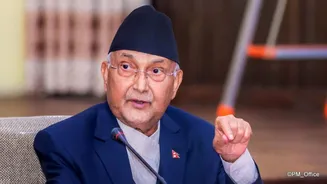
Karki has said more than once that her government will be guided by issues raised by Gen Z, even as former PM KP Oli has called the government illegal, sought Supreme Court intervention for revival of Parliament and criticised the Gen Z movement during the recent 11th Party General Convention of CPN (UML).
Now, here’s the point. The Gen Z movement was not ‘all that spontaneous’, as it was first made out to be. It was planned, organised and directed by Gurung and his team. A Nepali official noted that a US Embassy vehicle was seen outside Karki’s residence on the night of September 8-9. Karki was appointed interim PM through the Gen Z Discord app poll organised by Gurung. He’s known to have directed the protestors in selected targeting during the arson campaign on Twitter and a WhatsApp account, ROBN.
Gurung is the founder and beneficiary of ‘Hami Nepal’, an NGO supported by the Nepali diaspora in the US used mainly for disaster and emergency aid relief, which played a key role during the 2015 earthquake. It is reportedly also supported by USAID as well as the Barbara Adams Foundation. He is one of the many leaders allegedly shaped by the US Young Leaders Programme. Gagan Thapa, the rising star of the Nepali Congress and its general secretary, is also one of the products of this programme. I recall meeting Thapa at Madison University, Wisconsin, US, when he was first invited there in 2004 as part of the Young Leaders Programme during a discussion on the Maoist civil war and my book, Royal Nepal Army: Meeting the Maoist Challenge. Thapa is known to be connected with Gurung and has generally favoured the Gen Z programme.
US antipathy for Communist China is well known in Nepal. The CIA was supported by an elaborate US mission, with the US Peace Corps launching its pioneering projects, followed by other enterprises culminating in the ongoing Young Leaders Programme. Many other US-supported NGOs and INGOs, like the Democracy Forum and the Carter Foundation, have worked prominently to promote US interests in Nepal.
The US-Nepal policy since three decades ago was broadly guided by India, which changed subtly during Trump 1.0 when US diplomats said while they would let India take the lead, the US had interests that were independent of India. This was also the time I presented a paper in Kathmandu at the Nepal Institute for International Cooperation and Engagement in 2018, which noted that Nepal was not sandwiched by India and China alone, as noted by its founder King Prithvi Narayan Shah, but there was also a third power, the US.
An Indian diplomat in Kathmandu confirmed this month that the US was still aligned with India in its Nepal policy. Though Trump personally has shown tiny interest in Nepal — calling it ‘Nipples’ at a South Asia briefing — the State Department’s proactive policy was in free play.
The Grayzone has leaked US documents that reveal that the US funnelled $350,000 through the National Endowment for Democracy (NED) and International Republican Institute (IRI) to neutralise Chinese and Indian influence in Nepal. The programme ran from July 2021 to June 2022. Cash was provided to Gen Z potential leadership through the Youth Leadership Transparent Policy.
In addition, USAID had earmarked $158 million for governance and civil society to groom future politicians for office and embed US interest-aligned policy in Nepal. The Trump 2.0 administration had imposed a 90-day freeze/pause on the $659 million in US aid to Nepal. This pause also affected the $500 million MCC project to counter China’s BRI. These programmes are now back on stream.
With the CIA’s well-known coup in Bangladesh and acquisition of St Martin’s Island, a key sentinel in the Bay of Bengal dominating the Malacca Straits, the space between rumour and reality has shrunk about the US and Gen Z connecting in Nepal that removed a pro-China KP Oli government. In his speech on December 13 at the party’s convention in Kathmandu, Oli hinted at the US role in his ouster. Sudan Gurung’s shadow will follow Oli in his bid to recover power in the March 5 elections, if they are held in time or at all.
(The author is former GOC IPKF South Sri Lanka and founder member Defence Planning Staff, now Integrated Defence Staff, Ministry of Defence. Views expressed in the above piece are personal and solely those of the author. They do not necessarily reflect Firstpost’s views.)