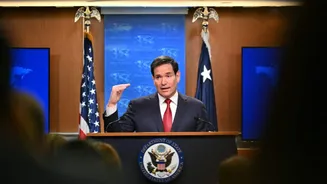

Rubio, who also serves as President Donald Trump’s national security adviser is scheduled to testify before the Senate Foreign Relations Committee on Wednesday at 10 am. The appearance marks his first public engagement on Capitol Hill since the administration launched a wave of strikes against suspected drug trafficking vessels in the Caribbean and Pacific in early September.
The hearing comes amid growing scrutiny of the administration’s foreign policy moves, particularly the unprecedented operation that led to Maduro’s detention and the mounting death toll linked to US anti-narcotics actions at sea.
Explaining a high-risk operation with global ramifications
The capture of Maduro stunned regional leaders and injected fresh volatility into US–Latin America relations. While the Trump administration has insisted there is “no war against Venezuela,” the scale and visibility of the operation have raised questions about whether Washington crossed a threshold from law enforcement into overt military intervention.
Since September 2, US strikes targeting suspected drug boats have reportedly killed more than 100 alleged “narco terrorists,” highlighting the kinetic nature of the campaign. Rubio has argued that these actions are part of a counter-narcotics strategy rather than a conventional conflict, framing them as necessary to disrupt transnational criminal networks tied to the Maduro regime.
Next week’s testimony will test that distinction under public scrutiny. Senators are expected to press Rubio on the legal justification for the operation, the criteria used to authorise lethal force, and whether Congress was adequately informed before such a sweeping action was undertaken.
As both America’s top diplomat and the president’s national security adviser, Rubio occupies an unusually powerful dual role — one that concentrates responsibility but also accountability. His appearance is likely to focus not only on the Maduro raid itself but on how the administration views the balance between executive authority and congressional oversight in fast-moving national security decisions.
A pivotal moment for Trump’s wider foreign policy agenda
Rubio’s Senate appearance comes at a critical juncture far beyond Venezuela. President Trump’s foreign policy agenda is facing mounting pressure on multiple fronts, most notably his pursuit of US control over Greenland, a move that has triggered a transatlantic crisis and raised questions about the future of Nato.
Trump’s Greenland push has unsettled European allies, with fears that the dispute could weaken alliance unity and reshape security dynamics in the Arctic. Against this backdrop, lawmakers are increasingly concerned about whether the administration’s assertive posture abroad risks overextension or diplomatic isolation.
For Rubio, the challenge will be to project coherence across these disparate fronts Latin America, Europe, and the Arctic while reassuring Congress that the administration’s actions form part of a clear and sustainable strategy rather than a series of isolated shocks.
The Senate hearing will also act as an early signal of how aggressively lawmakers intend to reassert oversight over foreign policy as Trump’s second-term agenda accelerates. A confrontational exchange could embolden sceptics within Congress, while a disciplined performance may help the administration consolidate support for its hardline approach.
What is clear is that Rubio’s testimony will not be a routine briefing. It represents a defining moment for how the Trump administration explains its expanding use of force, manages alliance strain and justifies unilateral action in an increasingly fractured global order.
With inputs from agencies