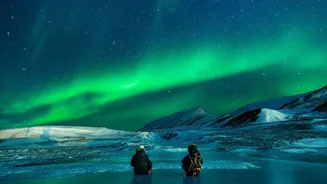

Solar activity follows an 11-year cycle, moving between periods of relative calm and intense eruptions. The sun is now approaching a solar maximum, expected to peak around 2025, with elevated activity continuing into 2026. This surge directly affects how often and how vividly the Northern lights appear across the Arctic region.
"The activity of the sun controls the activity of the northern lights," explains Pål Brekke, Head of Space Research at the Norwegian Space Agency. Right now, the sun is approaching a new solar maximum — when there is much more activity than usual. There are 11 years between such peaks, and we expect to reach a new peak in 2026."
One reason recent displays have been particularly striking is a phenomenon scientists call cannibal solar storms. When one solar storm catches up with another, the storms merge into a more powerful gas cloud, carrying an intensified magnetic field. When this field collides with Earth's magnetosphere, it triggers dramatic auroral activity. Sometimes producing rare colours such as pink and red alongside the usual green.
The conditions are expected to remain favourable through 2026, making this window especially attractive for Northern Lights tourism.
The aurora borealis is visible across Northern Norway, Sweden, Finland and Iceland between September and April, when skies are dark and clear. Statistically, activity peaks during the shoulder months of September, October, March and April. This is when solar interactions are strong and weather conditions can be more forgiving.
View this post on Instagram
In Norway, destinations such as Tromsø, the Lofoten Islands and Narvik sit directly beneath the auroral oval, the zone where sightings are most frequent. Sweden's Abisko National Park is known for its unqiue microclimate that often delivers clearer skies, while Finnish lapland offers wide open landscapes ideal for aurora photography. Iceland's northern regions and remote fjords also remain popular for their accessibility and dramatic backdrops.
As scientific forecasts point to stronger displays, travel demand is already responding. Tour operators across the Nordic region report earlier bookings for 2026, particularly for experiences that combine mobility with expert guidance.
One such experience is the Northern Lights train from Narvik which takes travellers through Arctic landscapes towards towards the Swedish border in search of clear skies. The moving route increases the chances of sightings while offering a slow travel alternative to road based aurora chases.
A 24-hour Northern Lights cruise offers an immersive Arctic experience, typically departing from places like Tromsø, Norway. It provides continuous searching, away from city lights, with options including cabins, meals, warm suits, and expert guides for better aurora viewing in the dark.
With solar activity aligning with rising interest in experiential travel, 2026 is emerging as a key year for aurora seekers. For travellers, willing to plan ahead, the coming season promises not just beautiful photographs but a rare alignment of science, nature and timing.