






What is the story about?
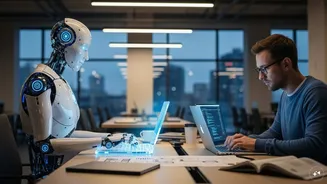
Artificial intelligence is no longer a distant disruption looming over the global economy. It is already changing how companies hire, how employees work and which skills are considered valuable in the modern workplace. Across industries, AI tools are beginning to automate tasks once associated with white-collar stability, from coding and financial analysis to customer service and content generation.
The shift has fuelled growing anxiety around career security, particularly among young professionals entering a labour market being reshaped in real time. Yet experts argue the bigger story is not simply about jobs disappearing. Instead, they say AI is fundamentally redefining the nature of work itself.
“History shows that technology often creates far more opportunities than it changes,” said Ankush Sabharwal, founder and CEO of CoRover.ai. He pointed to how the internet created industries that previously did not exist, arguing AI could follow a similar trajectory through roles such as AI trainers, ethics auditors and human-AI interaction designers.
However, experts caution that the transition will not be equally beneficial for everyone. The workers most likely to thrive are those willing to continuously adapt as AI evolves.
While AI systems excel at processing data and automating repetitive tasks, experts believe careers dependent on emotional intelligence, ethics and human judgement remain comparatively safer for now.
"Roles demanding empathy, ethics, creativity, and complex human judgment are the safest,” Sabharwal said.
“AI can process millions of data points, but cannot replicate lived experience, moral reasoning, or genuine emotional intelligence.”
This is one reason professions such as therapists, teachers, nurses, caregivers and social workers are widely viewed as more resistant to automation. According to Sonica Aron, founder and managing partner at Marching Sheep, roles involving leadership, negotiation, crisis management and relationship-building continue to rely heavily on interpersonal understanding that AI still struggles to imitate effectively.
“Human behaviour and social dynamics are nuanced and constantly changing,” Aron said, adding that AI may become a powerful support tool in these sectors without fully replacing professionals themselves.
Healthcare remains a particularly important example. AI is increasingly assisting doctors with diagnostics, reporting and data analysis, but patient-facing roles still require trust, reassurance and contextual decision-making.
Sabharwal listed a few roles that are relatively safe from AI:
• Mental health professionals and counsellors
• Nurses, caregivers, and allied healthcare workers
• Teachers, trainers, and learning facilitators
• HR and employee wellbeing professionals
• Skilled trades such as electricians, mechanics, and technicians
• UX researchers and human-centered designers
• Social workers and community development professionals
• Leadership and people management roles
• Sustainability, ESG, and DEI specialists
• Creative strategists, storytellers, and communication professionals
Experts also point to physically adaptive jobs as relatively insulated from immediate AI disruption. This resonates with what Zoho founder Sridhar Vembu had said previously.
Praphul Chandra, dean of research and director of the AI Centre of Excellence at Atria University, said professions requiring manual dexterity and real-world problem-solving continue to present major challenges for AI systems and robotics.
“AI cannot yet reliably navigate a leaking pipe in an old Mumbai apartment building or the organised chaos of a hospital ward,” he said.
Electricians, mechanics, plumbers, technicians and surgical nurses all fall into this category because they involve unpredictable environments requiring quick judgement and physical adaptability. "The future workplace may reward adaptability over expertise alone," he said.
However, Chandra also warned against viewing “AI-resistant” jobs as automatically secure or well-paid, particularly in India where many labour-intensive professions remain undervalued economically.
Several experts stressed that the safest long-term strategy may not involve searching for a profession untouched by AI altogether.
Instead, future career resilience may depend on combining technical awareness with human-centred capabilities such as creativity, communication and critical thinking.
Pooja Sharma Goyal, founding CEO of The Udaiti Foundation, argued that workers increasingly need to understand not only how to use AI tools, but also how to shape and supervise them responsibly.
“The jobs most likely to remain resilient will combine technical fluency with human judgment, contextual decision-making and oversight,” she said.
Goyal also highlighted the gender imbalance emerging within AI leadership despite India recording one of the world’s highest AI skill penetration rates among women.
"Research shows that Indian women recorded the highest AI skill penetration rate globally at 1.7, while India itself has the world’s highest AI skill penetration at 2.8, nearly three times the global average. Yet, women’s representation in GenAI drops from 33 per cent at the junior level to just 19 per cent at the senior level," she said.
Chandra believes the next phase of AI will move far beyond general-purpose chatbots into specialised systems built for industries such as healthcare, law, agriculture and education. That shift, he argued, will create entirely new categories of work while simultaneously transforming existing professions.
For workers trying to future-proof their careers, experts say the challenge is no longer avoiding AI entirely. It is learning how to work alongside it while strengthening the distinctly human abilities machines still cannot easily reproduce.
The shift has fuelled growing anxiety around career security, particularly among young professionals entering a labour market being reshaped in real time. Yet experts argue the bigger story is not simply about jobs disappearing. Instead, they say AI is fundamentally redefining the nature of work itself.
“History shows that technology often creates far more opportunities than it changes,” said Ankush Sabharwal, founder and CEO of CoRover.ai. He pointed to how the internet created industries that previously did not exist, arguing AI could follow a similar trajectory through roles such as AI trainers, ethics auditors and human-AI interaction designers.
However, experts caution that the transition will not be equally beneficial for everyone. The workers most likely to thrive are those willing to continuously adapt as AI evolves.
Human judgement may become the most valuable skill
While AI systems excel at processing data and automating repetitive tasks, experts believe careers dependent on emotional intelligence, ethics and human judgement remain comparatively safer for now.
"Roles demanding empathy, ethics, creativity, and complex human judgment are the safest,” Sabharwal said.
“AI can process millions of data points, but cannot replicate lived experience, moral reasoning, or genuine emotional intelligence.”
This is one reason professions such as therapists, teachers, nurses, caregivers and social workers are widely viewed as more resistant to automation. According to Sonica Aron, founder and managing partner at Marching Sheep, roles involving leadership, negotiation, crisis management and relationship-building continue to rely heavily on interpersonal understanding that AI still struggles to imitate effectively.
“Human behaviour and social dynamics are nuanced and constantly changing,” Aron said, adding that AI may become a powerful support tool in these sectors without fully replacing professionals themselves.
Healthcare remains a particularly important example. AI is increasingly assisting doctors with diagnostics, reporting and data analysis, but patient-facing roles still require trust, reassurance and contextual decision-making.
Sabharwal listed a few roles that are relatively safe from AI:
• Mental health professionals and counsellors
• Nurses, caregivers, and allied healthcare workers
• Teachers, trainers, and learning facilitators
• HR and employee wellbeing professionals
• Skilled trades such as electricians, mechanics, and technicians
• UX researchers and human-centered designers
• Social workers and community development professionals
• Leadership and people management roles
• Sustainability, ESG, and DEI specialists
• Creative strategists, storytellers, and communication professionals
Skilled trades and physical work remain difficult to automate
Experts also point to physically adaptive jobs as relatively insulated from immediate AI disruption. This resonates with what Zoho founder Sridhar Vembu had said previously.
Praphul Chandra, dean of research and director of the AI Centre of Excellence at Atria University, said professions requiring manual dexterity and real-world problem-solving continue to present major challenges for AI systems and robotics.
“AI cannot yet reliably navigate a leaking pipe in an old Mumbai apartment building or the organised chaos of a hospital ward,” he said.
Electricians, mechanics, plumbers, technicians and surgical nurses all fall into this category because they involve unpredictable environments requiring quick judgement and physical adaptability. "The future workplace may reward adaptability over expertise alone," he said.
However, Chandra also warned against viewing “AI-resistant” jobs as automatically secure or well-paid, particularly in India where many labour-intensive professions remain undervalued economically.
The future workplace may reward adaptability over expertise alone
Several experts stressed that the safest long-term strategy may not involve searching for a profession untouched by AI altogether.
Instead, future career resilience may depend on combining technical awareness with human-centred capabilities such as creativity, communication and critical thinking.
Pooja Sharma Goyal, founding CEO of The Udaiti Foundation, argued that workers increasingly need to understand not only how to use AI tools, but also how to shape and supervise them responsibly.
“The jobs most likely to remain resilient will combine technical fluency with human judgment, contextual decision-making and oversight,” she said.
Goyal also highlighted the gender imbalance emerging within AI leadership despite India recording one of the world’s highest AI skill penetration rates among women.
"Research shows that Indian women recorded the highest AI skill penetration rate globally at 1.7, while India itself has the world’s highest AI skill penetration at 2.8, nearly three times the global average. Yet, women’s representation in GenAI drops from 33 per cent at the junior level to just 19 per cent at the senior level," she said.
Chandra believes the next phase of AI will move far beyond general-purpose chatbots into specialised systems built for industries such as healthcare, law, agriculture and education. That shift, he argued, will create entirely new categories of work while simultaneously transforming existing professions.
For workers trying to future-proof their careers, experts say the challenge is no longer avoiding AI entirely. It is learning how to work alongside it while strengthening the distinctly human abilities machines still cannot easily reproduce.