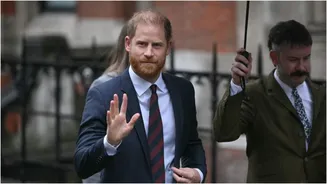







Prince Harry struck a guarded and emotional tone as he entered the witness box on Wednesday in London’s High Court, testifying against the publisher of the Daily Mail. Hours later, the Duke of Sussex stepped down visibly shaken, appearing close to tears as he described the toll years of tabloid scrutiny have taken on his life and his family.
The testimony marked a crucial moment in one of the most high-profile media privacy trials in the UK in recent years. Prince Harry, in the brink of tears, called out the "vicious, persistent attacks" on his wife Meghan Markle and even described how her life became an 'absolute misery' because of it, as per a report in the Associated Press. Read all the details about what transpired in the courtroom on Wednesday.
What is the case about?
Prince Harry, along with six other high-profile figures including Sir Elton John and actor Elizabeth Hurley, has accused Associated Newspapers Ltd (ANL) of carrying out a “clear, systematic and sustained use of unlawful information gathering” over a span of nearly two decades.
The claim alleges that journalists working for the Daily Mail group relied on illegal practices such as phone hacking, private investigators and deception to obtain personal information.
ANL has strongly denied the allegations, calling them baseless and insisting that the articles in question were based on legitimate reporting methods and lawful sources. The publisher has said it will name its sources during the nine-week trial.
Harry on life under constant surveillance
In his 23-page written witness statement, Harry said the persistent intrusions into his early life left him “paranoid beyond belief”. Speaking in court, he expanded on how the experience shaped his relationship with the press.
“They continue to come after me, they have made my wife’s life an absolute misery,” Harry said, his voice breaking as he referred to Meghan, Duchess of Sussex.
He described living under what he called “24-hour surveillance”, insisting that the personal details published about him could not have come from friends or official sources.
“My social circles were not leaky,” he told the court, firmly rejecting suggestions that people close to him had briefed journalists.
Cross-examination and courtroom tension
Under English court procedure, Harry was immediately cross-examined after confirming the truth of his written evidence under oath. Dressed in a dark suit, he held a small Bible as he swore to tell “the truth, the whole truth and nothing but the truth”.
Defence lawyer Antony White questioned whether the disputed articles were sourced from royal correspondents doing their jobs at public events or from acquaintances willing to speak to the press.
Harry denied ever being friendly with journalists covering the royal family and suggested that references to “unidentified sources” were sometimes used to disguise unlawful methods, including alleged phone interception.
“If you complain, they double down on you in my experience,” he said, explaining why he did not challenge some articles at the time.
As his answers grew increasingly detailed and defensive, the judge intervened.
“You don’t have to bear the burden of arguing the case today,” Justice Matthew Nicklin reminded him, urging him to focus on answering questions rather than debating the defence.
A long-running battle with the British press
This is Harry’s second appearance as a witness in a media privacy case. In 2023, he became the first senior royal in more than a century to testify in court during his successful lawsuit against the publisher of the Daily Mirror.
He told the court that years of following the royal family’s long-held protocol of “never complain, never explain” had left him feeling powerless.
Harry also linked his legal fight to the death of his mother, Princess Diana, who was killed in a car crash in Paris in 1997 while being pursued by paparazzi.
Why Meghan Markle features in the case
Harry said relentless press coverage and what he described as “vicious, persistent attacks” on Meghan, including racially charged reporting, played a decisive role in their decision to step back from royal duties and move to the United States in 2020.
Although Meghan is not a claimant in the case, her treatment by the media was repeatedly cited by Harry as a turning point that pushed him to take legal action.
‘All I wanted was an apology’
When asked by his lawyer how he felt about ANL’s defence, Harry said the process itself had been deeply distressing.
“I have never believed that my life is open season to be commercialised by these people,” he said, adding that it was “fundamentally wrong to put all of us through this again” when what he wanted was accountability and an apology.
As he concluded his testimony, Harry once again mentioned his wife, visibly struggling to hold back tears as he stepped down from the witness box and slowly left the courtroom.
The trial is set to continue over the coming weeks, with testimony from journalists and editors expected to be a key focus as the court examines how Britain’s most powerful tabloids gather their stories.