









What is the story about?
Following the suspension of the Indus Waters Treaty with Pakistan after the Pahalgam terror attack, the Union government has stepped up efforts to advance a major hydroelectric project on the Chenab river in Jammu and Kashmir, according to multiple reports.
State-run power utility National Hydroelectric Power Corporation (NHPC) has floated a Rs 5,129 crore tender for the construction of the Sawalkot Hydroelectric Project in Ramban district.
The Sawalkot project marks the first new hydroelectric venture to receive approval from the Narendra Modi government after the suspension of the Indus Waters Treaty.
A report by CNN-News18 said NHPC invited companies on February 5 to bid for the project, which will be developed across the Udhampur and Ramban districts of Jammu and Kashmir.
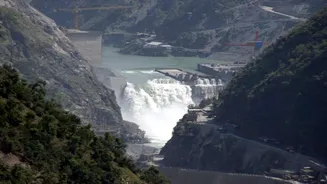
Planned on the Chenab river, the Sawalkot Hydroelectric Project will be developed in two stages, with Stage One accounting for 1,406 MW and Stage Two adding 450 MW, taking the total installed capacity to 1,856 MW.
The project will be located between the Baglihar project upstream and the Salal project downstream and will be executed as a “run-of-the-river” scheme. It is among the largest hydroelectric projects planned in the region and is seen as part of New Delhi’s broader push to maximise the use of waters allocated to India under the Indus framework.
According to the tender documents, bid submissions for the dam, tunnels and associated works will open on March 12 and close on March 20. The bids will remain valid for 180 days.
The overall completion period has been fixed at 3,285 days, indicating a long-term construction timeline spanning several years.
The Sawalkot project has been under consideration for years, but the renewed momentum comes amid shifting geopolitical dynamics and a sharper focus on harnessing India’s share of river waters.
Once completed, it is expected to significantly boost power generation capacity in Jammu and Kashmir and strengthen electricity supply to the national grid. Officials said the project would also generate employment and spur infrastructure development in Ramban district, where much of the construction activity will take place.
India suspended the Indus Waters Treaty with Pakistan in April last year following the terror attack in Pahalgam that killed 26 people, triggering a sharp escalation in diplomatic tensions.
Under the 1960 treaty, India has control over the eastern rivers — Ravi, Beas and Sutlej — while Pakistan receives most of the waters from the western rivers — Indus, Jhelum and Chenab — although India retains limited usage rights over the western rivers.
State-run power utility National Hydroelectric Power Corporation (NHPC) has floated a Rs 5,129 crore tender for the construction of the Sawalkot Hydroelectric Project in Ramban district.
First major project after Indus treaty suspension
The Sawalkot project marks the first new hydroelectric venture to receive approval from the Narendra Modi government after the suspension of the Indus Waters Treaty.
A report by CNN-News18 said NHPC invited companies on February 5 to bid for the project, which will be developed across the Udhampur and Ramban districts of Jammu and Kashmir.
Planned on the Chenab river, the Sawalkot Hydroelectric Project will be developed in two stages, with Stage One accounting for 1,406 MW and Stage Two adding 450 MW, taking the total installed capacity to 1,856 MW.
The project will be located between the Baglihar project upstream and the Salal project downstream and will be executed as a “run-of-the-river” scheme. It is among the largest hydroelectric projects planned in the region and is seen as part of New Delhi’s broader push to maximise the use of waters allocated to India under the Indus framework.
Tender timeline and construction schedule
According to the tender documents, bid submissions for the dam, tunnels and associated works will open on March 12 and close on March 20. The bids will remain valid for 180 days.
The overall completion period has been fixed at 3,285 days, indicating a long-term construction timeline spanning several years.
Strategic and local impact
The Sawalkot project has been under consideration for years, but the renewed momentum comes amid shifting geopolitical dynamics and a sharper focus on harnessing India’s share of river waters.
Once completed, it is expected to significantly boost power generation capacity in Jammu and Kashmir and strengthen electricity supply to the national grid. Officials said the project would also generate employment and spur infrastructure development in Ramban district, where much of the construction activity will take place.
Indus Waters Treaty in abeyance
India suspended the Indus Waters Treaty with Pakistan in April last year following the terror attack in Pahalgam that killed 26 people, triggering a sharp escalation in diplomatic tensions.
Under the 1960 treaty, India has control over the eastern rivers — Ravi, Beas and Sutlej — while Pakistan receives most of the waters from the western rivers — Indus, Jhelum and Chenab — although India retains limited usage rights over the western rivers.