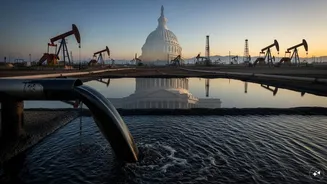








The United States plans to exercise long-term control over Venezuela’s oil sales as part of a broader transition strategy laid out by the Trump administration following the capture of President Nicolás Maduro. Senior officials said Washington will oversee the marketing of Venezuelan crude “indefinitely,” using oil revenues as leverage to stabilise the country, steer its economic recovery and shape an eventual political transition.
The approach, detailed by Energy Secretary Chris Wright and Secretary of State Marco Rubio signals a shift from ad-hoc pressure tactics to direct economic management of the oil-rich nation. While the administration insists the strategy is designed to prevent chaos and benefit the Venezuelan people, critics say it raises fresh questions about sovereignty, long-term US involvement and Washington’s intentions in Latin America’s largest proven oil reserves.
US Energy Secretary Chris Wright said on Wednesday that Washington plans to retain extensive control over Venezuela’s oil sector, including supervising the sale of the country’s oil output “indefinitely.” However, Rubio said that the United States has a three-step plan for Venezuela that will begin with stabilising the country after U.S. forces seized leader Nicolas Maduro on Saturday, overseeing the country’s recovery and finally a transition.
”We don’t want it descending into chaos,” said Rubio, speaking after briefing U.S. senators on the Trump administration’s plan for the Latin American country.
”The second phase will be a phase that we call recovery, and that is ensuring that American, Western and other companies have access to the Venezuelan market in a way that’s fair.
”Also, at the same time, begin to create the process of reconciliation nationally within Venezuela, so that the opposition forces can be amnestied and released and from prisons or brought back to the country, and begin to rebuild civil society,” Rubio added. ”And then the third phase, of course, will be one of transition.”
With inputs from agencies