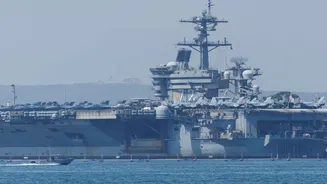

While the US president has seemed to back down on military action against the Islamic Republic, after being informed by “very important sources on the other side” that the killings had stopped, there are signs that suggest otherwise.
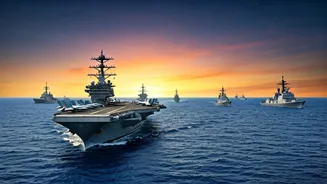
One such indicator is the Pentagon redirecting a carrier strike group from the South China Sea to the US Central Command area of responsibility, which includes West Asia. The carrier is reportedly on the move and will take at least a week to reach the West Asian waters.
So, what do we know of this move? What does it signify? We try to decode and get you the answers.
US supercarrier USS Abraham Lincoln sails to West Asia
The USS Abraham Lincoln has left the South China Sea waters and is making its way to West Asia at a time when Iran is witnessing one of its
“The US is moving a carrier strike group from the South China Sea to the CENTCOM area of responsibility,” Kellie Meyer, a NewsNation reporter, posted on X. CENTCOM’s “area of responsibility” covers over four million square miles, spanning Northeast Africa, West Asia, Central Asia, and South Asia. It encompasses 21 countries such as Egypt, Iraq, Afghanistan, Iran, and Pakistan.
As per the US Naval Institute’s carrier tracker, as of Monday, there was no US aircraft carrier in the West Asian region. The USS Abraham Lincoln was the closest, operating in the waters near Scarborough Shoal.
It is last November that the USS Abraham Lincoln departed its homeport of San Diego and has been in the waters of the South China Sea since last month.
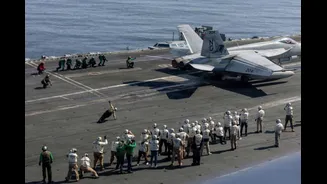
A South China Morning Post report noted that before its redeployment to West Asia, the Abraham Lincoln conducted various training activities last week. These included the live-fire drill on January 8, an exercise that involved a Phalanx close-in weapons system – an array of mounted turrets designed to counter incoming missiles, aircraft and boats. The drill also involved flight operations, replenishments at sea, damage control training and explosive ordnance disposal drills, according to the service.
Significance of redeploying USS Abraham Lincoln
The Pentagon’s order of redirecting the supercarrier —which includes fighter jets, guided missile destroyers and at least one attack submarine — comes as tensions between Washington and Tehran have spiked amid unrest in Iran over its economy and questions about whether US President Trump will strike the country to aid mass protests challenging the autocratic regime.
Some military experts note that moving the carrier suggests preparation for potentially sustained operations rather than a limited strike. “You don’t reposition a full carrier strike group from the Indo-Pacific for a one-night symbolic operation,” one defense source told
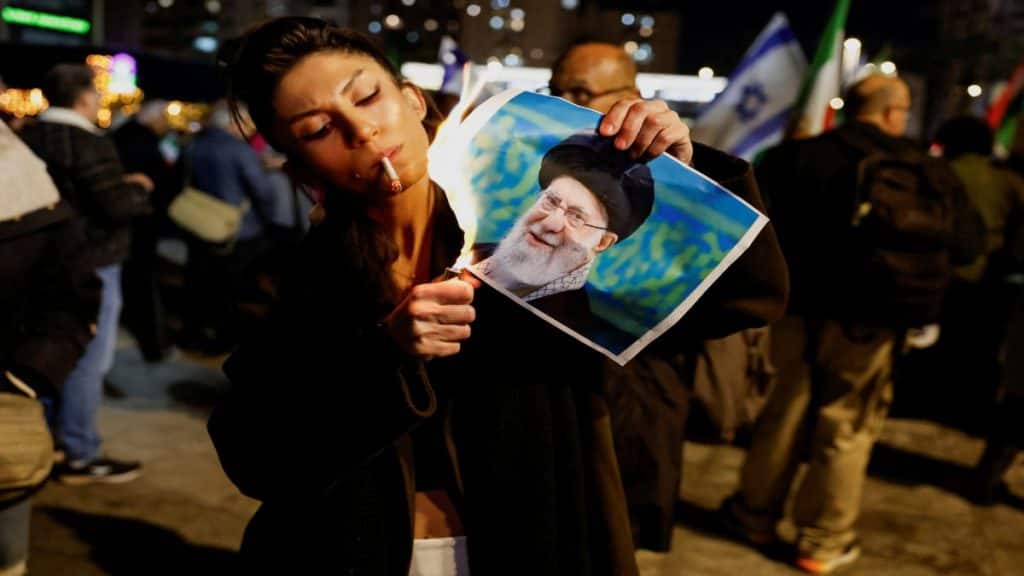
A woman lights a picture of Iran's Supreme Leader Ayatollah Ali Khamenei, as Israelis rally in support of the nationwide protests happening in Iran, in Holon, Israel. Reuters
Earlier this week, Trump urged demonstrators in Iran to continue their protests, vowing that “help is on the way”. “Iranian patriots, keep protesting – take over your institutions!!! … help is on its way,” Trump said in a post on Truth Social on Tuesday, a day after the White House press secretary said airstrikes were among “many, many options” the US president was considering.
Trump added that he had cancelled all meetings with Iranian officials until the “senseless killing” of protesters stopped.
The redeployment of the supercarrier is one among many signs of a possible US strike on Iran. Earlier, on Wednesday, the US asked its personnel at the Al Udeid Air Base in Qatar to evacuate . Speaking anonymously to the Associated Press, the official declined to clarify whether the departure was mandatory, who it affected, or how many were involved, citing operational security. Meanwhile, Qatar said the measures were in response to current tensions and reaffirmed steps to protect citizens, residents, and critical infrastructure.
There’s also the fact that Iran issued a “Notice to Air Missions,” or NOTAM, that flights in and out of Tehran have been restricted.
But it seems that Trump is giving mixed signals on Iran. After indicating that strikes were on the horizon, he did a volte-face saying that Tehran had stopped the killing of protesters. “They’ve said the killing has stopped and the executions won’t take place — there were supposed to be a lot of executions today and that the executions won’t take place — and we're going to find out,” Trump said.
When asked in the Oval Office if US military action was now off the table, Trump replied: “We’re going to watch it and see what the process is.”
It’s been reported that Saudi Arabia, Qatar, Turkey, Oman, as well as Israel’s Benjamin Netanyahu urged Trump not to launch airstrikes against Iran, saying an attack by Washington would lead to a major and intractable conflict across West Asia. The Guardian noted in one report that warnings of chaos from the longstanding US allies appear to have helped persuade Trump to hold off for the moment on a military assault.
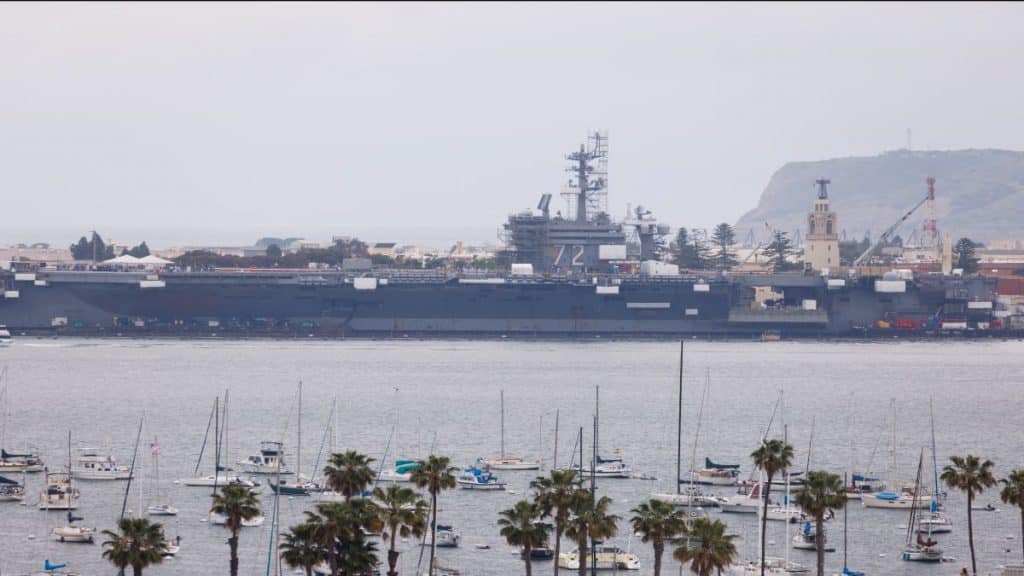
The USS Abraham Lincoln is the US navy’s fifth Nimitz-class aircraft carrier. It is nuclear-powered and among the largest warships in the world. File image/Reuters
About USS Abraham Lincoln
For those who are unaware, the USS Abraham Lincoln is the US navy’s fifth Nimitz-class aircraft carrier. Nuclear-powered and among the largest warships in the world, this ship is designed to operate for decades and project power far from US shores.
With a displacement of more than 100,000 tonnes, the almost 1,100-feet long, USS Abraham Lincoln can also carry a mix of 90 planes and helicopters, including F/A-18 and F-35 fighter jets. It also boasts of a speed of 30 knots.
The USS Abraham Lincoln also ran reconnaissance and combat air patrols in Iraq and Kuwait, assisting allied and US troops involved with Desert Storm. Morever, during Operation Iraqi Freedom, in 2003, the USS Abraham Lincoln and the carrier battle group and air wing helped deliver the opening salvos and air strikes.
And in 2024, the US also deployed the USS Abraham Lincoln during its action against Yemen’s Houthis in the Red Sea. At the time, the Pentagon also rejected the Houthi claims that the group targeted the USS Abraham Lincoln in the Arabian Sea.
With inputs from agencies