









What is the story about?
Cancer is fast becoming prevalent in India.
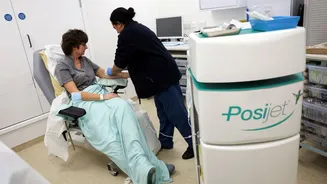
For many patients, this means undergoing expensive chemotherapy at hospitals. Cancer patients spend hours hooked up to an intravenous (IV) infusion with their caretakers on hand.
Now, a new drug, Tecentriq SC (atezolizumab), has been launched in India for treating certain types of lung cancer. Even better, this is administered in just seven minutes – meaning long hospital visits are a thing of the past. India every year sees around 80,000 lung cancer patients.
But what do we know about the drug? How does it work?
Let’s take a closer look.
Tecentriq SC has been launched by Swiss pharma giant Roche.
According to the company website, Tecentriq is usually administered via IV.
It is designed to treat:
This version, known as Tecentriq SC, which has been launched in India, is subcutaneous. This means it is injected directly under the skin rather than via IV, which takes hours. It is the world’s first subcutaneous immunotherapy aimed at treating certain types of lung cancer.
As per New Indian Express, the Drugs Controller General of India (DCGI) gave Tecentriq SC approval to treat those with adjuvant and metastatic lung cancer (NSCLC) in February. It costs around Rs 3.7 lakh per vial and is to be taken every three weeks. Those with Central Government Health Scheme cards can also avail of the drug. As per India Today, patients may need around six cycles of the drug.

Company officials told Hindu Business Line that the drug is being imported from Germany. The subcutaneous version of the drug was first approved in the United Kingdom in 2023. It is now widely available across 85 countries and has been administered to over 10,000 patients.
As per India Today, the intravenous (IV) version of the drug – which takes hours to inject – was launched in India in 2018. It targets cancers of the lung and urinary tract.
Tecentriq works by targeting PD-L1 receptors in the body. But first, let’s take a look at PD-1 and PD-L1. According to lung.org, the former is a receptor in the body that sits on the surface of immune cells, such as T-cells. In normal situations, it essentially acts as a ‘brake pad’ which stops immune cells, including T-cells, from attacking healthy tissues in the body.
However, certain cancers produce PD-L1 receptors in the body. These latch on to the PD-1 receptors and tell the immune system not to attack the unhealthy cells. Tecentriq works by targeting and blocking these PD-L1 receptors. By doing so, it allows the body’s immune system to target unhealthy cells.
According to The Print, Tecentriq SC combines atezolizumab with a technology from US biotech firm Halozyme Therapeutics. It does so by making the tissue under the skin more porous temporarily – which in turn allows the drug to be administered efficiently into the bloodstream. According to Indian Express, the drug can be injected into a patient’s thigh by trained nursing staff in hospital outpatient departments.

Dr Sajjan Rajpurohit, director and head of Medical Oncology at Medanta Hospital in New Delhi, told The Print that around half of India’s lung cancer patients likely have ‘meaningful’ levels of PD-L1.
However, according to the company website, Tecentriq comes with a number of side effects, including:
Tecentriq can also result in complications, including graft-versus-host disease (GVHD), in people who have received a bone marrow (stem cell) transplant that uses donor stem cells (allogeneic).
Given that the entire treatment can be done in just seven minutes, it has benefits for both patients and hospitals. Indian Express reported that hospitals can treat a minimum of five patients via subcutaneous injection in the same time it takes to give one patient an IV.
Roche India director, Medical and Regulatory Affairs, Dr Sivanesan Sivabalan, explained further.
“The first infusion for the IV takes about an hour; subsequent three-weekly infusions take about 30 minutes,” Dr Sivanesan told The Print. “This version reduces it (the treatment time) to seven minutes. More important than this reduction is that, if you take a step back and look at the holistic journey, there is a lot more preparation required for something given intravenously. A subcutaneous injection is given at the patient’s bedside within four to eight minutes. It is the same established treatment which patients know and clinicians know—it is just delivered very differently, with a significantly better experience,” he added.
“The time to administer reduces by 80 per cent because there is no more preparation and no need to wait for an infusion chair, as the eventual administration ranges between four to eight minutes, with a median of about seven minutes only. So there is a huge reduction in administration time,” Dr Sivanesan added.

This has real-world impacts. Dr Rajpurohit told The Print he has over half a dozen patients on Tecentriq SC at Medanta. One of them, an 80-year-old woman from Delhi, had refused chemotherapy, despite having lost seven kilos, coughing up blood and being in substantial pain from cancer. Rajpurohit said he administered her Tecentriq SC as well as a bone-strengthening injection every three weeks. “Within a week, she was about 30 per cent better. By her third dose, I would say she’s almost 80 to 90 per cent the way she probably would have been before she got this disease.”
Another patient, a 57-year-old male smoker, was in a similar position. He too was refusing chemotherapy despite the cancer spreading across his brain, liver and bones. He was put on Tecentriq SC after a bout of radiation. “He couldn’t believe that it is so simple to start the treatment,” Dr Rajpurohit said. “If a therapy does not cause pain to a person, then they are more willing to accept it.”
Others agreed. Dr Amit Rauthan, chief medical oncologist with Manipal Hospital in Bengaluru, told India Today, “Shorter administration formats can help improve accessibility and make cancer care more practical for patients and healthcare systems alike.”
More importantly, Roche says that the drug can also bring down the cost of cancer treatment by as much as 80 per cent. However, officials added that the total cost ultimately depends on the type of cancer the patient has and the duration of the treatment.
Hindu Business Line quoted the biotech firm as citing results from a study, saying that four out of five patients favoured Tecentriq SC compared to an IV. “Patients cited less time in clinic, greater comfort and lower emotional distress as key reasons for preference,” the firm said in a statement. The firm also said studies show that patients associate this method with less discomfort, pain and irritation compared to IV administration.
1. What is the 7-minute cancer shot launched in India?
Tecentriq SC is a subcutaneous version of the cancer immunotherapy drug atezolizumab, which can be administered in about seven minutes instead of hours.
2. How is Tecentriq SC different from traditional chemotherapy?
Unlike chemotherapy, which attacks cancer cells directly, Tecentriq is an immunotherapy that helps the body’s immune system recognise and fight cancer by blocking PD-L1 signals
3. Is Tecentriq SC available to all cancer patients in India?
No, it is approved for specific types of cancers, particularly certain types of lung cancer.
With inputs from agencies
For many patients, this means undergoing expensive chemotherapy at hospitals. Cancer patients spend hours hooked up to an intravenous (IV) infusion with their caretakers on hand.
Now, a new drug, Tecentriq SC (atezolizumab), has been launched in India for treating certain types of lung cancer. Even better, this is administered in just seven minutes – meaning long hospital visits are a thing of the past. India every year sees around 80,000 lung cancer patients.
But what do we know about the drug? How does it work?
Let’s take a closer look.
All about Tecentriq SC
Tecentriq SC has been launched by Swiss pharma giant Roche.
According to the company website, Tecentriq is usually administered via IV.
It is designed to treat:
- Non-small cell lung cancer after surgery and chemo (NSCLC)
- Metastatic non-small cell lung cancer (mNSCLC)
- Extensive-stage small cell lung cancer (ES-SCLC)
- Hepatocellular carcinoma (HCC) that has spread or cannot be removed by surgery
- BRAF V600+ advanced melanoma
This version, known as Tecentriq SC, which has been launched in India, is subcutaneous. This means it is injected directly under the skin rather than via IV, which takes hours. It is the world’s first subcutaneous immunotherapy aimed at treating certain types of lung cancer.
As per New Indian Express, the Drugs Controller General of India (DCGI) gave Tecentriq SC approval to treat those with adjuvant and metastatic lung cancer (NSCLC) in February. It costs around Rs 3.7 lakh per vial and is to be taken every three weeks. Those with Central Government Health Scheme cards can also avail of the drug. As per India Today, patients may need around six cycles of the drug.
India every year sees around 80,000 lung cancer patients. Representational image/Pexels
Company officials told Hindu Business Line that the drug is being imported from Germany. The subcutaneous version of the drug was first approved in the United Kingdom in 2023. It is now widely available across 85 countries and has been administered to over 10,000 patients.
As per India Today, the intravenous (IV) version of the drug – which takes hours to inject – was launched in India in 2018. It targets cancers of the lung and urinary tract.
How it works and side effects
Tecentriq works by targeting PD-L1 receptors in the body. But first, let’s take a look at PD-1 and PD-L1. According to lung.org, the former is a receptor in the body that sits on the surface of immune cells, such as T-cells. In normal situations, it essentially acts as a ‘brake pad’ which stops immune cells, including T-cells, from attacking healthy tissues in the body.
However, certain cancers produce PD-L1 receptors in the body. These latch on to the PD-1 receptors and tell the immune system not to attack the unhealthy cells. Tecentriq works by targeting and blocking these PD-L1 receptors. By doing so, it allows the body’s immune system to target unhealthy cells.
According to The Print, Tecentriq SC combines atezolizumab with a technology from US biotech firm Halozyme Therapeutics. It does so by making the tissue under the skin more porous temporarily – which in turn allows the drug to be administered efficiently into the bloodstream. According to Indian Express, the drug can be injected into a patient’s thigh by trained nursing staff in hospital outpatient departments.
Cancer patients spend hours hooked up to an intravenous (IV) infusion during chemo. Representational image/Pexels
Dr Sajjan Rajpurohit, director and head of Medical Oncology at Medanta Hospital in New Delhi, told The Print that around half of India’s lung cancer patients likely have ‘meaningful’ levels of PD-L1.
However, according to the company website, Tecentriq comes with a number of side effects, including:
- Lung problems
- Intestinal problems
- Liver problems
- Hormone gland problems
- Kidney problems
- Skin problems
- Problems in other organs
- Severe infusion reactions
Tecentriq can also result in complications, including graft-versus-host disease (GVHD), in people who have received a bone marrow (stem cell) transplant that uses donor stem cells (allogeneic).
The benefits
Given that the entire treatment can be done in just seven minutes, it has benefits for both patients and hospitals. Indian Express reported that hospitals can treat a minimum of five patients via subcutaneous injection in the same time it takes to give one patient an IV.
Roche India director, Medical and Regulatory Affairs, Dr Sivanesan Sivabalan, explained further.
“The first infusion for the IV takes about an hour; subsequent three-weekly infusions take about 30 minutes,” Dr Sivanesan told The Print. “This version reduces it (the treatment time) to seven minutes. More important than this reduction is that, if you take a step back and look at the holistic journey, there is a lot more preparation required for something given intravenously. A subcutaneous injection is given at the patient’s bedside within four to eight minutes. It is the same established treatment which patients know and clinicians know—it is just delivered very differently, with a significantly better experience,” he added.
“The time to administer reduces by 80 per cent because there is no more preparation and no need to wait for an infusion chair, as the eventual administration ranges between four to eight minutes, with a median of about seven minutes only. So there is a huge reduction in administration time,” Dr Sivanesan added.
Given that the entire treatment can be done in just seven minutes, it has benefits for both patients and hospitals. Pexels
This has real-world impacts. Dr Rajpurohit told The Print he has over half a dozen patients on Tecentriq SC at Medanta. One of them, an 80-year-old woman from Delhi, had refused chemotherapy, despite having lost seven kilos, coughing up blood and being in substantial pain from cancer. Rajpurohit said he administered her Tecentriq SC as well as a bone-strengthening injection every three weeks. “Within a week, she was about 30 per cent better. By her third dose, I would say she’s almost 80 to 90 per cent the way she probably would have been before she got this disease.”
Another patient, a 57-year-old male smoker, was in a similar position. He too was refusing chemotherapy despite the cancer spreading across his brain, liver and bones. He was put on Tecentriq SC after a bout of radiation. “He couldn’t believe that it is so simple to start the treatment,” Dr Rajpurohit said. “If a therapy does not cause pain to a person, then they are more willing to accept it.”
Others agreed. Dr Amit Rauthan, chief medical oncologist with Manipal Hospital in Bengaluru, told India Today, “Shorter administration formats can help improve accessibility and make cancer care more practical for patients and healthcare systems alike.”
More importantly, Roche says that the drug can also bring down the cost of cancer treatment by as much as 80 per cent. However, officials added that the total cost ultimately depends on the type of cancer the patient has and the duration of the treatment.
Hindu Business Line quoted the biotech firm as citing results from a study, saying that four out of five patients favoured Tecentriq SC compared to an IV. “Patients cited less time in clinic, greater comfort and lower emotional distress as key reasons for preference,” the firm said in a statement. The firm also said studies show that patients associate this method with less discomfort, pain and irritation compared to IV administration.
FAQs
1. What is the 7-minute cancer shot launched in India?
Tecentriq SC is a subcutaneous version of the cancer immunotherapy drug atezolizumab, which can be administered in about seven minutes instead of hours.
2. How is Tecentriq SC different from traditional chemotherapy?
Unlike chemotherapy, which attacks cancer cells directly, Tecentriq is an immunotherapy that helps the body’s immune system recognise and fight cancer by blocking PD-L1 signals
3. Is Tecentriq SC available to all cancer patients in India?
No, it is approved for specific types of cancers, particularly certain types of lung cancer.
With inputs from agencies