






What is the story about?
For decades, Europe’s relationship with India was, if not chilly, then certainly comfortable in its polite vagueness. Decently robust trade, occasional strategic alignment, but no urgency. This Davos was different. At the prestigious World Economic Forum in the Swiss Alps, where every handshake and keynote gets scrutinised by markets and ministries alike, the European Union’s top leadership didn’t just talk about India. They declared urgency.
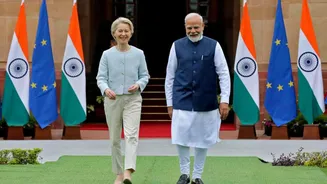
Ursula von der Leyen didn’t even attempt to sugarcoat it. Europe is racing to finalise a “historic” free trade agreement with India. The deal could encompass nearly two billion people and a quarter of global GDP – not just a headline number, but a statement of intent made by von der Leyen, the President of the European Commission.
Some might dismiss Davos as a cocktail party with awkward PowerPoint decks. However, when the EU president uses a global stage to say, “Geopolitical shocks make it necessary to build a new European independence,” it’s not spin. It is policy. And the reasons run far deeper than simply expanding trade.
First, let’s talk context. The global order is rattled. This year’s Davos had an uncommon theme: fracture. Former Canadian Prime Minister Mark Carney warned that the era of a rules-based international order may be ending, urging “middle powers” to work together in a world dominated by great-power rivalry. That’s not just Davos rhetoric; it is a recognition that the geopolitical tectonic plates are grinding.
The clearest symptom of this shift is the rising transactionalism of US policy. Recent tariff threats from Washington, including punitive duties targeted at European goods tied to the Greenland “problem”, have rattled EU markets and pushed leaders to contemplate using anti-coercion trade instruments against the US. In other words, the EU can no longer assume the US will be a stable partner in trade and security. When your oldest ally starts wielding tariffs like a hammer, you ask yourself if you need more than one cornerstone.
Europe’s response has been pretty neat, clean, and clear: diversify risk, deepen partnerships. And India sits at the apex of that strategy.
The idea of the EU-India FTA is nothing new; in fact, it’s been almost exasperating. The EU and India have been negotiating a free trade agreement for nearly two decades, an on-again, off-again limbo since talks began in 2007. At Davos, von der Leyen signalled that the long-stalled pact is close to its denouement, with leaders from both sides preparing to finalise it imminently. Piyush Goyal, Union Minister of Commerce, has already described it as the “mother of all deals”, emphasising its potential scale and impact.
This is not a small agreement. It promises to liberalise goods and services trade, eliminate barriers, and deepen investment ties, promising export growth, supply chain resilience, and long-term capital flows into India. But the geopolitical subtext is more compelling than the tariff lines on a graph.
Europe’s exporters, from machinery to chemicals, have been squeezed by global volatility. Suddenly, a stable partner with growth potential and a burgeoning market is not just desirable; it’s strategic.
Also, there’s the China factor. There’s no diplomatic euphemism needed here. China’s assertive economic and strategic posture looms large over Europe’s policy choices. Beijing’s growing clout as a trading partner, high-tech power, and geopolitical dominator has made Europe acutely aware of “single-market dependencies” in critical sectors. Asian supply chains are efficient but also vulnerable if geopolitics turns sharp. Diversifying without decoupling becomes the only sane middle path.
India checks multiple boxes in this equation. As a democratic giant with a young workforce, substantial manufacturing ambition, and rising technological capabilities, India offers an alternative supply-chain node that aligns with Europe’s values and interests. The partnership isn’t about shunning China but seems to be more about hedging risk.
What’s striking about this phase of EU-India engagement is how it’s spilling out of purely economic domains. In Davos and in related diplomatic channels, EU Foreign Policy Chief Kaja Kallas confirmed plans to advance a fresh security and defence partnership with India, a collaboration that goes beyond joint statements to signal real geopolitical cooperation.
The European Union, traditionally a soft-power actor with modest military coordination, is now openly exploring defence ties with a non-Nato, non-Western bloc partner. That’s not incremental; it may be read as acknowledgement that power politics matter again.
Across the Indo-Pacific, where sea lanes and trade routes are vital, Europe and India share concerns about freedom of navigation, maritime security, and an open regional order. India’s Indo-Pacific Ocean Initiative dovetails with Europe’s vision for an inclusive, rules-based regional architecture. By aligning strategic dots, the EU is signalling it’s ready to invest not just capital but credibility in a partner whose footprint is growing both in Africa and Asia.
Now, coming to Davos: World Economic Forum gatherings are often dismissed as elites talking to elites. But Davos is where geopolitics and global capital meet, and in 2026, those conversations were underscored by a shared anxiety about fragmentation—not merely economic slowdown. European leaders used the platform to broadcast a message: Europe wants partnerships built for resilience, not nostalgia.
Von der Leyen’s framing, that “geopolitical shocks can and must be an opportunity for Europe,” wasn’t simply a rally for technocrats; it was strategy.
And, of course, the timing is highly symbolic. She is set to visit India immediately after Davos and to be the chief guest at India’s Republic Day celebrations, a ceremonial honour with deep diplomatic signalling. That sequence—announce momentum in Davos, concretise it in New Delhi—tells global markets and governments that this partnership is real and urgent.
(The author is a freelance journalist and features writer based out of Delhi. Her main areas of focus are politics, social issues, climate change and lifestyle-related topics. Views expressed in the above piece are personal and solely those of the author. They do not necessarily reflect Firstpost’s views.)
Ursula von der Leyen didn’t even attempt to sugarcoat it. Europe is racing to finalise a “historic” free trade agreement with India. The deal could encompass nearly two billion people and a quarter of global GDP – not just a headline number, but a statement of intent made by von der Leyen, the President of the European Commission.
Some might dismiss Davos as a cocktail party with awkward PowerPoint decks. However, when the EU president uses a global stage to say, “Geopolitical shocks make it necessary to build a new European independence,” it’s not spin. It is policy. And the reasons run far deeper than simply expanding trade.
First, let’s talk context. The global order is rattled. This year’s Davos had an uncommon theme: fracture. Former Canadian Prime Minister Mark Carney warned that the era of a rules-based international order may be ending, urging “middle powers” to work together in a world dominated by great-power rivalry. That’s not just Davos rhetoric; it is a recognition that the geopolitical tectonic plates are grinding.
The clearest symptom of this shift is the rising transactionalism of US policy. Recent tariff threats from Washington, including punitive duties targeted at European goods tied to the Greenland “problem”, have rattled EU markets and pushed leaders to contemplate using anti-coercion trade instruments against the US. In other words, the EU can no longer assume the US will be a stable partner in trade and security. When your oldest ally starts wielding tariffs like a hammer, you ask yourself if you need more than one cornerstone.
Europe’s response has been pretty neat, clean, and clear: diversify risk, deepen partnerships. And India sits at the apex of that strategy.
The idea of the EU-India FTA is nothing new; in fact, it’s been almost exasperating. The EU and India have been negotiating a free trade agreement for nearly two decades, an on-again, off-again limbo since talks began in 2007. At Davos, von der Leyen signalled that the long-stalled pact is close to its denouement, with leaders from both sides preparing to finalise it imminently. Piyush Goyal, Union Minister of Commerce, has already described it as the “mother of all deals”, emphasising its potential scale and impact.
This is not a small agreement. It promises to liberalise goods and services trade, eliminate barriers, and deepen investment ties, promising export growth, supply chain resilience, and long-term capital flows into India. But the geopolitical subtext is more compelling than the tariff lines on a graph.
Europe’s exporters, from machinery to chemicals, have been squeezed by global volatility. Suddenly, a stable partner with growth potential and a burgeoning market is not just desirable; it’s strategic.
Also, there’s the China factor. There’s no diplomatic euphemism needed here. China’s assertive economic and strategic posture looms large over Europe’s policy choices. Beijing’s growing clout as a trading partner, high-tech power, and geopolitical dominator has made Europe acutely aware of “single-market dependencies” in critical sectors. Asian supply chains are efficient but also vulnerable if geopolitics turns sharp. Diversifying without decoupling becomes the only sane middle path.
India checks multiple boxes in this equation. As a democratic giant with a young workforce, substantial manufacturing ambition, and rising technological capabilities, India offers an alternative supply-chain node that aligns with Europe’s values and interests. The partnership isn’t about shunning China but seems to be more about hedging risk.
What’s striking about this phase of EU-India engagement is how it’s spilling out of purely economic domains. In Davos and in related diplomatic channels, EU Foreign Policy Chief Kaja Kallas confirmed plans to advance a fresh security and defence partnership with India, a collaboration that goes beyond joint statements to signal real geopolitical cooperation.
The European Union, traditionally a soft-power actor with modest military coordination, is now openly exploring defence ties with a non-Nato, non-Western bloc partner. That’s not incremental; it may be read as acknowledgement that power politics matter again.
Across the Indo-Pacific, where sea lanes and trade routes are vital, Europe and India share concerns about freedom of navigation, maritime security, and an open regional order. India’s Indo-Pacific Ocean Initiative dovetails with Europe’s vision for an inclusive, rules-based regional architecture. By aligning strategic dots, the EU is signalling it’s ready to invest not just capital but credibility in a partner whose footprint is growing both in Africa and Asia.
Now, coming to Davos: World Economic Forum gatherings are often dismissed as elites talking to elites. But Davos is where geopolitics and global capital meet, and in 2026, those conversations were underscored by a shared anxiety about fragmentation—not merely economic slowdown. European leaders used the platform to broadcast a message: Europe wants partnerships built for resilience, not nostalgia.
Von der Leyen’s framing, that “geopolitical shocks can and must be an opportunity for Europe,” wasn’t simply a rally for technocrats; it was strategy.
And, of course, the timing is highly symbolic. She is set to visit India immediately after Davos and to be the chief guest at India’s Republic Day celebrations, a ceremonial honour with deep diplomatic signalling. That sequence—announce momentum in Davos, concretise it in New Delhi—tells global markets and governments that this partnership is real and urgent.
(The author is a freelance journalist and features writer based out of Delhi. Her main areas of focus are politics, social issues, climate change and lifestyle-related topics. Views expressed in the above piece are personal and solely those of the author. They do not necessarily reflect Firstpost’s views.)