







What is the story about?
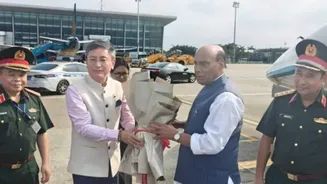
Two not-so-unrelated things are happening today. Defence Minister Rajnath Singh is on a two-day visit to Hanoi. He just met his Vietnamese counterpart, General Phan Van Giang, to discuss, among other things, whether Vietnam would become the second country in Southeast Asia to acquire a BrahMos missile system.
SoAnd in Umroi, a field training node on the outskirts of Shillong in Meghalaya, the Indian Army has just opened Exercise Pragati-I, a multinational military exercise. It involves 15 nations, all from the ASEAN region. The exposition running alongside it, organised by FICCI with Eastern Command and the Army Design Bureau, will showcase Indian defence hardware to the procurement heads and defence attachés of all those countries.
India has spent 30 years talking about its Act East Policy. It is now living it.
Vietnam and Korea
Vietnam and South Korea are joined by two proximities. They are geographically proximate, almost neighbours in the broader sweep of East Asia, and the other, more consequential proximity is to a China that has become more powerful and more comfortable showing it. Both states have territorial disputes with Beijing that it pursues with persistent pressure, and both have concluded, with varying degrees of explicitness, that they need to diversify their security sources.
Vietnam does not do alliances; its history has taught it well. A country occupied and ravaged by China, France, Japan and the United States in living memory tends to develop strong views on entanglement.
Hanoi wants options and the ability to price them against each other.
India is an option that makes a particular kind of sense. No colonial footprint in the region. No territorial ambitions. Its own unresolved disputes with Beijing lend it a certain bonhomie.
When Vietnamese President To Lam flew to New Delhi earlier this month, the two countries upgraded their partnership and set a $25 billion trade target for 2030. The leaders also confirmed that BrahMos missile talks had entered an advanced stage. Along with that, there is further engagement through Defence Lines of Credit and an Army Software Park being built at the Telecommunications University in Vietnam with Indian support.
The whole of it has been part of the Joint Vision Statement on India-Vietnam Defence Partnership towards 2030, signed during Singh’s last visit to Hanoi in June 2022.
South Korea wants something adjacent but distinct. Seoul’s anxieties run through the peninsula, not the sea, and what it seeks is industrial partnership and a reliable presence in a region where American commitment is subject to revision. Singh will chair a defence business roundtable in Seoul and meet the head of the Defence Acquisition Programme Administration. India’s Act East Policy and South Korea’s Indo-Pacific Strategy share overlapping values, and both countries have acknowledged the alignment.
The Missile That Started It All
The most persuasive argument in any negotiation is the one that travels at Mach 2.8. The BrahMos has become India’s single most eloquent contribution to regional diplomacy.
The Philippines understood this first. Manila signed a $375 million deal in 2022 for three shore-based batteries, a decision driven, fairly explicitly, by what China has been doing in the South China Sea. The first battery arrived on an Indian Air Force C-17 in April 2024. The second was shipped by sea last year. When Philippine Army chief General Romeo Brawner came to Delhi earlier this year, he had one word for how the system had performed: exemplary. Then he asked about helicopters, fighter aircraft, and submarines. Manila wants more. They are negotiating for more, and they are telling their friends about it.
And the friends are listening. Indonesia sent a formal letter to the Indian Embassy in Jakarta regarding a $450 million deal. Vietnam, Malaysia, the UAE, Chile, and South Africa have all expressed interest. In Hanoi, this is one of the topics on the table. The Vietnamese President all but confirmed it during his visit to New Delhi.
India’s defence exports rose from ₹686 crore in 2014 to over ₹21,000 crore in FY2024. There is a reason behind that. India has gone from being the world’s largest arms importer to a nation that has finally understood that selling weapons is not merely commerce, but also important to building relationships forged in steel and jet fuel.
Lines of Credit, Training Teams and A Real Partnership
But anyone can sell a weapon. The truly sophisticated operator sells the ecosystem that surrounds it: the training, the maintenance contracts. When you sell a weapon, you sell a way of thinking about war.
Defence Lines of Credit to Vietnam have quietly contributed to strengthening Hanoi’s capabilities for years, and have been welcomed by both governments. They call it foundational to the broader relationship.
Indian training teams operate at Vietnam’s Telecommunications University, Naval Academy, and Air Force College, and India has supported the establishment of an Army Software Park in Nha Trang. Twenty-one Philippine Navy officers received instruction in India in early 2023, trained specifically to operate and maintain the BrahMos.
A Vietnamese admiral who trained at an Indian institution. A Philippine officer whose entire professional vocabulary around missile systems is Indian. A Memorandum on submarine rescue, a Mutual Logistics Support Agreement, and a joint hydrographic survey completed in May 2025 off the Vietnamese coast. They are the capillaries of influence, invisible until you need them, indispensable when you do.
India is building its own ecosystem, a structural dependency. Not an alliance, because the term demands too much.
Exercise Pragati and the Point It Makes
Which brings us back to Umroi.
Exercise Pragati-I is a joint military exercise, straightforwardly enough. Fifteen nations, almost all in ASEAN, are converging on a field training node in Meghalaya for a fortnight of joint operations. Bangladesh, Cambodia, Indonesia, the Philippines, Vietnam, and a full roster of countries. Fifteen flags in the hills of Meghalaya.
Meghalaya sits at India’s northeastern shoulder, its gateway to Southeast Asia, the hinge between the subcontinent and the ASEAN world. To host a fifteen-nation military exercise there is to announce that this is where India’s strategic attention lies.
Running alongside the military exercise on 30-31 May is a defence industry exposition, organised by FICCI in collaboration with HQ Eastern Command and the Army Design Bureau, designed to allow Indian defence manufacturers to showcase their capabilities to the procurement heads and senior military leadership of the fifteen participating nations.
The product range spans drones, counter-drone systems, surveillance equipment, communications hardware, autonomous maritime systems, precision ammunition, and more, with hands-on demonstration opportunities for foreign military personnel.
The structure of this event tells you everything about how militaries build bonds. Not through brochures. The Philippines did not want more BrahMos batteries simply because the hardware is good. It wanted more because India proved it could deliver on time, with training and follow-through. That is what you build by sharing a command post, a meal, a map. The exposition is how you convert that trust into procurement.
That Rajnath Singh is currently in Hanoi, negotiating the next BrahMos deal, is proof enough that the model works.
So, What Does It All Add Up To?
What New Delhi is constructing across Southeast Asia is more durable than, let’s say, an alliance, which comes with its own headaches and obligations. It is building a lattice of structural dependence, built from missile deliveries, training programmes, credit lines, shared exercises, hydrographic surveys, and software parks in Nha Trang.
And once a nation’s officers have trained alongside yours, operated your equipment, maintained it with your spare parts, and shared your frequencies, the bond is made. It will persist through changes of government, shifts in alignment, and the ordinary turbulence of regional politics.
China has understood and applied this logic for decades. India is now applying it in its own neighbourhood, with a clarity that has historically been absent. The difference is that India can offer something Beijing cannot: the credible appearance of a partner that wants nothing from you except the relationship itself.
That is, of course, not entirely true. India wants influence, markets, and a regional order that constrains the country with which it shares a long and disputed border. But those are interests that align rather than conflict with what Vietnam, the Philippines, South Korea, and their neighbours actually need. And the best deals are the ones where everyone believes they got the better end.
Rajnath Singh’s flights to Hanoi and Seoul are, in isolation, unremarkable. A minister travels. Meetings are held. Statements are issued. But context is everything. India is no longer positioning itself as a regional power. It is behaving like one.
(Views expressed in the above piece are personal and solely those of the author. They do not necessarily reflect Firstpost’s views.)