






What is the story about?
There is a 10-20 per cent chance that a 2008‑like global financial crisis may hit the world in 2026, the Economic Survey 2025–26 has warned.
In the 2008 financial crisis, the United States lost around 7.5 million jobs and worldwide losses were around 200 million. American households lost around $10–17 trillion in net worth, and American and European banks lost around $1 trillion.
While the 2008 crisis was rooted in the housing market collapse and began with the bankruptcy of investment bank Lehman Brothers, a crisis of similar scale could erupt in 2026 from an artificial‑intelligence (AI) bubble burst coinciding with escalating geopolitical and trade conflicts, the Economic Survey said.
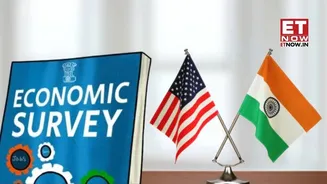
Union Finance Minister Nirmala Sitharaman on Thursday tabled the Economic Survey. It said that India’s outlook has remained positive, but the global environment continues to be fragile.
The Economic Survey presented three scenarios for the global economy in 2026–27: a best‑case scenario in which the world remains ‘business as in 2025’ with a 40-45 per cent probability, a second scenario in which the world experiences a disorderly breakdown of the multipolar order with a 40-45 per cent probability, and a worst‑case scenario in which the world witnesses a 2008‑like financial crisis with a 10–-20 per cent probability.
In the first and best‑case scenario , the world would be ‘business as in 2025’ but increasingly less secure and more fragile, according to the Economic Survey.
As the margin of safety narrows, minor shocks could escalate into larger reverberations.
Under this scenario, episodes of financial stress, trade frictions, and geopolitical escalations would not lead to systemic collapse but would fuel volatility and require governments to intervene more actively to stabilise expectations.
Far from being business as usual, it would be a situation of managed disorder, with countries operating in a world that remains integrated yet increasingly distrustful.
In the second scenario, the probability of a disorderly multipolar breakdown would rise materially and could no longer be treated merely as a tail risk.
Under this scenario, strategic rivalry would intensify, the Russia‑Ukraine war would remain unresolved in a destabilising form, and collective security arrangements would unravel.
At the same time, trade would become increasingly coercive, sanctions and counter‑measures would proliferate across the world, supply chains would realign under political pressure, and financial‑stress events would be transmitted across borders with fewer buffers and weaker institutional shock absorbers.
In such a case, countries’ policies would become narrower and more nationalised as they face sharper trade‑offs between autonomy, growth, and stability.
In the third and worst‑case scenario, the Economic Survey said there could be a 10-20 per cent risk of a systemic shock cascading across sectors such that financial, technological, and geopolitical stresses amplify one another rather than unfolding independently.
The Economic Survey said the recent phase of highly leveraged AI‑infrastructure investment has exposed business models dependent on optimistic execution timelines, narrow customer concentration, and long‑duration capital commitments. It warned that if a correction in this segment coincided with geopolitical escalation or trade disruption, the macroeconomic consequences could be worse than even the 2008 financial crisis.
The Economic Survey added that an AI bubble burst would not end technological adoption but could tighten financial conditions, trigger risk aversion, and spill over into broader capital markets. Coupled with geopolitical and trade disruptions, the resulting interaction could produce a sharper contraction in liquidity, a sudden weakening of capital flows, and a shift toward defensive economic responses across regions.
In the 2008 financial crisis, the United States lost around 7.5 million jobs and worldwide losses were around 200 million. American households lost around $10–17 trillion in net worth, and American and European banks lost around $1 trillion.
While the 2008 crisis was rooted in the housing market collapse and began with the bankruptcy of investment bank Lehman Brothers, a crisis of similar scale could erupt in 2026 from an artificial‑intelligence (AI) bubble burst coinciding with escalating geopolitical and trade conflicts, the Economic Survey said.
Union Finance Minister Nirmala Sitharaman on Thursday tabled the Economic Survey. It said that India’s outlook has remained positive, but the global environment continues to be fragile.
The Economic Survey presented three scenarios for the global economy in 2026–27: a best‑case scenario in which the world remains ‘business as in 2025’ with a 40-45 per cent probability, a second scenario in which the world experiences a disorderly breakdown of the multipolar order with a 40-45 per cent probability, and a worst‑case scenario in which the world witnesses a 2008‑like financial crisis with a 10–-20 per cent probability.
3 scenarios for the world economy in 2026–27
In the first and best‑case scenario , the world would be ‘business as in 2025’ but increasingly less secure and more fragile, according to the Economic Survey.
As the margin of safety narrows, minor shocks could escalate into larger reverberations.
Under this scenario, episodes of financial stress, trade frictions, and geopolitical escalations would not lead to systemic collapse but would fuel volatility and require governments to intervene more actively to stabilise expectations.
Far from being business as usual, it would be a situation of managed disorder, with countries operating in a world that remains integrated yet increasingly distrustful.
Under this scenario, strategic rivalry would intensify, the Russia‑Ukraine war would remain unresolved in a destabilising form, and collective security arrangements would unravel.
At the same time, trade would become increasingly coercive, sanctions and counter‑measures would proliferate across the world, supply chains would realign under political pressure, and financial‑stress events would be transmitted across borders with fewer buffers and weaker institutional shock absorbers.
In such a case, countries’ policies would become narrower and more nationalised as they face sharper trade‑offs between autonomy, growth, and stability.
In the third and worst‑case scenario, the Economic Survey said there could be a 10-20 per cent risk of a systemic shock cascading across sectors such that financial, technological, and geopolitical stresses amplify one another rather than unfolding independently.
The Economic Survey said the recent phase of highly leveraged AI‑infrastructure investment has exposed business models dependent on optimistic execution timelines, narrow customer concentration, and long‑duration capital commitments. It warned that if a correction in this segment coincided with geopolitical escalation or trade disruption, the macroeconomic consequences could be worse than even the 2008 financial crisis.
The Economic Survey added that an AI bubble burst would not end technological adoption but could tighten financial conditions, trigger risk aversion, and spill over into broader capital markets. Coupled with geopolitical and trade disruptions, the resulting interaction could produce a sharper contraction in liquidity, a sudden weakening of capital flows, and a shift toward defensive economic responses across regions.