

However, its proposal has faced flak, including from within CDU. But why is the ruling party in Germany against part-time employment?
We take a look.
CDU wants to restrict part-time work
German Chancellor and Conservative leader Friedrich Merz’s party is divided over part-time work. The business wing of CDU has recommended restricting part-time employment.
Lawmakers from the party are calling for the right to part-time work to be granted only to those raising children, caring for relatives or undertaking additional training, as per a motion, dubbed “No legal right to lifestyle part time”, obtained by
People who decide to work part-time but do not fall in these categories should no longer be allowed to hold side jobs, it said.
Part-time workers are people working fewer hours than a full-time employee in a similar job.
Currently, every employee in Germany has the fundamental right to part-time work. The labour law empowers employees to slash their working hours if they have been with the company for at least six months and if the firm has more than 15 employees.
Companies can deny the request only if the reduction significantly hinders workflows or causes disproportionate costs.
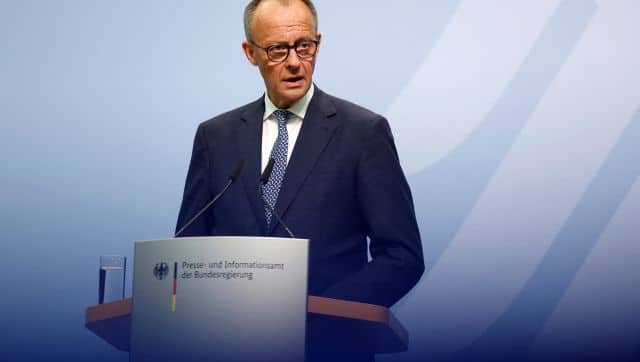
Members of German Chancellor Friedrich Merz's ruling party has opposed part-time work. File Photo/AFP
CDU’s business wing, which represents Germany’s small- and medium-sized enterprises, has argued that the German economy is suffering due to a lack of skilled workers; hence, no one should have a legal entitlement to do what it calls “lifestyle part-time work”, reported The Guardian.
Lawmakers reportedly argued in their motion that the part-time employment rate touched a record high of about 40 per cent in Germany in 2025, while "at the same time, there is a shortage of skilled workers throughout the economy."
“Those who can work more should work more,” the business wing’s chair, Gitta Connemann, told the news magazine
CDU members’ proposal faces opposition
The CDU business wing’s proposal could be passed at the party's general conference in Stuttgart next month, when it would become official party policy.
However, the proposal is being opposed, even from within the CDU.
"I would also like to see more people in part-time work [...] switch back to full-time work," Dennis Radtke, chair of CDU’s social wing, told the Funke media group.
"To achieve this, however, we need to improve the framework conditions for childcare and care."
IG Metall, the powerful metalworkers’ union, also expressed concerns about the proposal. “The problem is not a lack of willingness or performance, but inadequate conditions” for those who cannot work full time, the union’s boss, Christiane Benner, was quoted as saying by The Guardian.
How prevalent is part-time work?
Part-time employment has become popular in Europe. According to Eurostat, 17.1 per cent of employed people in the European Union (EU) engaged in part-time work in 2024.
The part-time employment rates differ across Europe, ranging from 1.5 per cent in Bulgaria to 40.5 per cent in Switzerland.
In Germany, three in 10 people have side jobs. As per Germany’s Institute for Employment Research (IAB), the part-time employment rate in the country rose to a little over 40 per cent in the third quarter of 2025.
This rate was 24 per cent in the UK as of 2025, and just under 18 per cent in France in 2024, reported The Guardian.
“Women, young people, older workers, and those with reduced work capacity are more likely to prefer part-time employment. Therefore, countries where these groups have high employment rates tend to exhibit higher levels of part-time work,” Rasa Mieziene and Sandra Krutuliene from the Lithuanian Centre for Social Sciences told
“Part-time jobs are also more common in service-oriented sectors — such as retail, health, education, and hospitality — where staffing needs vary throughout the day or week,” they added.
In Germany, the UK and France, 76 per cent of part-time workers are women. According to IAB, the surge in part-time employment in Germany last year was partly due to an increase in employment in sectors such as health, social services, education and teaching, and a drop in jobs in the manufacturing sector, where full-time work is more common.
For employees, part-time work offers flexibility and greater work-life balance; while for employers, it reduces labour costs and meets fluctuating demand.
According to Mieziene and Krutuliene, in high-wage economies, part-time work can still provide adequate income. In lower-wage economies, it may not be financially practical, decreasing both worker interest and employer offerings.
“This helps explain why part-time employment remains relatively low in many Eastern European countries,” they told
According to Stan De Spiegelaere of Ghent University, other factors affecting part-time work include shifting cultural norms surrounding women’s work and stagnant wages that make full-time employment inadequate as a ‘family wage', leading to people opting for part-time jobs, reported Euronews.
He also pointed out that a lack of infrastructure that restricts mothers from working full-time, along with rising flexibilisation of labour regulations in countries like Germany, influences part-time employment rates.
Last year, the Organisation for Economic Co-operation and Development (OECD) found that the German economy suffered partly because women and older people were not sufficiently integrated into the workplace.
With inputs from agencies