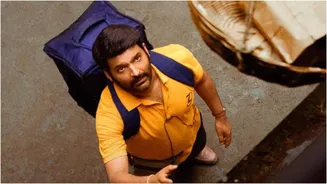









“Majboor hoon, isiliye majdoor hoon”
The conversation around the gig economy has grown louder in recent months, and for good reason. Delivery partners and app-based workers across India are increasingly vocal about shrinking incentives, arbitrary penalties, rising fuel costs, and the quiet erosion of dignity that comes with algorithm-driven labour. What was once sold as “flexible work” has, for many, turned into a relentless race against time, ratings, and faceless systems that rarely pause to listen.
It is in this context that Zwigato, the film from which the first line is quoted, feels less like a film from the recent past and more like a mirror held up to the present.
Watch the trailer of Zwigato here:
Nandita Das’s 2022 film, led by Kapil Sharma and Shahana Goswami, captures the everyday grind of a gig worker with unsettling accuracy. The film understands something crucial about this ecosystem: exploitation here is rarely dramatic. It is mundane, procedural, and often disguised as efficiency. Zwigato shows how gig workers seldom get the luxury of time, not to rest, not to eat, sometimes not even to think. A delayed delivery or pickup due to an unforeseen event, a customer complaint unchecked for context, or even stepping outside a designated zone can immediately translate into fines, penalties, or reduced visibility on the app. There is no conversation, only consequences.
The cruelty of the system lies in its impersonality. Workers are constantly evaluated, rated, and nudged into compliance by notifications and incentives, while their lived realities remain invisible. They are expected to stay available round the clock, and even failing to accept deliveries can result in account suspension. Zwigato captures this imbalance without sensationalising it. The film’s power lies in its attention to small humiliations- the anxious glances at the phone, the loud notification sound, the fear of taking a break, the helplessness of being “logged out” of work without explanation.
Nandita Das approaches the subject with empathy, not sympathy. She does not frame her protagonist as a victim to be pitied, but as a man negotiating survival within a system stacked against him. Kapil Sharma’s character was earlier employed as a manager, but circumstances forced him to remain without a job for eight months when the company suddenly shut down. It is precisely this helplessness that pushes him to take up work as a gig worker. There is dignity in Das’s gaze, even when the circumstances are deeply dehumanising. This choice allows the film to resonate without becoming didactic.
The film also shows how gig workers are looked down upon. Even within his own home, the protagonist faces uncomfortable questions from his children, one of whom asks him not to deliver to her principal’s house because it embarrasses her. With quiet nuance, Das also shows how gig workers seldom receive even a simple thank you, and how easily people overlook the effort and struggle required to complete what seems like a routine delivery.
Kapil Sharma’s performance is central to this effect. Known primarily for comedy, he brings a simple, resolute quality to the role. There are no dramatic outbursts or grand speeches. Instead, he plays the character with restraint, embodying a man who absorbs indignities because resistance comes at a cost he cannot afford. His ordinariness is the point. He could be anyone you see waiting outside a restaurant with a delivery bag slung over their shoulder.
Revisiting Zwigato today, as gig workers continue to push back against opaque systems and unfair practices, underlines just how prescient the film was. It does not offer solutions, nor does it pretend to resolve the contradictions of the gig economy. What it does instead is more enduring; it documents, with honesty and compassion, what it feels like to live inside it.
In an age where labour is increasingly invisible and efficiency often overrides empathy, Zwigato stands as a quiet but firm reminder. Behind every app notification is a human being, trying to make it through the day.
The film is available on Prime Video.