







What is the story about?
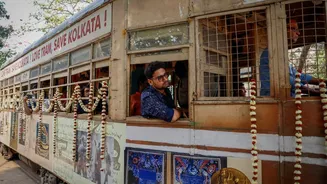
For more than a century, trams have woven through Kolkata’s streets, shaping daily life as much as the city’s colonial architecture. Today, that familiar clang risks falling silent as authorities move towards ending what remains of Asia’s oldest tram network, citing changing transport priorities in a rapidly modernising city.
The West Bengal government plans to shut down the 152-year-old tram system, preserving only a short heritage route. The proposal has triggered a court battle, with residents and heritage groups arguing that the trams are inseparable from Kolkata’s identity.
“As children, we would take the trams for fun, but as I grew older it became a necessity,” said Abha Maity, 44, recalling her school and college journeys. “I can’t imagine Kolkata without them.”
Introduced as horse-drawn carriages in 1873 and electrified in 1902, the network once spanned the entire city, operating more than 340 trams. Today, just two routes survive, served by a fleet of about 10 vehicles.
Once dominant on Kolkata’s roads, the ageing trams now struggle amid traffic congestion, competing with buses and yellow taxis as the city prioritises faster transport.
“When I joined, more than 340 trams were running. Now it’s down to seven or eight,” said Bacchu Sidda, a conductor with 36 years of service, still checking his duty roster at the last working depot in Gariahat.
Years of depot sales and tram scrapping led the Calcutta Tram Users Association (CTUA) to move the courts, campaigning since 2016 to save the system.
“I love my trams more than myself,” said Deep Das, 19, a journalism student and CTUA member. “If they disappear, it will be like a part of my body has left me.”
Despite the opposition, authorities are investing billions in metro expansion, wider roads and highways to ease congestion. The trams’ future now rests with the courts, even as they continue to carry passengers who see them as living reminders of Kolkata’s past.
From city lifeline to shrinking relic
The West Bengal government plans to shut down the 152-year-old tram system, preserving only a short heritage route. The proposal has triggered a court battle, with residents and heritage groups arguing that the trams are inseparable from Kolkata’s identity.
“As children, we would take the trams for fun, but as I grew older it became a necessity,” said Abha Maity, 44, recalling her school and college journeys. “I can’t imagine Kolkata without them.”
Introduced as horse-drawn carriages in 1873 and electrified in 1902, the network once spanned the entire city, operating more than 340 trams. Today, just two routes survive, served by a fleet of about 10 vehicles.
Legal fight as modernisation accelerates
Once dominant on Kolkata’s roads, the ageing trams now struggle amid traffic congestion, competing with buses and yellow taxis as the city prioritises faster transport.
“When I joined, more than 340 trams were running. Now it’s down to seven or eight,” said Bacchu Sidda, a conductor with 36 years of service, still checking his duty roster at the last working depot in Gariahat.
Years of depot sales and tram scrapping led the Calcutta Tram Users Association (CTUA) to move the courts, campaigning since 2016 to save the system.
“I love my trams more than myself,” said Deep Das, 19, a journalism student and CTUA member. “If they disappear, it will be like a part of my body has left me.”
Despite the opposition, authorities are investing billions in metro expansion, wider roads and highways to ease congestion. The trams’ future now rests with the courts, even as they continue to carry passengers who see them as living reminders of Kolkata’s past.