
In fact, on Saturday (January 17), in an extraordinary escalation, the US president announced new tariffs on eight European nations — Denmark, Sweden, Norway, Finland, Great Britain, France, Germany and the Netherlands — starting from February 1 until he is able to buy the semi-autonomous Danish territory. That tariff will then increase from 10 per cent to 25 per cent on June 1.
This, in turn, has led Europe to collectively rebuke Trump, with the leaders of the eight countries saying that they stood in “full solidarity” with Denmark and Greenland. The European Union is also weighing up retaliatory tariffs on American goods and even deploying its most serious economic sanctions against the US, with Denmark’s Prime Minister Mette Frederiksen saying Europe won’t be blackmailed.
If you are still left wondering what’s going on, we break it down for you.
What is Trump’s tariff threat over Greenland?
Over the weekend, Donald Trump resorted to his favourite negotiating tactic — of levying tariffs — against Europe in his quest to acquire Greenland. The US president noted on his social media platform that he has subsidised Denmark and other European Union countries by not charging them tariffs.
“Now, after centuries, it is time for Denmark to give back – world peace is at stake! China and Russia want Greenland, and there is not a thing that Denmark can do about it.”
He added that “the national security of the United States, and the world at large, is at stake.”

US President Donald Trump Donald Trump has threatened eight European countries – Denmark, Sweden, Norway, Finland, Great Britain, France and Germany and the Netherlands – with a 10 per cent tariff on all goods coming into the United States from February 1 until he is able to buy Greenland. File image/Reuters
The US president wrote on Truth Social that starting February 1, the countries of Denmark, Norway, Sweden, France, Germany, the United Kingdom, the Netherlands and Finland will be charged a 10 per cent tariff on all their exports to the US.
Moreover, that tariff would increase to 25 per cent on June 1. “This tariff will be due and payable until such time as a deal is reached for the complete and total purchase of Greenland,” Trump wrote.
Trump additionally wrote: “The United States has been trying to do this transaction for over 150 years. Many presidents have tried, and for good reason, but Denmark has always refused.”
Why is Trump so keen on acquiring Greenland?
The tariff announcement by Trump is just the latest chapter in the US president’s attempt to acquire Greenland.
In his second term in office, Trump has renewed his desire for the resource-rich Greenland, especially after America’s capture of Venezuela’s Nicolas Maduro. Greenland is rich in minerals, including most of the EU’s listed “critical raw materials”. Moreover, it is strategically located — its location offers the shortest air and sea routes between North America and Europe, making it vital for US military operations and missile early-warning systems. Washington has also sought more radar coverage around the Greenland-Iceland-UK gap to monitor Russian and Chinese movements.
Earlier, the White House noted that the Trump administration was exploring all options to acquire Greenland, with even a military choice being considered.

Danish soldiers take pictures next to the statue of Hans Egede, at Nuuk's old harbour, Greenland. Reuters
How has Europe reacted to Trump’s tariffs over Greenland?
It’s not a surprise that Europe has collectively rebuked Donald Trump for pushing transatlantic ties to the brink. The leaders collectively issued a statement on Sunday, following Trump’s tariff announcement. In the statement, the leaders of the eight countries underscored their commitment to shared Nato goals, saying that they stood in “full solidarity” with Denmark and Greenland. They also reaffirmed their willingness to “engage in a dialogue based on the principles of sovereignty and territorial integrity” in response to President Trump’s repeated threats to take control of Greenland.
The eight Nato countries said that Trump’s proposed tariffs “undermine transatlantic relations and risk a dangerous downward spiral”.
“As members of Nato, we are committed to strengthening Arctic security as a shared transatlantic interest,” the leaders said. “The pre-coordinated Danish exercise ‘Arctic Endurance’ conducted with Allies, responds to this necessity. It poses no threat to anyone.”
Apart from the collective statement, European leaders also condemned Trump’s tariff move. Swedish Prime Minister Ulf Kristersson and Dutch Foreign Minister David van Weel both labelled Trump’s plan as “blackmail,” while Spanish Prime Minister Pedro Sanchez said a US invasion of Greenland “would make Putin the happiest man on Earth”.
The United Kingdom Prime Minister Keir Starmer also had a phone call with Trump, telling him that levying tariffs would be “wrong”. Following the phone call, a representative of Starmer’s office said that the UK PM had told Trump that “security in the high north is a priority for all Nato allies in order to protect Euro-Atlantic interests”.
“He also said that applying tariffs on allies for pursuing the collective security of Nato allies is wrong.”
French President Emmanuel Macron called the tariffs “unacceptable”. “No intimidation nor threat will influence us, neither in Ukraine, nor in Greenland, nor anywhere else in the world when we are confronted with such situations,” he said.
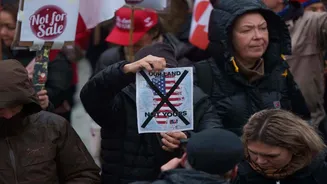
And it’s not just the leaders who have expressed their opposition to Trump’s tariff plan. Ordinary citizens carried out large protests in Denmark and Greenland against the US president, with many expressing their support for Maga — Make America Go Away.

People march during a pro- Greenlanders demonstration, in Copenhagen, Denmark. AP
What is Europe’s plan to counter Trump’s tariffs?
Apart from issuing a verbal condemnation of Trump’s tariff plan, Europe is also reportedly coming up with a way to retaliate against the United States.
One of the options that Europe is looking at deploying against Trump and the US is to deploy its Anti-Coercion Instrument, the EU’s so-called trade “bazooka” — a powerful trade retaliation tool that was originally conceived to fend off bullying from China and that would allow Europe to impose tariffs and investment limits against offending nations. Notably, it’s never been triggered before and using it against Washington would have been previously unthinkable.
News agency Reuters has also reported that Europe is looking to impose €93 billion of previously announced retaliatory tariffs against the United States that were delayed when the EU and US reached a tentative trade truce in July last year.
As Carsten Brzeski, global head of macro at ING, was quoted by CNN as saying: “At least judging from the first reactions, some European leaders are willing to play hardball. For businesses, the developments over the weekend mean another period of uncertainty around investments in and exports to the US.”
There’s also another option that is being looked at — diplomacy. Trump has said the new tariffs will kick in on February 1. This gives Europe enough time to negotiate with the US president. In fact, the American leader has repeatedly threatened tariffs against countries, only to then delay, reduce or quietly scrap them.
As Giorgia Meloni, the prime minister of Italy, who is also believed to be a close ally of Trump, said: “I don’t think the issue here is to create an escalation. I believe it is rather to try to engage in dialogue.”

A protester takes part in a demonstration to show support for Greenland in Copenhagen, Denmark. Reuters
What comes next?
It’s hard to predict the next steps in this tension. Previously, Trump has announced tariffs, only to cancel them or to pause them. Moreover, Trump is expected to travel to the World Economic Forum in Switzerland’s Davos this week, where he will meet the leaders of France, Germany, the Netherlands and other Nato members. There’s hope that this face-to-face will help calm the tensions down.
It’s left to be seen if Europe can get Trump to change his mind and hope that he climbs down the Greenland ladder.
With inputs from agencies