
The shooting, which unfolded during a public Hanukkah celebration on Sunday evening, has been declared the deadliest mass shooting in the country since the Port Arthur massacre of 1996.
Authorities have confirmed that the attack was carried out by two gunmen — a father and son — who opened fire on crowds gathered near the beachfront.
How the Bondi Beach shooting unfolded
Sunday, December 14, was meant to be an evening of celebration and community. The Hanukkah by the Sea event, organised by Chabad of Bondi, began around 5 pm (AEDT) and was promoted as a family-friendly gathering celebrating the Jewish festival of lights.
More than 1,000 people were estimated to be present, including families with children, elderly members of the community and visitors enjoying the summer evening by the waterfront.
Less than two hours later, the atmosphere was shattered.
At approximately 6.40 pm (AEDT), residents and beachgoers reported hearing multiple gunshots. Almost immediately, police vehicles were seen converging on the Bondi Beach area, particularly around Campbell Parade.
Witnesses described hundreds of people running for safety as fear spread rapidly through the crowded precinct.
Footage that later emerged showed two men dressed in black positioned on a pedestrian bridge connecting Campbell Parade to the Bondi Pavilion and the Bondi Surf Lifesaving Club, close to Archer Park.
From this elevated position, the men appeared to fire rifles towards crowds gathered below. Video clips circulating online showed cars continuing to pass beneath the bridge even as shots were being fired.
NSW Police received reports of an active shooter around 6.45 pm. According to investigators, the volume of gunfire and the speed at which events unfolded made the scene extremely difficult to immediately secure.
Timeline of the shooting: minute by minute
Reconstructing the precise sequence of events has been challenging due to the scale of the incident and the volume of footage shared online.
However, based on verified videos, police statements and witness accounts, authorities have established a broad timeline of how the attack unfolded.
After opening fire from the bridge, one of the gunmen — later identified as Sajid Akram — moved down into the park area near the bridge.
At this point, members of the public were fleeing in all directions, while others sought cover behind vehicles, trees and nearby structures.
During this phase of the attack, a bystander intervened. Ahmed el Ahmed, a 43-year-old father of two, lunged at Sajid Akram and managed to grab his weapon.
Ahmed had no known experience with firearms and had been at Bondi Beach simply to get a coffee with his cousin when the shooting began.
Despite the intervention, Sajid Akram managed to break free and return to the bridge, where his son, Naveed Akram, continued firing. Footage showed Sajid re-arming himself before both men came under fire from police who had moved into position nearby.
Sajid Akram was shot and collapsed.
Naveed Akram was also struck by police gunfire. In one video, a man dressed in pale clothing can be seen approaching the bridge and gesturing for officers to advance. Moments later, another individual walked onto the bridge with his hands raised, and a gunshot can be heard.
As police moved in, chaotic scenes followed. Officers and civilians ran onto the bridge, while footage showed one man kicking one of the alleged attackers and others grappling amid confusion and distress.
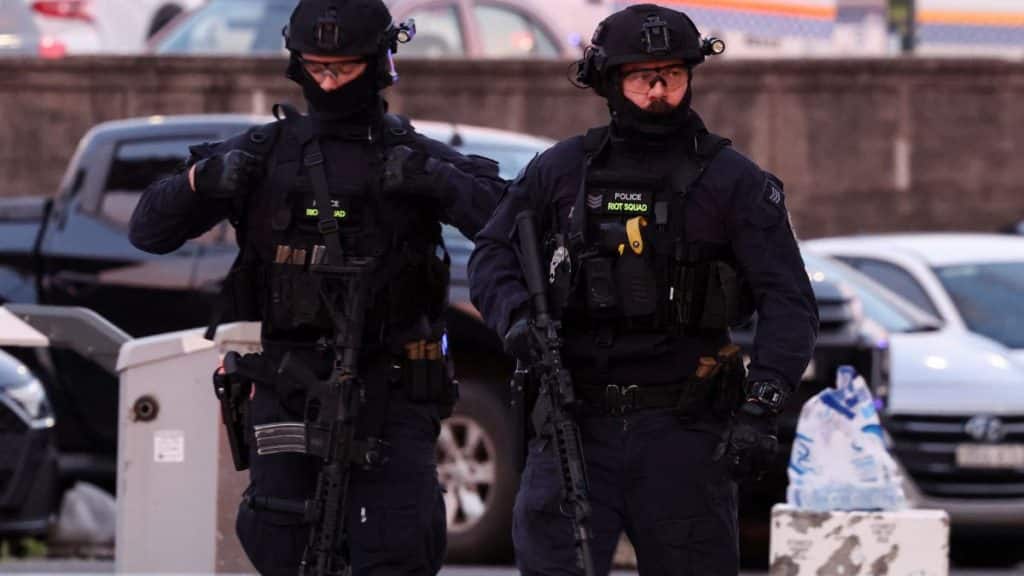
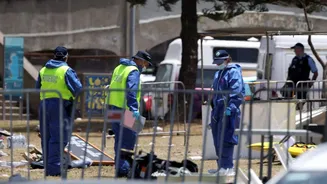
Armed police work at the scene after a shooting incident at Bondi Beach in Sydney on December 14, 2025. File Image/AFP
By approximately 7.30 pm, police had secured the immediate area and surrounded both gunmen on the ground.
Sajid Akram was later pronounced dead at the scene. Naveed Akram was transported to hospital under police guard.
The entire shooting, from the first shots to police securing the suspects, lasted less than an hour.
What we know about the casualties, injuries
Authorities confirmed that 15 people were killed in the attack, making it the deadliest mass shooting in Australia in nearly three decades.
The victims ranged in age from 10 to 87.
NSW Health Minister Ryan Park confirmed that the youngest victim, a 10-year-old child, died at Sydney Children’s Hospital in Randwick. Four children were among the injured and were also taken to the same hospital for treatment.
In total, 40 people were injured during the attack. As of Monday afternoon, police said 33 people remained in hospital.
Six were listed in critical condition, while 27 were described as serious but stable.
Among those hospitalised were two police officers — a constable and a probationary constable — who were injured while responding to the attack.
The identities of several victims were later confirmed by community organisations and international leaders.
Ten-year-old Matilda, who died from gunshot wounds, was identified as a former student of Bellevue Hill’s Harmony Russian School of Sydney, reported The Sydney Morning Herald.
Another victim was Rabbi Eli Schlanger, a 41-year-old father of five and assistant rabbi at Chabad of Bondi. He had a newborn son and was the organiser of the Hanukkah by the Sea event that became the site of the attack.
French President Emmanuel Macron confirmed the death of French national Dan Elkayam, who was in his late 20s. Elkayam worked as an IT analyst for NBC Universal and had lived in Australia for several years.
Chabad also confirmed the death of Alex Kleytman, a Holocaust survivor originally from Ukraine. In a statement, the organisation said Kleytman “died shielding [his wife] from the gunman’s bullets”.
Another victim, Reuven Morrison, was described by Chabad as a businessman and community member who had emigrated from the Soviet Union before he “discovered his Jewish identity in Sydney”.
What we know about the attackers
Police identified the shooters as Sajid Akram, 50, and his son Naveed Akram, 24. Investigators say the two men had told family members they were going on a weekend fishing trip prior to the attack.
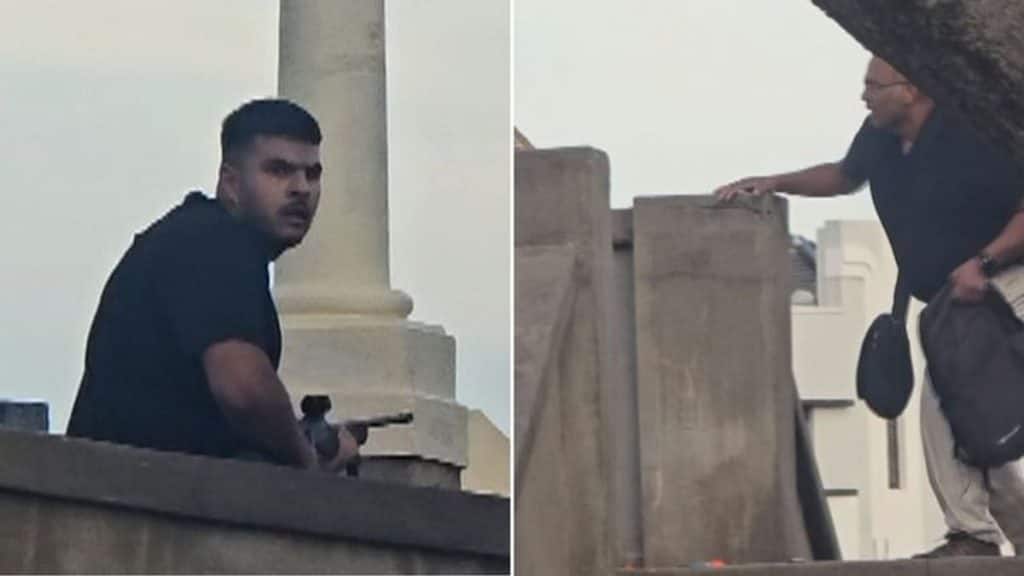
The two gunmen behind the Bondi Beach shooting are father and son, aged 50 and 24.
We have since learnt that the duo reportedly had origins from Pakistan. Sajid Akram died at the scene after being shot by police.
NSW Police Commissioner Mal Lanyon said Sajid held a valid firearms licence for recreational hunting and was a member of a gun club.
According to Lanyon, Sajid legally owned six firearms and brought six registered guns to Bondi Beach on the day of the attack. All six weapons were seized by police.
Home Affairs Minister Tony Burke revealed that Sajid Akram arrived in Australia in 1998 on a student visa.
Naveed Akram, who survived the shooting, was described as a recently unemployed bricklayer. He is an Australian-born citizen and remains in hospital in a critical but stable condition under police guard. Authorities have said he is likely to survive his injuries.
Prime Minister Anthony Albanese confirmed that Naveed Akram had come to the attention of the Australian Security Intelligence Organisation (ASIO) in October 2019.
Albanese said ASIO assessed that there was no indication of a threat of violence at the time. He added that ASIO’s concerns related to Naveed’s associates rather than his own behaviour or character.
Lanyon stated that police were aware of one of the shooters prior to the attack but had no intelligence suggesting a planned act of violence.
What the terror probe has revealed so far
NSW Police formally declared the Bondi Beach shooting a terrorism incident. Lanyon described the scene confronted by officers as “incredibly chaotic and terrifying”, even for seasoned police.
The response involved multiple police vehicles, dozens of officers and specialist counter-terrorism units. The Joint Counter Terrorism Team (JCTT) later confirmed it seized three firearms and two improvised explosive devices from the Bondi Beach area on Sunday night.
A further firearm and a third improvised explosive device were discovered at the location the following day. Police also confirmed that an improvised explosive device was found in the attackers’ vehicle.
As part of the investigation, authorities conducted raids at properties in Bonnyrigg and Campsie.
At the Bonnyrigg address, where the alleged shooter lived with his parents, 22-year-old sister and 20-year-old brother, forensic teams seized two firearms. Sections of the street were closed as investigators worked at the scene.
Police believe the father and son had stayed at a Campsie property prior to the attack, which was suspected to be a short-term rental.
That location was also searched, though investigators said it remains unclear how long the pair had been staying there or when they intended to leave.
The bystander who intervened
Amid the violence, authorities and witnesses highlighted the actions of Ahmed el Ahmed as a moment of extraordinary bravery.
Ahmed, a 43-year-old father of two, tackled one of the attackers and managed to take hold of his rifle before being shot. He was later taken to hospital with gunshot wounds.
Ahmed’s cousin, Jozay Alkanj, said Ahmed had been terrified but acted instinctively to protect others. “He was very scared,” Alkanj said, quoted by The Sydney Morning Herald.
“He said ‘I’m going to die – please see my family [and tell them] that I went down to save people’s lives’.”
Speaking in Arabic outside the hospital as his son awaited surgery, Ahmed’s father praised his actions and said Ahmed was in “good spirits”.
“He said he thanks God that he was able to do this, to help innocent people and to save people from these monsters, these killers.”
How Australian gun laws have come under the lens
Albanese described the shooting as an “act of evil antisemitism” directed at Jewish Australians and the broader nation.
NSW Premier Chris Minns said hearts were bleeding for the Jewish community as it processed the scale of the loss.
Jewish leaders warned that the impact of the attack would be felt for years. Alex Ryvchin, co-chief executive of the Executive Council of Australian Jewry, said the “shredded” Jewish community may never recover from the “almighty blow”.
Rabbi Mendel Kastel, chief executive of Jewish House, who lost multiple family members in the shooting, said it was easy to “become very angry” and “blame people”, but stressed that this was “not what this is about”.
NSW Jewish Board of Deputies president David Ossip said the community had repeatedly warned during the “summer of terror earlier this year” that violence was inevitable.
Jillian Segal, Australia’s special envoy to combat antisemitism, told ABC Radio National that the federal government must “accelerate” and “fully endorse” the recommendations of her review into antisemitism, adding that authorities “can’t do this in a half-hearted fashion”.
Australia’s gun laws were significantly tightened after
Following that attack, the federal government moved within 12 days to ban semi-automatic weapons, introduce a national buyback scheme and overhaul licensing requirements.
Despite those reforms, the number of legally held firearms has steadily increased over the past two decades. According to the Australia Institute, there are now around four million guns held legally in Australia — more than before the 1996 crackdown.
Albanese said he would ask cabinet to consider reforms aimed at limiting the number of firearms permitted under a single licence and reviewing how long licences should remain valid. “People’s circumstances can change,” he said.
“People can be radicalised over a period of time. Licences should not be in perpetuity.”
Minns said he would consider recalling state parliament before Christmas to fast-track firearms legislation. “It’s time we have a change to the law in relation to the firearms legislation,” he said, adding that action could be expected soon.
Lanyon confirmed that, under existing laws, the licence held by one of the suspects entitled him to own the weapons he possessed.
What happens next
NSW Police confirmed that the Joint Counter Terrorism Team has launched a full investigation under Operation Arques.
The probe is being led by NSW Police and includes the Australian Federal Police, ASIO and the NSW Crime Commission.
Lanyon pledged a “very thorough and transparent investigation” into every aspect of the attack, including how the weapons were obtained, the movements of the attackers before the shooting and whether any warning signs were missed.
With inputs from agencies