








What is the story about?
The Delhi Gymkhana Club controversy has put the spotlight on other such elite clubs in India. As the exclusive British-era club faces an uncertain future, another club for the rich and powerful in the city has come under the scanner.
The Supreme Court has directed the imposition of a 100-metre prohibited zone around two protected, Mughal-era mausolea located within the premises of the Delhi Golf Club (DGC). This has further set off a debate on exclusive clubs occupying prime government land.
Let’s take a closer look.
The Supreme Court on Wednesday (May 27) ordered the declaration of a 100-metre prohibited zone around the medieval monuments of Lal Bangla I and II, located outside the entrance gate of the Delhi Golf Club.
The apex court has ordered the suspension of all activities and to seal structures within that area. This will include parts of the DGC’s kitchen just three metres away from the monument, as per a Hindustan Times (HT) report.
The Archaeological Survey of India-protected Lal Bangla mausoleum complex was built around 1779–1780. It is linked to the Mughal emperor Shah Alam II's family. Other structures inside the club premises include the Tomb of Syed Abid, the Lodi-era Barah Khamba, other Mughal-era tombs, mosque ruins, and gateways, among others.
The Supreme Court also separately directed against conducting any activity within 20 metres of nine other historical sites located inside the club premises, which are not “protected” under the Ancient Monuments and Archaeological Sites and Remains (AMASR) Act.
A bench of Justices Ahsanuddin Amanullah and N Kotiswar Singh passed the order after analysing a spot survey report submitted by court commissioners.
“The photos produced in the report reveal that in most of the monuments there is not even a semblance of conservation. They are in a dilapidated condition with not even the basic conservation work being done,” the bench noted.
Senior advocate Kapil Sibal, who appeared for the club, urged the top court for time to respond to the report.
“The construction in the club is of 1952 while the Ancient Monuments and Archaeological Sites and Remains Act is of 1958. This is a very harsh order being passed. If the entrance is sealed nobody can enter the Delhi Golf Club. Let the order not be passed without seeing our response. The court is only going by the commissioner’s report,” he was quoted as saying by HT.
The report, submitted by court commissioners, stated, “The Lal Bangla I & II (AD 1779-80), is dangerously close to the kitchen area of DGC. The entire kitchenette portion, which at some portion is barely 3 metres away from the protected monument, has to be removed forthwith by the DGC.”
The kitchen area housed hot boilers, pucca construction, drums, heavy boiler fans, a chimney and water tanks. The court commissioners, led by senior advocate Gopal Sankaranarayanan, recommended that action be taken within 30 days.
Responding to the report, the Supreme Court said, “Section 20A of the AMASR Act, 1958 requires there will be a protected area of 100 metres. With immediate effect, no activity within 100 metres of the said structure can happen. Any structure built shall be seized forthwith.”
The bench added, “The NDMC [New Delhi Municipal Council] is directed to take immediate steps, and if necessary take assistance from the Commissioner of Police…We make the NDMC Chairperson and Commissioner of Police responsible for compliance.”
Earlier, the apex court had warned of criminal action against NDMC officials over delays in conserving heritage structures on DGC's premises.
Spread over nearly 179 acres in central Delhi, the Delhi Golf Club is situated on Dr Zakir Hussain Road near India Gate, Humayun's Tomb and Lodhi Garden.
Previously known as the Lodhi Golf Club, its location is close to several important military and government establishments.
The government land, on which the club is located, is also home to nine to 10 Tughlaq- and Lodhi-era monuments, while roughly 50 per cent of the area is forest cover.
The British-era club was originally built as a municipal golf course in the early 1930s and became a corporate entity in February 1950.
The exclusive club, which has around 5,400 permanent members, boasts the 18-hole Lodhi Course and the 9-hole Peacock Course.
It also features a clubhouse, restaurants, bars, a swimming pool and private event spaces.
Over the decades, DGC has emerged as a networking hub for the country’s powerful bureaucratic, political, and business elite. Its current members include serving and retired civil servants, judges, politicians, military officers, diplomats and wealthy businesspersons, reported India Today.
The club reportedly inducts only 60 to 70 permanent members every year, depending on vacancies.
Under the "business category", civilians, entrepreneurs and corporate professionals can apply to become its members. However, applicants often have to wait for decades to get the exclusive club’s membership.
On the other hand, dependents of existing members reportedly get priority access through reserved quotas.
The club charges hefty fees from most of its members, running into lakhs.
The Delhi Golf Club is not new to controversies. In 2017, the DGC faced severe backlash after a Khasi woman from Meghalaya alleged that she was humiliated and asked to leave for wearing her traditional jainsem attire, which the staffers, she said, compared to a "maid's uniform".
Last May, two-time Asian Tour winner Rashid Khan and several Delhi-based professional golfers had threatened a sit-in protest at Jantar Mantar, demanding the right to practice at DGC.
They argued that the club stands on government land and its purpose is "promotion and advancement" of golf as a sport and hence they should not be excluded from the premises for practice.

The Centre extended Delhi Golf Club’s lease till 2050 last year. One of the factors behind the extension was the elite club's promise to raise the facility to “international standards”, “since golf would be part of Olympics from 2016”, the Housing and Urban Affairs Ministry told Lok Sabha in 2025.
Speaking to Times of India (TOI), DGC captain Vikram Sethi pointed out that doing away with the historic club would not be sensible when Delhi is already struggling with shrinking green cover.
“The construction within the premises is limited to just 0.52 acres... the rest is green cover... The Club has contributed to Delhi’s reputation for decades and continues to host prestigious national and international events, including the DP World Tournament, which sees participation from leading golfers across the world,” he said.
On concerns related to conservation of the heritage monuments inside the premises, Sethi said the Aga Khan Trust for Culture has already carried out restoration work at about five sites, while work at other locations is in progress. “The site was visited by the Supreme Court-appointed commissioner. As far as access to the monuments is concerned, even members are usually not allowed near them,” he said.
DGC members also said the vacation notice served to the Delhi Gymkhana Club by the Centre cannot be raised in connection with their club. “You cannot compare apples to oranges. The biggest advantage of this place is that over 50 per cent of the area is under forest cover... Ours is among the shortest golf courses in the country and we are managing within the available space,” Sethi said.
With inputs from agencies
The Supreme Court has directed the imposition of a 100-metre prohibited zone around two protected, Mughal-era mausolea located within the premises of the Delhi Golf Club (DGC). This has further set off a debate on exclusive clubs occupying prime government land.
Let’s take a closer look.
Parts of Delhi Golf Club to be shut
The Supreme Court on Wednesday (May 27) ordered the declaration of a 100-metre prohibited zone around the medieval monuments of Lal Bangla I and II, located outside the entrance gate of the Delhi Golf Club.
The apex court has ordered the suspension of all activities and to seal structures within that area. This will include parts of the DGC’s kitchen just three metres away from the monument, as per a Hindustan Times (HT) report.
The Archaeological Survey of India-protected Lal Bangla mausoleum complex was built around 1779–1780. It is linked to the Mughal emperor Shah Alam II's family. Other structures inside the club premises include the Tomb of Syed Abid, the Lodi-era Barah Khamba, other Mughal-era tombs, mosque ruins, and gateways, among others.
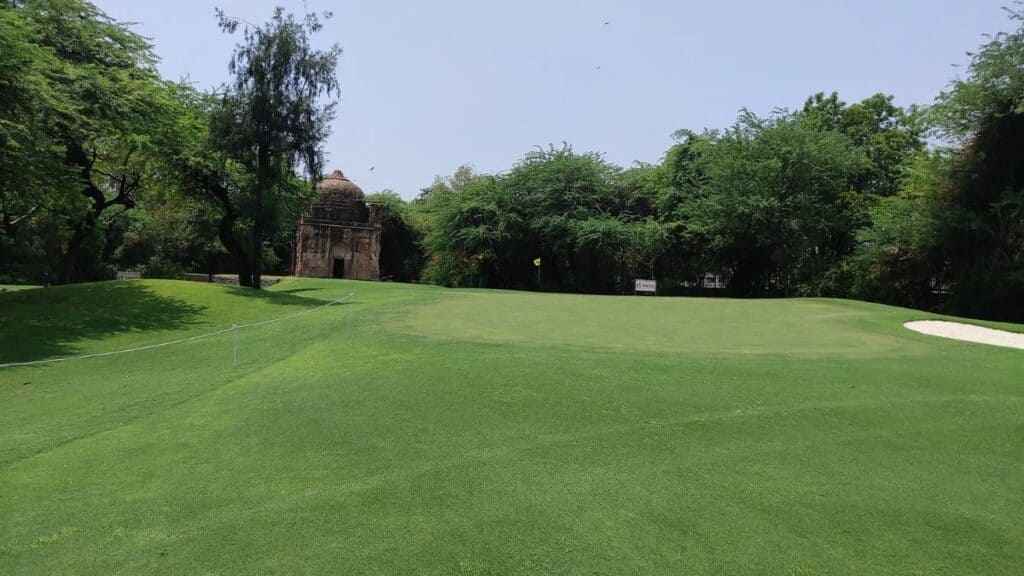
There are several centuries-old monuments on the premises of the Delhi Golf Club. Image Courtesy: delhigolfclub.org
The Supreme Court also separately directed against conducting any activity within 20 metres of nine other historical sites located inside the club premises, which are not “protected” under the Ancient Monuments and Archaeological Sites and Remains (AMASR) Act.
A bench of Justices Ahsanuddin Amanullah and N Kotiswar Singh passed the order after analysing a spot survey report submitted by court commissioners.
“The photos produced in the report reveal that in most of the monuments there is not even a semblance of conservation. They are in a dilapidated condition with not even the basic conservation work being done,” the bench noted.
Senior advocate Kapil Sibal, who appeared for the club, urged the top court for time to respond to the report.
“The construction in the club is of 1952 while the Ancient Monuments and Archaeological Sites and Remains Act is of 1958. This is a very harsh order being passed. If the entrance is sealed nobody can enter the Delhi Golf Club. Let the order not be passed without seeing our response. The court is only going by the commissioner’s report,” he was quoted as saying by HT.
The report, submitted by court commissioners, stated, “The Lal Bangla I & II (AD 1779-80), is dangerously close to the kitchen area of DGC. The entire kitchenette portion, which at some portion is barely 3 metres away from the protected monument, has to be removed forthwith by the DGC.”
The kitchen area housed hot boilers, pucca construction, drums, heavy boiler fans, a chimney and water tanks. The court commissioners, led by senior advocate Gopal Sankaranarayanan, recommended that action be taken within 30 days.
Responding to the report, the Supreme Court said, “Section 20A of the AMASR Act, 1958 requires there will be a protected area of 100 metres. With immediate effect, no activity within 100 metres of the said structure can happen. Any structure built shall be seized forthwith.”
The bench added, “The NDMC [New Delhi Municipal Council] is directed to take immediate steps, and if necessary take assistance from the Commissioner of Police…We make the NDMC Chairperson and Commissioner of Police responsible for compliance.”
Earlier, the apex court had warned of criminal action against NDMC officials over delays in conserving heritage structures on DGC's premises.
The majestic Delhi Golf Club
Spread over nearly 179 acres in central Delhi, the Delhi Golf Club is situated on Dr Zakir Hussain Road near India Gate, Humayun's Tomb and Lodhi Garden.
Previously known as the Lodhi Golf Club, its location is close to several important military and government establishments.
The government land, on which the club is located, is also home to nine to 10 Tughlaq- and Lodhi-era monuments, while roughly 50 per cent of the area is forest cover.
The British-era club was originally built as a municipal golf course in the early 1930s and became a corporate entity in February 1950.
The exclusive club, which has around 5,400 permanent members, boasts the 18-hole Lodhi Course and the 9-hole Peacock Course.
It also features a clubhouse, restaurants, bars, a swimming pool and private event spaces.
Over the decades, DGC has emerged as a networking hub for the country’s powerful bureaucratic, political, and business elite. Its current members include serving and retired civil servants, judges, politicians, military officers, diplomats and wealthy businesspersons, reported India Today.
The club reportedly inducts only 60 to 70 permanent members every year, depending on vacancies.
Under the "business category", civilians, entrepreneurs and corporate professionals can apply to become its members. However, applicants often have to wait for decades to get the exclusive club’s membership.
On the other hand, dependents of existing members reportedly get priority access through reserved quotas.
The club charges hefty fees from most of its members, running into lakhs.
Elite club debate embroils DGC
The Delhi Golf Club is not new to controversies. In 2017, the DGC faced severe backlash after a Khasi woman from Meghalaya alleged that she was humiliated and asked to leave for wearing her traditional jainsem attire, which the staffers, she said, compared to a "maid's uniform".
Last May, two-time Asian Tour winner Rashid Khan and several Delhi-based professional golfers had threatened a sit-in protest at Jantar Mantar, demanding the right to practice at DGC.
They argued that the club stands on government land and its purpose is "promotion and advancement" of golf as a sport and hence they should not be excluded from the premises for practice.
The elite club features the 18-hole Lodhi Course and the 9-hole Peacock Course. Image Courtesy: delhigolfclub.org
The Centre extended Delhi Golf Club’s lease till 2050 last year. One of the factors behind the extension was the elite club's promise to raise the facility to “international standards”, “since golf would be part of Olympics from 2016”, the Housing and Urban Affairs Ministry told Lok Sabha in 2025.
Speaking to Times of India (TOI), DGC captain Vikram Sethi pointed out that doing away with the historic club would not be sensible when Delhi is already struggling with shrinking green cover.
“The construction within the premises is limited to just 0.52 acres... the rest is green cover... The Club has contributed to Delhi’s reputation for decades and continues to host prestigious national and international events, including the DP World Tournament, which sees participation from leading golfers across the world,” he said.
On concerns related to conservation of the heritage monuments inside the premises, Sethi said the Aga Khan Trust for Culture has already carried out restoration work at about five sites, while work at other locations is in progress. “The site was visited by the Supreme Court-appointed commissioner. As far as access to the monuments is concerned, even members are usually not allowed near them,” he said.
DGC members also said the vacation notice served to the Delhi Gymkhana Club by the Centre cannot be raised in connection with their club. “You cannot compare apples to oranges. The biggest advantage of this place is that over 50 per cent of the area is under forest cover... Ours is among the shortest golf courses in the country and we are managing within the available space,” Sethi said.
With inputs from agencies