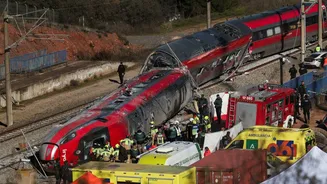

Rail network operator Adif said the crash occurred at 19:45 local time (18:45 GMT), around an hour after one of the trains left Málaga heading north to Madrid. The Madrid-bound train derailed on a straight stretch of track near the city of Córdoba and crossed onto the opposite line, where it collided with an oncoming train.
The incident is the worst rail crash Spain has experienced in more than a decade.
Impact and casualties
Transport Minister Óscar Puente said the force of the collision pushed the carriages of the second train into an embankment. He added that most of those killed and injured were travelling in the front carriages of the southbound train, which was heading from Madrid to Huelva.
Rail authorities said 400 passengers and staff were on board the two trains. Emergency services treated 122 people, while 41, including children, remained in hospital. Of those, 12 are in intensive care. Puente said the death toll “is not yet final”, as efforts continue to identify those who died.
Rescue efforts at the scene
Rescue teams said twisted wreckage made it difficult to reach people trapped inside the carriages. Footage from the scene appeared to show several carriages tipped onto their sides, with emergency workers climbing over the damaged trains to pull survivors through doors and windows.
Prime Minister Pedro Sanchez visited the crash site with senior officials on Monday afternoon.
“This is a day of sorrow for all of Spain, for our entire country,” he told reporters.
“We are going to get to the truth, we are going to find the answer, and when that answer about the origin and cause of this tragedy is known, as it could not be otherwise, with absolute transparency and absolute clarity, we will make it public.”
Puente said the investigation could take at least a month, describing the incident as “extremely strange”.
Early investigation findings
Reuters news agency quoted an unnamed source briefed on initial investigations as saying experts had identified a faulty joint on the rails. The source said the joint caused a gap between rail sections to widen as trains passed over it and was key to identifying the cause of the accident.
Spain’s El Paíi newspaper reported that it was unclear whether the fault caused the crash or resulted from it.
Salvador Jimenez, a journalist with RTVE who was on one of the trains, said the impact felt like an “earthquake”.
“I was in the first carriage. There was a moment when it felt like an earthquake and the train had indeed derailed,” Jimenez said.
A Madrid-bound passenger, José, told public broadcaster Canal Sur: “There were people and screaming, calling for doctors.”
All high-speed services between Madrid and the southern cities of Malaga, Cordoba, Sevilla and Huelva have been suspended until Friday.
King Felipe VI and Queen Letizia said they were following developments “with great concern” and offered their “most heartfelt condolences”.
The emergency agency in Andalusia urged survivors to contact relatives or post on social media to confirm they are alive. The Spanish Red Cross deployed emergency support services to the scene and provided counselling to families.