







What is the story about?
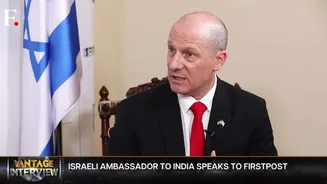
Israel’s Ambassador to India, Reuven Azar, has hailed India’s rising influence in West Asia, saying New Delhi has a significant role to play in promoting stability across the region amid ongoing geopolitical challenges and economic uncertainty.
Azar also expressed distrust towards Pakistan, alleging that anti-Semitic rhetoric from Islamabad remains a major obstacle to improved ties. He said any future involvement of Pakistan in the Abraham Accords would require a fundamental shift in its approach towards Israel.
Speaking on the sidelines of the Greater West Asia Forum India (GWAFI) in New Delhi, Azar discussed a range of regional issues, including Pakistan’s stance on Israel, the Abraham Accords, tensions involving Hezbollah, efforts to pressure Iran, and India’s growing strategic importance in West Asia.
Highlighting India’s economic rise, Azar said the country’s expanding trade links and global economic footprint could help transform the region, provided stability is maintained and extremist threats are contained.
“India has a huge role to play because it is the fastest-growing economy in our region. With the trade agreements it has signed with major blocs, we are likely to witness trillions of dollars in trade and investment flows. West Asia can benefit immensely from this if stability prevails,” he said.
He stressed that regional countries must work together to counter radical elements and maintain peace to unlock the economic opportunities generated by India’s growth.
“We need stability and must neutralise extremist forces. If that is achieved, India, Israel and other countries in the region will be able to share in the prosperity that India’s growth can bring,” Azar added.
His remarks come as Israel increasingly underscores its strategic partnership with India, viewing New Delhi as both an important bilateral partner and a potential stabilising force in the broader West Asian region.
Israeli Prime Minister Benjamin Netanyahu recently highlighted the strength of India-Israel ties, noting that Israel continues to enjoy strong public support in India despite criticism elsewhere.
Addressing a public gathering last week, Netanyahu described India as a major global power and said support for Israel remains strong among Indians. He also remarked on the popularity Israel enjoys in India and pointed to the close relationship that has developed between the two countries.
The Israeli leader further recalled a personal connection to India during Prime Minister Narendra Modi’s visit to Israel earlier this year, sharing that his early meetings with his wife Sara took place at an Indian restaurant in Tel Aviv.
The visit also saw Modi receive the Knesset Speaker’s Medal, Israel’s highest parliamentary honour, reflecting the growing warmth in bilateral ties.
Over the past decade, India and Israel have significantly expanded cooperation across defence, technology, agriculture, trade and innovation. Israel’s latest comments indicate that New Delhi is increasingly being seen not only as a close partner but also as a key player in shaping stability and prosperity across West Asia.
Azar also expressed distrust towards Pakistan, alleging that anti-Semitic rhetoric from Islamabad remains a major obstacle to improved ties. He said any future involvement of Pakistan in the Abraham Accords would require a fundamental shift in its approach towards Israel.
#WATCH | Delhi | On India's role in the West Asia crisis, Israeli Ambassador to India, Reuven Azar, says, "India has a huge role to play because India is the fastest growing economy in our region and because of the agreements we have with all the big trade blocs, we will see… pic.twitter.com/h2SRIoaOC0
— ANI (@ANI) June 1, 2026
Speaking on the sidelines of the Greater West Asia Forum India (GWAFI) in New Delhi, Azar discussed a range of regional issues, including Pakistan’s stance on Israel, the Abraham Accords, tensions involving Hezbollah, efforts to pressure Iran, and India’s growing strategic importance in West Asia.
Highlighting India’s economic rise, Azar said the country’s expanding trade links and global economic footprint could help transform the region, provided stability is maintained and extremist threats are contained.
“India has a huge role to play because it is the fastest-growing economy in our region. With the trade agreements it has signed with major blocs, we are likely to witness trillions of dollars in trade and investment flows. West Asia can benefit immensely from this if stability prevails,” he said.
He stressed that regional countries must work together to counter radical elements and maintain peace to unlock the economic opportunities generated by India’s growth.
“We need stability and must neutralise extremist forces. If that is achieved, India, Israel and other countries in the region will be able to share in the prosperity that India’s growth can bring,” Azar added.
His remarks come as Israel increasingly underscores its strategic partnership with India, viewing New Delhi as both an important bilateral partner and a potential stabilising force in the broader West Asian region.
Israeli Prime Minister Benjamin Netanyahu recently highlighted the strength of India-Israel ties, noting that Israel continues to enjoy strong public support in India despite criticism elsewhere.
Addressing a public gathering last week, Netanyahu described India as a major global power and said support for Israel remains strong among Indians. He also remarked on the popularity Israel enjoys in India and pointed to the close relationship that has developed between the two countries.
The Israeli leader further recalled a personal connection to India during Prime Minister Narendra Modi’s visit to Israel earlier this year, sharing that his early meetings with his wife Sara took place at an Indian restaurant in Tel Aviv.
The visit also saw Modi receive the Knesset Speaker’s Medal, Israel’s highest parliamentary honour, reflecting the growing warmth in bilateral ties.
Over the past decade, India and Israel have significantly expanded cooperation across defence, technology, agriculture, trade and innovation. Israel’s latest comments indicate that New Delhi is increasingly being seen not only as a close partner but also as a key player in shaping stability and prosperity across West Asia.