
The proposal, put forward by a Republican lawmaker, seeks to grant the president legal authority to annex the Arctic territory and potentially make it a US state.
Greenland, an autonomous territory within the Kingdom of Denmark, occupies a strategically vital position in the Arctic. The island has become increasingly important due to its location along emerging shipping routes and its natural resources.
The United States already maintains a military presence there, but Trump has repeatedly argued that Washington needs full control of the territory to prevent China or Russia from gaining influence.
The Greenland Annexation and Statehood Act: What the bill proposes
On January 12, Republican Representative Randy Fine of Florida introduced a two-page piece of legislation titled the Greenland Annexation and Statehood Act.
The bill is designed to provide Trump with the authority to pursue the annexation of Greenland and establish a process that could eventually lead to the island becoming a US state.
The legislation, as seen by Firstpost, states, "The President is authorised to take such steps as may be necessary, including by seeking to enter into negotiations with the Kingdom of Denmark, to annex or otherwise acquire Greenland as a territory of the United States."
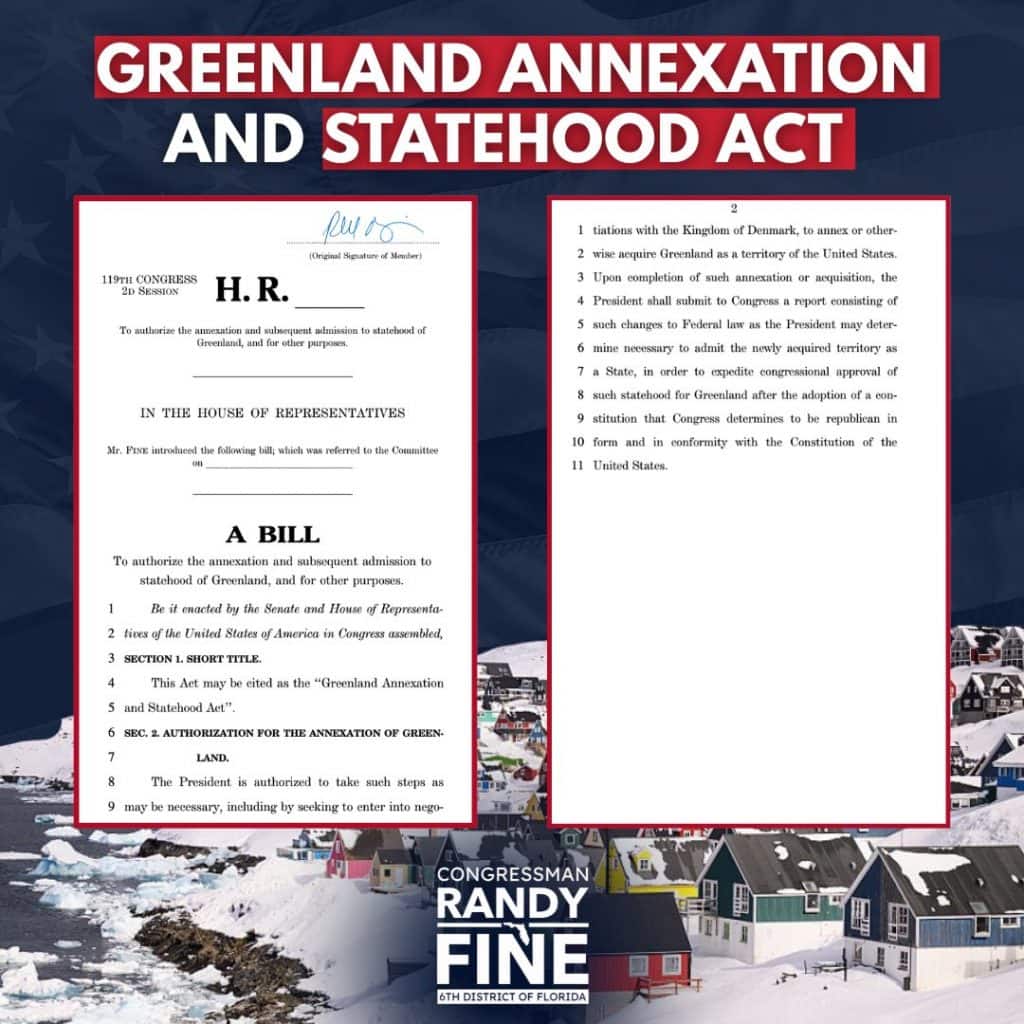
In addition to authorising negotiations or other actions to acquire Greenland, the bill outlines a mechanism that would allow for expedited congressional approval if the territory were to be granted statehood.
Fine announced the bill’s introduction on social media, writing, "Huge News! Today, I am proud to introduce the Greenland Annexation and Statehood Act, a bill that allows the President to find the means necessary to bring Greenland into the Union."
The Florida lawmaker has positioned the proposal as a response to what he describes as growing foreign influence in the Arctic. He has argued that control over Greenland is central to maintaining US national security and dominance in the region.
"Whoever controls Greenland controls key Arctic shipping lanes and the security architecture protecting the United States," Fine said in a statement.
"America cannot leave that future in the hands of regimes that despise our values and seek to undermine our security."
Fine also claimed that Trump and US Secretary of State Marco Rubio have both expressed support for acquiring Greenland. According to Fine, Washington needs to "restore American Dominance by acquiring Greenland."
He added, "My bill turns this vision into reality and would give America the high ground for the next century by making it an official state. China and Russia should be put on notice that the days of impeding on our sovereignty in the Arctic region are over."
Unlike previous Republican proposals that focused on allowing Trump to attempt to purchase Greenland from Denmark, Fine’s legislation goes further by authorising broader actions to secure the territory.
The bill would strengthen the administration’s ability to pursue annexation through negotiation or other unspecified means.
Despite the bill’s introduction, it is widely seen as having little chance of advancing. Even within the Republican Party, many lawmakers oppose the idea of using force or coercive measures to acquire Greenland.
Lawmakers from both major parties have also dismissed suggestions of invading sovereign nations such as Greenland, Mexico, or Colombia. An invasion of Greenland, which remains part of the Kingdom of Denmark, could trigger a response under Nato’s Article 5, which treats an attack on one member as an attack on all.
How Trump has been pushing for Greenland
Trump has repeatedly insisted that the United States must take control of Greenland to protect its strategic interests. He has argued that maintaining a military presence on the island is insufficient to
At one point, Trump stated, "One way or the other we are going to take Greenland,"
while also noting that he would prefer to reach an agreement with Denmark rather than resort to other measures.
The White House has defended Trump’s stance by framing it as a matter of national and allied security. Press Secretary Caroline Leavitt told reporters that the president believes Greenland is crucial to safeguarding both American and European interests.
"He said that he wants to see the United States acquire Greenland, because he feels that if we do not, then it will eventually be acquired, or even perhaps hostilely taken over by either China or Russia," Leavitt said.
"Which is not a good thing for the United States or for Europe or for Greenland as well."
Leavitt also suggested that Greenland itself could benefit from becoming part of the United States. "Let's not forget, it would not just be in the best interest of the United States, but perhaps it would be in the best interest of Greenland as well, to be part of the United States," she said.
When asked whether the administration had set a timeline for pursuing Greenland’s acquisition, Leavitt replied, "He has not set a timeline, but it's definitely a priority."
Greenland’s location has drawn increasing attention as climate change opens new shipping routes and intensifies competition among global powers.
How Denmark and Greenland have reacted to US takeover calls
On Tuesday, Danish Prime Minister Mette Frederiksen and Greenland Prime Minister Jens-Frederik Nielsen appeared together in Copenhagen to present a united stance against Trump’s calls for the United States to take control of the Arctic territory.
Their joint appearance came ahead of high-level meetings in Washington involving Denmark’s and Greenland’s foreign ministers, Lars Løkke Rasmussen and Vivian Motzfeldt, who were scheduled to meet US Vice President JD Vance and US Secretary of State Marco Rubio.
At the press conference, Frederiksen addressed Greenlanders directly, saying, “Dear Greenlanders, you should know that we stand together today, we will do so tomorrow, and we will continue to do so."
Nielsen reinforced Greenland’s position by stressing loyalty to Denmark, Nato, and the European Union. “If we have to choose between the United States and Denmark here and now, we choose Denmark. We choose Nato. We choose the Kingdom of Denmark. We choose the EU."
Both leaders pointed out that Greenland remains part of Denmark and therefore falls under Nato’s collective defence framework.
They warned that any attempt by the US to seize or forcibly separate Greenland from Denmark would severely damage the transatlantic alliance that has underpinned Western security since World War II.
Trump dismissed their concerns, telling reporters in Washington that “That's their problem.”
When asked about Nielsen’s remarks, Trump responded, “I disagree with him. I don’t know who he is. I don’t know anything about him. But, that’s going to be a big problem for him.”
Despite the growing tensions, Danish officials have made it clear that they are open to expanding military cooperation with the United States in Greenland. However, they have consistently stated that the territory is not for sale and will not be handed over to another country.
How Denmark is cooperating with US military presence in Greenland
The United States has maintained a military presence in Greenland since World War II, although the scale of that presence has declined significantly over the decades.
In 1945, thousands of American soldiers were stationed across more than 17 bases and installations on the island.
Today, the US presence is limited to the Pituffik Space Base in northwest Greenland, where around 200 personnel support missile warning, missile defence, and space surveillance operations for the United States and Nato.
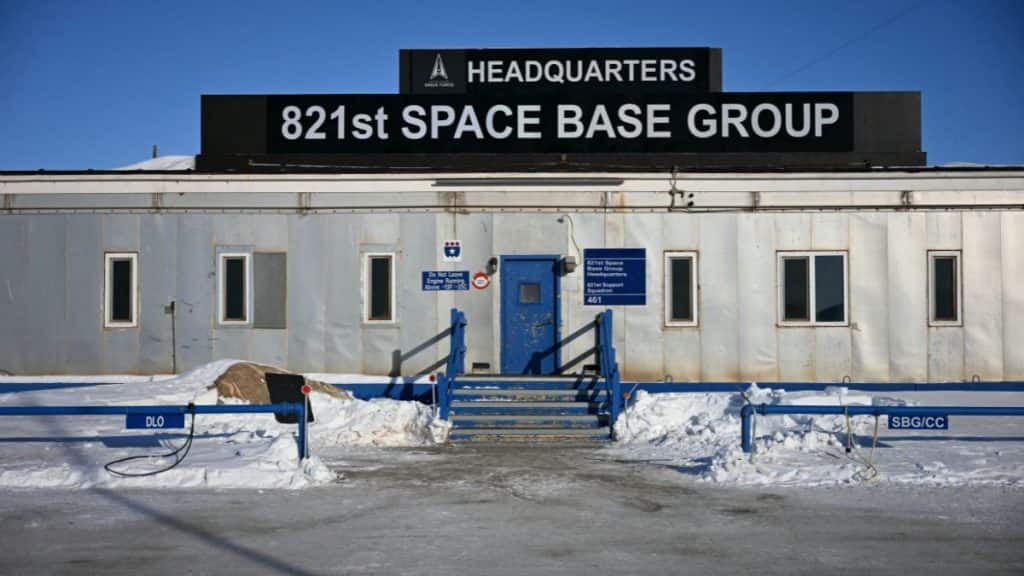
A view shows the US military's Pituffik Space Base in Greenland on March 28, 2025. File Image/Pool via Reuters
Denmark’s parliament approved legislation last June that allows US military bases to operate on Danish soil. This expanded a 2023 agreement with the Biden administration that had already granted American troops broad access to Danish air bases.
Danish officials have also highlighted their continued cooperation with Washington on security matters. A Danish government official, who spoke to AP, confirmed that Denmark recently assisted US forces in the eastern Atlantic as they intercepted an oil tanker suspected of violating American sanctions.
The interception followed a weeks-long pursuit that began in the Caribbean Sea. It was part of a US naval blockade targeting Venezuelan waters in an effort to capture sanctioned vessels travelling to and from the South American country.
How the people of Greenland are faring
While Danish officials have highlighted their alliance with the United States, Greenland’s leaders have voiced deep concern about the impact of Trump’s statements on the island’s population.
Naaja Nathanielsen, Greenland’s minister for business and mineral resources, described the situation as alarming and said it was difficult for residents to understand why the United States was discussing taking over a Nato ally.
She said Greenlanders were increasingly anxious about the prospect of US control. “People are not sleeping, children are afraid, and it just fills everything these days. And we can’t really understand it,” Nathanielsen said during a meeting with lawmakers in Britain’s Parliament.
She urged the Trump administration to listen to the voices of Greenland’s people and urged that the territory should not be treated as a bargaining chip in global politics.
Nathanielsen acknowledged that Greenlanders understand the need for increased security monitoring in the Arctic due to rising geopolitical tensions. However, she said it was difficult to accept the idea that their homeland could be sold or annexed.
“My deepest dream or hope is that the people of Greenland will get a say no matter what," she said. "For others this might be a piece of land, but for us it’s home.”
How US Congress reacted to Greenland takeover bids
Trump’s repeated threats to take over Greenland have triggered bipartisan concern in Washington. Lawmakers from both parties have expressed support for Denmark’s sovereignty and warned that the president’s rhetoric could weaken the Nato alliance.
A group of US lawmakers is travelling to Denmark this week to demonstrate unity with the country.
The delegation is being led by Democratic Senator Chris Coons and includes Republican Senator Thom Tillis, as well as Democratic Senators Jeanne Shaheen and Dick Durbin. Members of the US House of Representatives are also part of the trip.
The delegation is scheduled to visit Copenhagen on Friday and Saturday.Tillis said, "As co-chair of the Senate Nato Observer Group, I believe it is critical that Congress stands united in supporting our allies and respecting the sovereignty of Denmark and Greenland."
Durbin criticised Trump’s approach, stating, "Trump's continued threats toward Greenland are unnecessary and would only weaken our Nato alliance."
Lawmakers from both parties have said they expect the US Senate to eventually vote on legislation aimed at limiting Trump’s ability to attempt to seize Greenland from Denmark.
Democratic Representative Jimmy Gomez is planning to introduce a competing bill known as the Greenland Sovereignty Protection Act. The proposed legislation would block federal funding from being used to support any attempt by Trump to take over Greenland.
Concerns have been heightened by Trump’s recent actions abroad. Earlier this month, he ordered a US military raid in Venezuela to capture the country’s now-ousted leader, Nicolas Maduro. Maduro was subsequently brought to New York, where he remains in custody.
How Nato has reacted
Nato Secretary-General Mark Rutte has avoided commenting directly on the Greenland dispute. Speaking at the European Parliament in Brussels, Rutte said it was not his role to intervene in internal alliance disagreements.
“I never, ever comment when there are discussions within the alliance,” Rutte said. “My role has to be to make sure we solve issues.”
He stated that Nato’s priority should be maintaining security in the Arctic region, which includes Greenland.
“When it comes to the protection of the High North, that is my role.”
With inputs from agencies