



What is the story about?
As Artemis II inches closer to a historic milestone, NASA has shared new photos captured by the Artemis II astronauts showcasing the moon and the interior of the Orion spacecraft. The awe-inspiring photographs offer a glimpse into the lives of space.
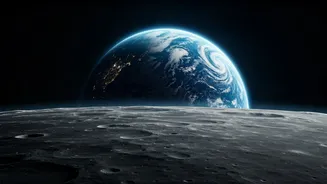
One of the most striking images highlights the moon and even captures a portion of the Orientale basin, marking a first for human eyes, according to NASA. It is pertinent to note that only robotic imagers have witnessed this lunar region.

The shadowed crater, which is 600 miles (965 kilometres) wide, represents a key transition region between the near and far sides of the moon. NASA astronaut Christina Koch said that the crew's first view of the lunar far side had been "absolutely spectacular since the side which permanently faces away from Earth has rarely been seen.
“Something about your senses, ‘That is not the moon that I’m used to seeing,’” Koch said. Meanwhile, images taken from inside the Orion capsule have shifted from solely highlighting the glowing spectacle of Earth as seen from a cosmic perspective to refocusing on the moon as the mission draws close to its completion.

As of now, the crew is more than halfway to the moon, and the highly anticipated lunar flyby is scheduled for Monday. The astronauts said that the moon continues to appear larger through Orion’s windows as their journey continues.
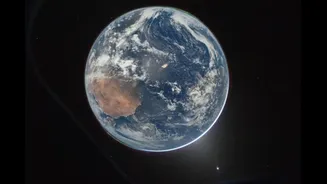
The Artemis II images of Earth have also been equally stunning, showcasing the planet in a way it has never been seen before with human eyes. It is monumental since the last time astronauts left Earth orbit was during the Apollo era.
The crew has also appeared live on camera throughout NASA’s continuing broadcast of the mission, allowing candid glimpses of their life in space. The majority of the Orion's lights have been turned off to avoid glare on the windows, allowing Canadian Space Agency astronaut Jeremy Hansen to look outside and enjoy the view. And much like during the Artemis I mission in 2022, Artemis II’s journey will include multiple selfie opportunities.
One of the most striking images highlights the moon and even captures a portion of the Orientale basin, marking a first for human eyes, according to NASA. It is pertinent to note that only robotic imagers have witnessed this lunar region.
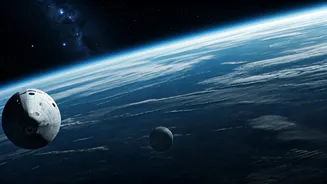
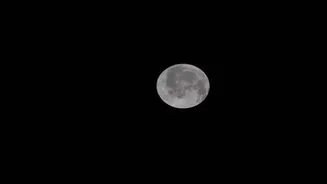
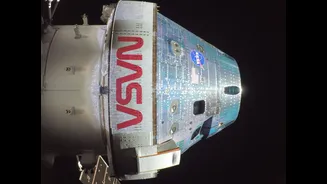
A camera on Orion's solar array wings shows the moon in the distance on the mission's second day. NASA
The shadowed crater, which is 600 miles (965 kilometres) wide, represents a key transition region between the near and far sides of the moon. NASA astronaut Christina Koch said that the crew's first view of the lunar far side had been "absolutely spectacular since the side which permanently faces away from Earth has rarely been seen.
“Something about your senses, ‘That is not the moon that I’m used to seeing,’” Koch said. Meanwhile, images taken from inside the Orion capsule have shifted from solely highlighting the glowing spectacle of Earth as seen from a cosmic perspective to refocusing on the moon as the mission draws close to its completion.
Koch reads on a tablet while Canadian Space Agency astronaut Jeremy Hansen peers out of one of Orion’s windows. NASA
More than halfway to the moon
As of now, the crew is more than halfway to the moon, and the highly anticipated lunar flyby is scheduled for Monday. The astronauts said that the moon continues to appear larger through Orion’s windows as their journey continues.
The Artemis II images of Earth have also been equally stunning, showcasing the planet in a way it has never been seen before with human eyes. It is monumental since the last time astronauts left Earth orbit was during the Apollo era.
This view just hits different 🌍
@Astro_Christina and @astro_reid take a moment to look back at Earth as they continue deep into space toward the Moon. pic.twitter.com/NMDeLj256K
— NASA (@NASA) April 4, 2026
The crew has also appeared live on camera throughout NASA’s continuing broadcast of the mission, allowing candid glimpses of their life in space. The majority of the Orion's lights have been turned off to avoid glare on the windows, allowing Canadian Space Agency astronaut Jeremy Hansen to look outside and enjoy the view. And much like during the Artemis I mission in 2022, Artemis II’s journey will include multiple selfie opportunities.