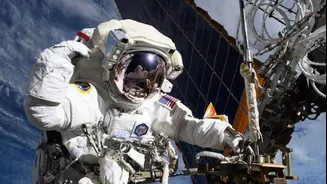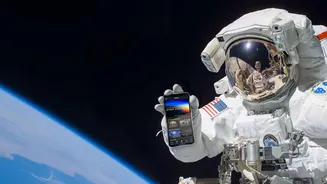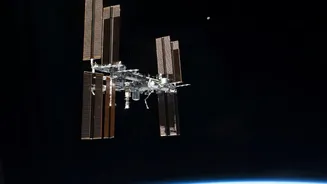

National Aeronautics and Space Administration (Nasa) has cancelled its first planned spacewalk of the year and is weighing an early return of astronauts from the International Space Station (ISS) after a medical issue involving one crew member raised concerns about mission safety.
While the space agency has said the astronaut is now stable, the incident has put the spotlight back on the health risks of long-duration space missions and the tight safety margins under which the ISS operates. The postponed spacewalk, scheduled for Thursday, was meant to support routine maintenance and scientific objectives aboard the orbiting laboratory. Instead, Nasa opted for caution, underscoring once again that human spaceflight remains as much about risk management as exploration.
Spacewalk halted as precaution
Nasa said the spacewalk was postponed due to an unspecified medical concern with one astronaut. The agency did not identify the crew member or disclose the nature of the medical issue, citing privacy considerations. What it did make clear was that the decision was precautionary, taken to ensure that the crew’s overall health and operational readiness were not compromised.
“The crew member is stable,” Nasa said, adding that it is “actively evaluating all options,” including the possibility of ending the mission earlier than planned. Nasa spokesperson Cheryl Warner reiterated the agency’s core principle, stating: “Safely conducting our missions is our highest priority.”
Such postponements are rare but not unprecedented. Spacewalks, or extravehicular activities (EVAs), are among the most physically demanding tasks astronauts perform. They require intense preparation, place strain on the cardiovascular system and involve inherent risks due to exposure to the vacuum of space. Even a minor health concern can be reason enough to delay or cancel an EVA, particularly when the mission does not involve an urgent repair.
Implications for the ISS mission
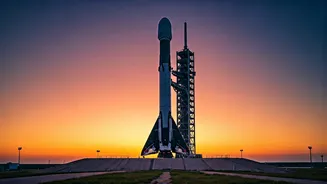
The crew affected by the decision is a four-member team representing the United States, Japan and Russia, highlighting the ISS’s continued role as one of the few remaining platforms for international cooperation in space. They have been aboard the station since August following a launch from Florida.
An early return would not necessarily indicate a mission failure, but it would have ripple effects. Scientific experiments could be curtailed, maintenance schedules adjusted, and future crew rotations reshuffled. NASA and its partners typically plan ISS missions months, if not years, in advance, with limited flexibility built into timelines.
Medical issues in space present unique challenges. Microgravity affects muscle mass, bone density, fluid distribution and even immune function. Diagnosing and managing health problems is more complex when astronauts are hundreds of kilometres above Earth, with limited medical equipment and no possibility of immediate evacuation in the way that would be routine for remote terrestrial missions.
If NASA does opt to bring the crew back early, it will reflect a conservative risk assessment rather than a crisis response. Return vehicles linked to the ISS are designed to enable safe departure if circumstances demand it and mission planners regularly simulate such scenarios.
A reminder of human limits in space
The episode comes at a time when space agencies worldwide are planning longer and more ambitious missions, including sustained lunar operations and eventual crewed missions to Mars. Each medical incident on the ISS even if resolved without serious consequences, feeds into a growing body of data on the human body’s limits beyond Earth.
For NASA, transparency is also a balancing act. While the agency has acknowledged the issue and its potential consequences, it has stopped short of providing details that could allow speculation or misinterpretation. This reflects both ethical considerations around astronaut privacy and operational prudence.
In the short term, NASA’s focus remains on monitoring the crew member’s condition and ensuring the safety of the entire team. Whether the spacewalk is rescheduled or the mission is cut short will depend on medical assessments in the coming days. In the larger picture, the decision serves as a reminder that even routine operations in space carry inherent risks and that caution not spectacle, continues to guide human activity aboard the International Space Station.
With inputs from agencies