








What is the story about?
For years, the global conversation around artificial intelligence has revolved around bigger models, faster chips and billion-dollar investments. But in India, a different AI story is quietly unfolding, one that has less to do with Silicon Valley-style spectacle and more to do with solving deeply local problems.
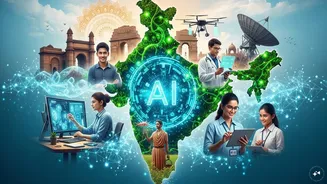
On National Technology Day 2026, industry leaders say India’s true AI success will not be measured by how many large language models it builds, but by whether the technology can meaningfully improve healthcare, education, governance and financial access for millions who remain digitally underserved.
“The AI conversation in India keeps happening among people who already have everything the technology promises to deliver,” says Ankush Sabharwal, CEO and founder of CoRover.ai. “Meanwhile, the real story is unfolding elsewhere: a health worker in Odisha documenting patient visits without knowing how to type, or a citizen navigating a government portal in their mother tongue.”
For companies building AI in India, the challenge is fundamentally different from that of Western markets. India’s digital ecosystem is multilingual, infrastructure gaps remain uneven, and millions of first-time internet users interact with technology through voice rather than text.
Sabharwal argues that AI products designed primarily around English-speaking urban users risk missing the country’s actual needs. According to him, many so-called multilingual systems still rely on translation layers built on top of English-centric models, often failing to understand dialects, accents and code-switching patterns common across India.
“In healthcare, that is not merely a product gap. It becomes a patient safety risk,” he says.
CoRover’s BharatGPT platform reflects this philosophy. The company says its systems currently handle millions of multilingual citizen queries across public platforms including IRCTC and government portals. Beyond conversational AI, the company has also deployed public health-focused systems at scale.
Its platform “Khushi – Aapki E-Sangini”, developed with JSI for the Ministry of Health, supports India’s TB Elimination Programme through NiKshay by helping frontline health workers monitor patients and bridge care gaps. Other deployments include Hello VAXI for immunisation support, AskDoc for verified Covid-19 information, and SnehaAI, which provides health and safety guidance for adolescent girls.
“These are not pilots or experimental showcases,” Sabharwal says. “They are deployed systems operating inside real government programmes.”
Experts say India’s AI ambitions must move beyond vanity metrics such as leaderboard rankings or model size.
Dr Kanishk Agarwal, Chief Technology Officer at Judge Group India, believes the country’s AI success should instead be judged through measurable public impact.
“AI’s real success in Bharat must be assessed based on how its products improve everyday life,” he says.
“That includes healthcare access, education, financial inclusion, agriculture support and citizen services in local languages.”
According to Agarwal, AI is already beginning to reshape governance and public service delivery by reducing inefficiencies, automating processes and helping smaller businesses access digital capabilities previously available only to larger firms.
At the same time, he warns that unchecked deployment carries serious risks. Concerns around misinformation, algorithmic bias, privacy, job displacement and overreliance on opaque “black-box” systems continue to grow globally.
“The future of AI in India will depend not just on innovation, but on building responsible, inclusive and trustworthy ecosystems,” he says.
That may ultimately become India’s defining AI advantage. While global technology giants compete for computational supremacy, India is attempting something far more difficult: building AI that works across linguistic diversity, patchy infrastructure and large-scale public systems.
If it succeeds, experts say, India may not just solve its own challenges. It could offer the world a blueprint for population-scale AI designed for inclusion rather than privilege.
On National Technology Day 2026, industry leaders say India’s true AI success will not be measured by how many large language models it builds, but by whether the technology can meaningfully improve healthcare, education, governance and financial access for millions who remain digitally underserved.
“The AI conversation in India keeps happening among people who already have everything the technology promises to deliver,” says Ankush Sabharwal, CEO and founder of CoRover.ai. “Meanwhile, the real story is unfolding elsewhere: a health worker in Odisha documenting patient visits without knowing how to type, or a citizen navigating a government portal in their mother tongue.”
AI built for Bharat, not boardrooms
For companies building AI in India, the challenge is fundamentally different from that of Western markets. India’s digital ecosystem is multilingual, infrastructure gaps remain uneven, and millions of first-time internet users interact with technology through voice rather than text.
Sabharwal argues that AI products designed primarily around English-speaking urban users risk missing the country’s actual needs. According to him, many so-called multilingual systems still rely on translation layers built on top of English-centric models, often failing to understand dialects, accents and code-switching patterns common across India.
“In healthcare, that is not merely a product gap. It becomes a patient safety risk,” he says.
CoRover’s BharatGPT platform reflects this philosophy. The company says its systems currently handle millions of multilingual citizen queries across public platforms including IRCTC and government portals. Beyond conversational AI, the company has also deployed public health-focused systems at scale.
Its platform “Khushi – Aapki E-Sangini”, developed with JSI for the Ministry of Health, supports India’s TB Elimination Programme through NiKshay by helping frontline health workers monitor patients and bridge care gaps. Other deployments include Hello VAXI for immunisation support, AskDoc for verified Covid-19 information, and SnehaAI, which provides health and safety guidance for adolescent girls.
“These are not pilots or experimental showcases,” Sabharwal says. “They are deployed systems operating inside real government programmes.”
The real benchmark for Indian AI
Experts say India’s AI ambitions must move beyond vanity metrics such as leaderboard rankings or model size.
Dr Kanishk Agarwal, Chief Technology Officer at Judge Group India, believes the country’s AI success should instead be judged through measurable public impact.
“AI’s real success in Bharat must be assessed based on how its products improve everyday life,” he says.
“That includes healthcare access, education, financial inclusion, agriculture support and citizen services in local languages.”
According to Agarwal, AI is already beginning to reshape governance and public service delivery by reducing inefficiencies, automating processes and helping smaller businesses access digital capabilities previously available only to larger firms.
At the same time, he warns that unchecked deployment carries serious risks. Concerns around misinformation, algorithmic bias, privacy, job displacement and overreliance on opaque “black-box” systems continue to grow globally.
“The future of AI in India will depend not just on innovation, but on building responsible, inclusive and trustworthy ecosystems,” he says.
That may ultimately become India’s defining AI advantage. While global technology giants compete for computational supremacy, India is attempting something far more difficult: building AI that works across linguistic diversity, patchy infrastructure and large-scale public systems.
If it succeeds, experts say, India may not just solve its own challenges. It could offer the world a blueprint for population-scale AI designed for inclusion rather than privilege.