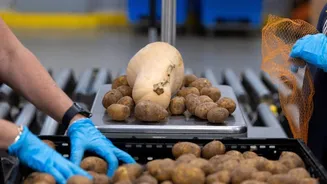

The free distribution took place at several locations across the German capital, including the historic Tempelhofer Feld, a former airfield turned public park. By midday at many sites, thousands of potatoes had vanished, snapped up by residents eager to take advantage of the unexpected bounty. But the event was not about generosity alone. It was a rescue mission for a crop trapped by market failure.
Germany's surplus potato harvest
Germany’s potato harvest in 2025 reached 13.4 million tonnes, according to the Federal Ministry of Food and Agriculture, the highest in 25 years and more than two million tonnes above the national average. Favourable weather conditions combined with expanded planting across Germany and neighbouring European countries created what industry watchers have dubbed a "potato flood."
The surge in supply far outpaced demand and processing capacity. As prices collapsed, farmers were left with limited options. Despite being safe to eat, large quantities of potatoes have been diverted to animal feed, biogas plants or destroyed altogether. One farmer, quoted in German media, said incinerating hundreds of tonnes of food was heartbreaking.
Farmers insisted to support local producers
The Berlin giveaway was organised by Ecosia, the eco-friendly search engine, in partnership with local newspaper Berliner Morgenpost. Ecosia financed the transport of 4,000 tonnes of surplus potatoes from a farm near Leipzig, while the newspaper helped coordinate distribution across the city. More than 1,300 organisations applied to become collection points, with 174 ultimately selected, ranging from food banks and schools to churches, businesses and cultural spaces.
While many praised the initiative for reducing food waste, it also sparked backlash from farmers’ groups. Agricultural associations warned that handing out potatoes for free risked further depressing already fragile prices and undermining growers struggling to stay afloat. The regional farmers’ body described the effort as harmful to the market, urging consumers to support local producers instead.
Tension within Europe's food system
The episode highlights a deeper tension within Europe’s food system. Gluts are not new — Germany has recently faced oversupply in hops and warnings of excess milk production — but the potato crisis underscores how abundance can coexist with waste and financial distress. Farmers face boom-and-bust cycles driven by global competition, speculative planting and shifting consumer demand, while consumers are confronted with rising food prices in other categories.
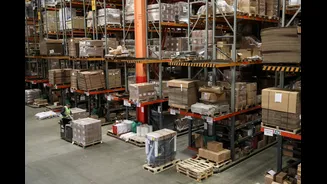
As the crowds in Berlin dispersed and the last sacks of potatoes were emptied, millions more remained in warehouses across the country. The free potatoes offered a temporary solution and a striking visual, but they also exposed a persistent problem: Europe can grow enough food, yet still struggles to distribute it sustainably without harming those who produce it.