



What is the story about?
As the race among AI chatbot providers intensifies, the focus is rapidly shifting from innovation to retention and now, portability. Following similar moves by rivals, Google has introduced a set of “switching tools” for its AI assistant, Google Gemini, aimed at making it significantly easier for users to migrate from competing platforms without losing their digital history.
The timing is notable. Just as Anthropic has begun emphasising continuity through its own memory features in Claude, Google’s latest update signals an escalation in what is quickly becoming a battle over user lock-in. This also comes at a time when significant ChatGPT users are moving to other chatbots, amid safety concerns.
Hence, the approach is clear. The easier it is to switch, the harder it becomes to keep users tied to a single ecosystem.
At the heart of Gemini’s update is a simple but effective idea, reduce the friction of starting over. Traditionally, users who moved from one chatbot to another had to rebuild context manually, reintroducing preferences, personal details, and ongoing projects.
Google’s approach avoids that entirely. Gemini actively guides users through the migration process by suggesting prompts that can be entered into their current chatbot, such as ChatGPT or others. These prompts generate structured responses containing key personal information, ranging from interests and routines to relationships and background details.
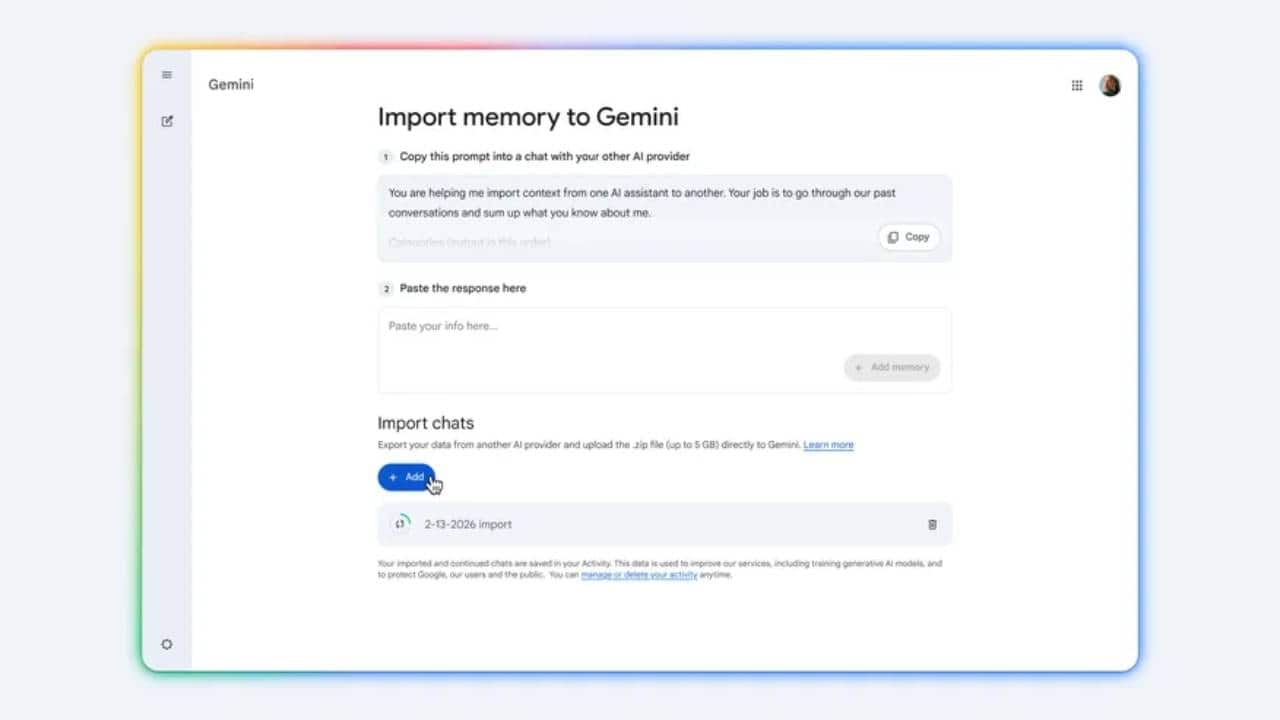
Users can then copy and paste this output directly into Gemini, allowing it to quickly reconstruct a personalised profile. The process is deliberately user-driven, sidestepping the need for formal integrations between rival platforms while still achieving a similar outcome.
In addition, Gemini supports the import of entire chat histories. Users can export conversations from other platforms, typically as compressed files, and upload them into Gemini. Once imported, these chats become searchable, enabling users to revisit past discussions and continue workflows without interruption.
This dual approach, combining memory transfer with chat history import, effectively turns migration into a guided, low-effort process. Instead of losing accumulated knowledge, users carry it forward, making Gemini feel familiar from the outset.
More importantly, if you are planning to switch, you must do check these boxes before leaving. Here is a list of tasks you must do before quitting.
While Google focuses on simplifying migration, Anthropic is tackling the same problem from a slightly different angle. Its Memory feature in Claude is designed to retain and apply user context across interactions, particularly for those switching from other AI platforms.
Claude allows users to import summaries of their previous chatbot usage, including tone preferences, recurring tasks, and ongoing projects. These summaries can be generated from assistants like ChatGPT, Gemini, or Microsoft’s Copilot, and then stored within Claude’s memory system. Once integrated, the assistant uses this information to personalise future responses.
There is also a strategic distinction. Google’s method emphasises accessibility and scale, making it easy for any user to transition quickly. Anthropic’s approach appears more curated, targeting users who want refined, high-quality context rather than a complete data transfer.
Together, these developments point to a broader industry shift. AI companies are no longer just competing on intelligence or features, but on how seamlessly users can move between platforms. In this evolving landscape, reducing switching costs may prove to be the most powerful tool for winning user attention.
By making migration nearly frictionless, Google is not just improving Gemini, it is challenging the very idea of chatbot loyalty.
The timing is notable. Just as Anthropic has begun emphasising continuity through its own memory features in Claude, Google’s latest update signals an escalation in what is quickly becoming a battle over user lock-in. This also comes at a time when significant ChatGPT users are moving to other chatbots, amid safety concerns.
Hence, the approach is clear. The easier it is to switch, the harder it becomes to keep users tied to a single ecosystem.
Google’s easy switch tools: How to use
At the heart of Gemini’s update is a simple but effective idea, reduce the friction of starting over. Traditionally, users who moved from one chatbot to another had to rebuild context manually, reintroducing preferences, personal details, and ongoing projects.
Google’s approach avoids that entirely. Gemini actively guides users through the migration process by suggesting prompts that can be entered into their current chatbot, such as ChatGPT or others. These prompts generate structured responses containing key personal information, ranging from interests and routines to relationships and background details.
Google Gemini switching tools
Users can then copy and paste this output directly into Gemini, allowing it to quickly reconstruct a personalised profile. The process is deliberately user-driven, sidestepping the need for formal integrations between rival platforms while still achieving a similar outcome.
In addition, Gemini supports the import of entire chat histories. Users can export conversations from other platforms, typically as compressed files, and upload them into Gemini. Once imported, these chats become searchable, enabling users to revisit past discussions and continue workflows without interruption.
This dual approach, combining memory transfer with chat history import, effectively turns migration into a guided, low-effort process. Instead of losing accumulated knowledge, users carry it forward, making Gemini feel familiar from the outset.
More importantly, if you are planning to switch, you must do check these boxes before leaving. Here is a list of tasks you must do before quitting.
Google’s Switching tool vs Anthropic’s Memory tool
While Google focuses on simplifying migration, Anthropic is tackling the same problem from a slightly different angle. Its Memory feature in Claude is designed to retain and apply user context across interactions, particularly for those switching from other AI platforms.
Claude allows users to import summaries of their previous chatbot usage, including tone preferences, recurring tasks, and ongoing projects. These summaries can be generated from assistants like ChatGPT, Gemini, or Microsoft’s Copilot, and then stored within Claude’s memory system. Once integrated, the assistant uses this information to personalise future responses.
There is also a strategic distinction. Google’s method emphasises accessibility and scale, making it easy for any user to transition quickly. Anthropic’s approach appears more curated, targeting users who want refined, high-quality context rather than a complete data transfer.
Together, these developments point to a broader industry shift. AI companies are no longer just competing on intelligence or features, but on how seamlessly users can move between platforms. In this evolving landscape, reducing switching costs may prove to be the most powerful tool for winning user attention.
By making migration nearly frictionless, Google is not just improving Gemini, it is challenging the very idea of chatbot loyalty.