






What is the story about?
The Trump administration continues to take shots at India as the two countries negotiate a trade deal.
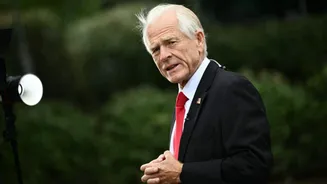
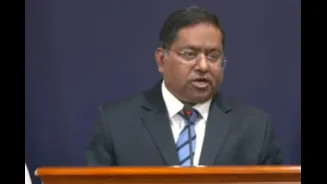
This time, White House trade adviser Peter Navarro has claimed that Americans are paying for artificial intelligence (AI) in India and China. The development comes at a time when India is set to host the Global AI Summit in New Delhi.
But what did Navarro say? And is it really true?
Let’s take a closer look.
Navarro on Saturday slammed India and China, claiming that the US was subsidising Artificial Intelligence for them.
Navarro, in an interview on Real America’s Voice, said, “…It’s like, why are Americans paying for AI in India? ChatGPT is operating on US soil, using American electricity, servicing large users of ChatGPT, for example, in India and China and elsewhere around the world. So, that’s another issue that’s got to be dealt with.”
Navarro made the remarks in an interview with former White House Chief Strategist Steve Bannon. This isn’t the first time he has attacked India. The White House trade adviser previously claimed Indians were arrogant and accused New Delhi of “cosying up to both China and Russia”.
He also said India’s dependence on Russian oil was “opportunistic”, adding that if New Delhi “wants to be treated as a strategic partner of the US, it needs to start acting like one”.
“In effect, India acts as a global clearinghouse for Russian oil, converting embargoed crude into high-value exports while giving Moscow the dollars it needs,” Navarro wrote. Navarro also slammed India as the ‘Maharaja in tariffs’, claimed that ‘Brahmins were profiteering’ at the expense of the ordinary Indian citizen. Navarro also called the BRICS grouping, which India belongs to, “vampires”.
Unsurprisingly, no.
It isn’t the American government that is paying for people in India and China to use AI. Rather, it is private American firms such as OpenAI, Google, Microsoft and Perplexity that are doing so. They are doing this voluntarily and with the eye on the bigger picture.
All the AI firms are locked in a strategic arms race towards Artificial General Intelligence. Their primary requirement is exponential user growth – expanding the user base. Growing their customer base in India, which has over one billion internet users and one of the world’s fastest-growing smartphone markets, is a commercial no-brainer and certainly not an act of charity.
Companies like OpenAI are spending billions of dollars every year on ChatGPT. OpenAI generated approximately $12–13 billion in annualised revenue in 2025 (Rs. 1.09–1.18 lakh crore). Yet, the company recorded over $7 billion in operating losses in the first half of 2025 alone (Rs. 0.64 lakh crore), largely due to data centre, GPU and electricity costs.
Company filings and industry estimates show that AI firms have already lost tens of billions of dollars over the past few years and are projected to lose hundreds of billions of dollars cumulatively by 2030, as they build infrastructure at scale.
While these AI firms are offering a subscription-based model, only a small minority of ChatGPT users pay for premium offerings — estimates suggest less than 5 per cent of total users are on paid plans. Which means that they simply aren’t generating enough revenue to offset the amount they’re spending on talent, data centres and computation power.
OpenAI has already announced that ChatGPT will begin introducing advertising into its products as a way of trying to tamp down their expenses.
In fact, it is US tech firms, whose valuations have soared as speculation and hype around AI increases, American investors, pension funds and retirement portfolios that are invested in big tech and the US stock market — where a handful of AI-linked firms have driven the majority of market gains over the past two years — that have reaped the rewards. Also, all these LLMs were trained on global data, including copyrighted material from around the world, a fact Navarro chooses to overlook.
India also forms an invaluable part of America’s AI journey. xAI CEO Elon Musk recently praised Indian AI engineers as part of his team, calling them “epicly hardcore”. Of five names on a patent described as a “mathematical cheat code” that helps low-cost 8-bit chips run advanced 32-bit AI models, four are Indian-origin engineers.
Many of the tech teams in Silicon Valley and at firms such as OpenAI, Google DeepMind, Microsoft, Meta and Nvidia comprise Indians or those of Indian origin. A 2024 report by Joint Venture Silicon Valley shows that 23 per cent of foreign-born tech professionals in the region have Indian nationality. Almost a third of all tech workers are of Indian origin.

India is now the fastest-growing developer community on GitHub. Projections show India could surpass the US in total software developers by 2030. It also ranks among the top countries globally for AI skill penetration.
Not only that, Google, Microsoft, Amazon and Nvidia have all announced major AI infrastructure and research investments in India. These include data centres, AI research hubs, startup accelerators and cloud partnerships.
Google has committed $15 billion (Rs. 1.36 lakh crore) to AI and data-centre infrastructure in India. Microsoft has vowed to invest $17.5 billion (Rs. 1.59 lakh crore) in cloud and AI. Amazon has announced $35 billion (Rs. 3.18 lakh crore) in long-term digital and AI infrastructure spending in India. In total, over $60 billion (Rs. 5.45 lakh crore) in US tech investment is currently flowing into India’s AI and data ecosystem.
American firms are not known for their charity. They are making these moves in India because they want early access to one of the world’s largest potential AI markets.
With inputs from agencies
This time, White House trade adviser Peter Navarro has claimed that Americans are paying for artificial intelligence (AI) in India and China. The development comes at a time when India is set to host the Global AI Summit in New Delhi.
But what did Navarro say? And is it really true?
Let’s take a closer look.
What Navarro said
Navarro on Saturday slammed India and China, claiming that the US was subsidising Artificial Intelligence for them.
Navarro, in an interview on Real America’s Voice, said, “…It’s like, why are Americans paying for AI in India? ChatGPT is operating on US soil, using American electricity, servicing large users of ChatGPT, for example, in India and China and elsewhere around the world. So, that’s another issue that’s got to be dealt with.”
Navarro made the remarks in an interview with former White House Chief Strategist Steve Bannon. This isn’t the first time he has attacked India. The White House trade adviser previously claimed Indians were arrogant and accused New Delhi of “cosying up to both China and Russia”.
He also said India’s dependence on Russian oil was “opportunistic”, adding that if New Delhi “wants to be treated as a strategic partner of the US, it needs to start acting like one”.
“In effect, India acts as a global clearinghouse for Russian oil, converting embargoed crude into high-value exports while giving Moscow the dollars it needs,” Navarro wrote. Navarro also slammed India as the ‘Maharaja in tariffs’, claimed that ‘Brahmins were profiteering’ at the expense of the ordinary Indian citizen. Navarro also called the BRICS grouping, which India belongs to, “vampires”.
Are Navarro’s AI claims true?
Unsurprisingly, no.
It isn’t the American government that is paying for people in India and China to use AI. Rather, it is private American firms such as OpenAI, Google, Microsoft and Perplexity that are doing so. They are doing this voluntarily and with the eye on the bigger picture.
All the AI firms are locked in a strategic arms race towards Artificial General Intelligence. Their primary requirement is exponential user growth – expanding the user base. Growing their customer base in India, which has over one billion internet users and one of the world’s fastest-growing smartphone markets, is a commercial no-brainer and certainly not an act of charity.
Companies like OpenAI are spending billions of dollars every year on ChatGPT. OpenAI generated approximately $12–13 billion in annualised revenue in 2025 (Rs. 1.09–1.18 lakh crore). Yet, the company recorded over $7 billion in operating losses in the first half of 2025 alone (Rs. 0.64 lakh crore), largely due to data centre, GPU and electricity costs.
OpenAI logo is seen in this illustration taken February 8, 2025. Reuters
Company filings and industry estimates show that AI firms have already lost tens of billions of dollars over the past few years and are projected to lose hundreds of billions of dollars cumulatively by 2030, as they build infrastructure at scale.
While these AI firms are offering a subscription-based model, only a small minority of ChatGPT users pay for premium offerings — estimates suggest less than 5 per cent of total users are on paid plans. Which means that they simply aren’t generating enough revenue to offset the amount they’re spending on talent, data centres and computation power.
OpenAI has already announced that ChatGPT will begin introducing advertising into its products as a way of trying to tamp down their expenses.
Who is actually profiting?
In fact, it is US tech firms, whose valuations have soared as speculation and hype around AI increases, American investors, pension funds and retirement portfolios that are invested in big tech and the US stock market — where a handful of AI-linked firms have driven the majority of market gains over the past two years — that have reaped the rewards. Also, all these LLMs were trained on global data, including copyrighted material from around the world, a fact Navarro chooses to overlook.
India also forms an invaluable part of America’s AI journey. xAI CEO Elon Musk recently praised Indian AI engineers as part of his team, calling them “epicly hardcore”. Of five names on a patent described as a “mathematical cheat code” that helps low-cost 8-bit chips run advanced 32-bit AI models, four are Indian-origin engineers.
Many of the tech teams in Silicon Valley and at firms such as OpenAI, Google DeepMind, Microsoft, Meta and Nvidia comprise Indians or those of Indian origin. A 2024 report by Joint Venture Silicon Valley shows that 23 per cent of foreign-born tech professionals in the region have Indian nationality. Almost a third of all tech workers are of Indian origin.
xAI CEO Elon Musk recently praised Indian AI engineers as part of his team. Reuters
India is now the fastest-growing developer community on GitHub. Projections show India could surpass the US in total software developers by 2030. It also ranks among the top countries globally for AI skill penetration.
Not only that, Google, Microsoft, Amazon and Nvidia have all announced major AI infrastructure and research investments in India. These include data centres, AI research hubs, startup accelerators and cloud partnerships.
Google has committed $15 billion (Rs. 1.36 lakh crore) to AI and data-centre infrastructure in India. Microsoft has vowed to invest $17.5 billion (Rs. 1.59 lakh crore) in cloud and AI. Amazon has announced $35 billion (Rs. 3.18 lakh crore) in long-term digital and AI infrastructure spending in India. In total, over $60 billion (Rs. 5.45 lakh crore) in US tech investment is currently flowing into India’s AI and data ecosystem.
American firms are not known for their charity. They are making these moves in India because they want early access to one of the world’s largest potential AI markets.
With inputs from agencies