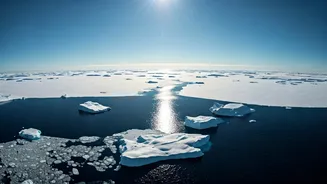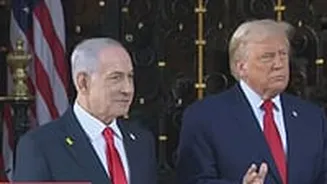

What began as rhetoric around strategic interests in the Arctic has now escalated into open warnings from European capitals that Nato itself could collapse if Washington acts unilaterally against a fellow member state.
The development comes immediately after a US military operation in Venezuela that resulted in the capture of President Nicolas Maduro and his wife.
That action, followed now with Trump’s refusal to rule out the use of force against Greenland — a semi-autonomous territory of Denmark and therefore part of Nato — has profoundly alarmed European allies.
How Europe united behind Denmark
The strongest signal of European unease came when seven leaders from across the continent issued a rare joint statement rejecting Trump’s claims over Greenland.
Among them were French President Emmanuel Macron, German Chancellor Friedrich Merz, and UK Prime Minister Keir Starmer.
The statement made clear that Greenland’s status was not open to external pressure, declaring that the mineral-rich Arctic island “belongs to its people”.
“It is for Denmark and Greenland, and them only, to decide on matters concerning Denmark and Greenland,” the leaders said.
Canada quickly echoed this position. Prime Minister Mark Carney stated that “The future of Greenland is a decision exclusively for the people of Greenland and Denmark.”
Carney later met Danish Prime Minister Mette Frederiksen, after which his office said he had “emphasised Canada's support for the sovereignty and territorial integrity of Denmark, including Greenland, which must be respected in accordance with international law”.
Poland also weighed in with Prime Minister Donald Tusk framing the issue as existential for Nato itself,
“No member of should attack or threaten another member of the North Atlantic Treaty. Otherwise, Nato would lose its meaning if conflict or mutual conflicts occurred within the alliance,” Tusk said.
How Denmark reacted
Denmark’s response has been unusually direct, reflecting the gravity with which Copenhagen views the situation. Prime Minister Mette Frederiksen warned that any US attempt to seize Greenland would effectively mark the end of the transatlantic defence alliance.
“If the United States chooses to attack another Nato country militarily, then everything stops,” Frederiksen said.
“That is, including our Nato and thus the security that has been provided since the end of the Second World War,” she added in remarks to Danish broadcaster TV2.
Her comments came after Trump renewed his insistence that Greenland should fall under US jurisdiction. The US president told reporters that he would “talk about Greenland in 20 days” and has repeatedly framed the island as a strategic necessity for American security.
Denmark itself has sought to demonstrate its commitment to Arctic security.
In response to rising tensions, Denmark has already pledged $4 billion to strengthen Greenland’s defence capabilities, including investments in naval vessels, drones, and aircraft.
Despite these efforts, Danish officials say the Trump administration has shown little interest in substantive engagement.
Greenland’s status as a semi-autonomous territory within the Danish kingdom makes the situation especially sensitive. Denmark is a founding Nato member and a close US ally, making any threat to its territory unprecedented within the alliance.
How Greenland reacted
Greenland’s own leaders have consistently rejected the idea of becoming part of the United States. Premier Jens-Frederik Nielsen has sought to convey firm resistance while attempting to calm public anxiety on the island.
Tensions escalated after Katie Miller, the wife of Trump’s deputy chief of staff Stephen Miller, posted an image on X depicting Greenland in the colours of the US flag, accompanied by the word “SOON”.
Nielsen condemned the post as “disrespectful”.
“Relations between nations and peoples are built on mutual respect and international law – not on symbolic gestures that disregard our status and our rights,” he said.
At the same time, Nielsen urged Greenlanders not to panic. “There is neither reason for panic nor for concern. Our country is not for sale, and our future is not decided by social media posts,” he added.
In subsequent remarks, Nielsen emphasised that while geopolitical tensions were real, the notion of an imminent takeover was not.
“We are not in a situation where we think that there might be a takeover of the country overnight,” he said at a news conference.
“The situation is not such that the United States can simply conquer Greenland,” Nielsen added, while reiterating Greenland’s desire for constructive cooperation rather than confrontation.
Why Greenland matters to Washington
Positioned between Europe and North America, the island plays a critical role in US ballistic missile defence architecture and Arctic surveillance.
Trump has repeatedly cited growing Russian and Chinese activity in the region as justification for US control.
“Greenland is covered with Russian and Chinese ships all over the place,” Trump said.
“We need Greenland from the standpoint of national security, and Denmark is not going to be able to do it,” he added.
The rump administration also views Greenland’s mineral deposits as strategically vital. These resources are considered important for advanced technology and military applications, particularly as the US seeks to reduce its dependence on Chinese supply chains.
Despite their potential, many of these deposits remain undeveloped due to infrastructure gaps, labour shortages, and logistical challenges. Washington argues that direct or indirect US control would allow faster exploitation of these assets.
Under a bilateral agreement, the US already operates a military base on Greenland, originally established during the Cold War. At its height, the base hosted around 10,000 US personnel, though that number has since fallen to approximately 200.
What Trump may do to annex Greenland
The White House has acknowledged that Trump is actively exploring multiple paths to acquire Greenland,
“The president and his team are discussing a range of options to pursue this important foreign policy goal, and of course, utilising the US military is always an option at the commander-in-chief's disposal,” the White House said in a statement.
It added that Trump views Greenland as a national security priority needed to “deter our adversaries in the Arctic region”.
According to a senior US official speaking to Reuters on condition of anonymity, the administration is considering several approaches, including outright purchase of the territory or the establishment of a Compact of Free Association (COFA).
Such an arrangement would fall short of full annexation but would give Washington significant influence over defence and foreign policy. The official did not provide any potential purchase price but stressed that Trump prefers transactional solutions.
“Diplomacy is always the president’s first option with anything, and dealmaking. He loves deals. So if a good deal can be struck to acquire Greenland, that would definitely be his first instinct,” the official said.
Despite Trump’s determination, US Secretary of State Marco Rubio told lawmakers during a classified briefing that the administration’s rhetoric did not indicate an imminent invasion and that the preferred route remained a purchase from Denmark.
The Wall Street Journal first reported Rubio’s comments. Some members of Congress, including Republicans, have warned that pressing the issue risks violating US treaty obligations.
“When Denmark and Greenland make it clear that Greenland is not for sale, the United States must honor its treaty obligations and respect the sovereignty and territorial integrity of the Kingdom of Denmark,” said Democratic Senator Jeanne Shaheen and Republican Senator Thom Tillis, the co-chairs of the Senate Nato Observer Group.
How Nato is facing an internal existential crisis
The Greenland dispute has forced Nato into an unprecedented dilemma. The alliance was created to protect member states from external threats, not to mediate territorial disputes initiated by its most powerful member.
European officials fear that Trump’s rhetoric effectively tests Nato’s Article 5 commitment to collective defence. If one Nato country threatens another, the credibility of the alliance’s core guarantee is called into question.
The situation also exposes a widening gap in strategic language and priorities. European leaders continue to emphasise collective security, legal norms, and territorial integrity.
By contrast, the Trump administration increasingly frames foreign policy in terms of unilateral advantage and strategic opportunity.
The irony has not been lost on European capitals. As Nato leaders urge unity in defending Ukraine’s sovereignty against Russia, the US is simultaneously threatening the territorial integrity of Denmark — itself a Nato member.
This contradiction, analysts warn, risks hollowing out the moral and political foundations of the Western alliance.
The public nature of the dispute has already had broader consequences as European officials privately worry that the standoff provides an opening for Russia and China to portray the West as divided and driven by power politics rather than shared principles.
With inputs from agencies