








What is the story about?
Prime Minister Narendra Modi’s two-day state visit to Israel commencing Wednesday has brought India-Israel defence cooperation under the lens.
Both governments have framed the trip as an opportunity to broaden cooperation across security, trade, advanced technologies and industrial partnerships, even as anxieties persist over the risk of a wider military escalation involving the United States and Iran.
The visit carries added diplomatic weight for Israel, which has seen ties with several traditional partners come under strain since the Gaza conflict erupted in October 2023.
India’s outreach to Israel is no longer episodic or transactional. Over the past decade, the relationship has evolved into a dense web of political engagement and defence co-development.
“Our nations share a robust and multifaceted Strategic Partnership,” Modi wrote on X. “Ties have significantly strengthened in the last few years.”
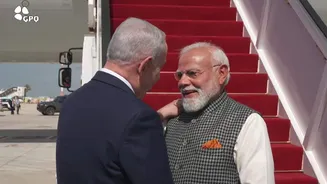
On the Israeli side, Prime Minister Benjamin Netanyahu described his rapport with Modi personally. “We are partners in innovation, security, and a shared strategic vision," Netanyahu said on X ahead of Modi’s arrival.
“Together, we are building an axis of nations committed to stability and progress.”
Beyond the veneer, the visit has been closely watched for concrete defence outcomes, particularly discussions around Israel’s offer to share advanced air-defence technologies with India.
Among these, the laser-based Iron Beam has drawn attention as a potential addition to India’s fast-evolving Integrated Air Defence System.
India’s air defence network is in the midst of its most consequential transformation since the last century.
The older emphasis on point defence — protecting discrete assets in isolation — has been supplanted by a layered, integrated construct that links sensors, shooters and command nodes into a single operational grid.
This architecture, often described within the Indian military as the “Sudarshan Chakra,” is designed to provide overlapping coverage from long-range strategic interceptors down to very short-range point-defence weapons.
At the outermost tier, India fields long-range systems intended to deter and intercept high-value aerial platforms and standoff threats.
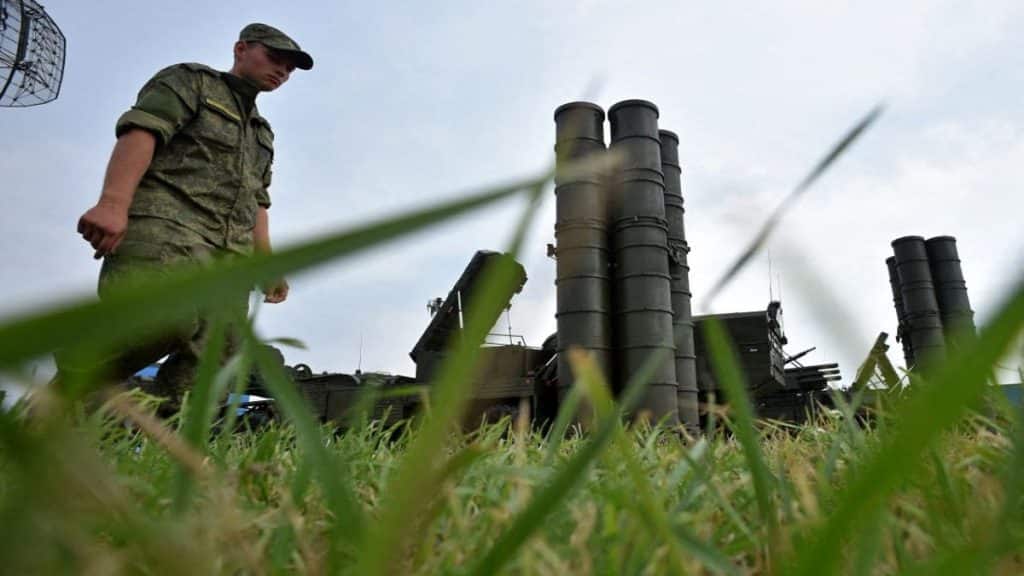
The Russian-origin S-400 Triumf has already been inducted, with three regiments operational and the remaining two scheduled for full integration
by late 2026 after supply chains stabilised.
This layer is complemented by India’s indigenous Project Kusha, conceived as a sovereign alternative to imported long-range air-defence systems.
Early trials of the M1 interceptor, with an engagement envelope of around 150 km, have been completed, while subsequent variants with extended reach are planned over the next several years to create a sanction-resilient long-range shield.
Beneath this strategic tier sits the medium-range layer, anchored by the MR-SAM/Barak-8 system jointly developed by India’s Defence Research and Development Organisation and Israel Aerospace Industries.
This layer is crucial to protecting naval task forces and air bases from agile aircraft and cruise missiles, with coverage extending across wide swathes of airspace.
Closer to the frontline, short-range systems such as Akash-NG and QRSAM are tailored to protect mobile formations and forward-deployed units.
The final layer of very short-range air defence includes man-portable and vehicle-mounted systems designed to counter low-flying drones, helicopters and other close-in threats, especially in mountainous terrain along sensitive borders.
Despite this dense architecture, planners have identified a structural weakness in the economics of defence. Adversaries increasingly deploy inexpensive drones and unguided rockets in large numbers, forcing defenders to expend costly interceptor missiles.
This imbalance creates incentives for saturation attacks aimed not at breaching defences outright but at depleting stocks of high-value interceptors.
India’s doctrinal shift towards an Integrated Air Defence System seeks to close this gap by pairing expensive interceptors for high-end threats with cheaper, high-volume solutions for low-cost projectiles.
It is within this context that Iron Beam is being evaluated as a prospective bottom layer of the Sudarshan Chakra.
Iron Beam, known in Hebrew as Or Eitan (“Eitan’s light”), was first presented to the international defence community at the Singapore Airshow in 2014.
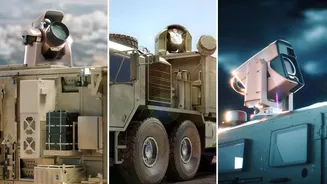
Developed by Rafael Advanced Defense Systems, the system represents a class of directed-energy weapons designed to neutralise short-range aerial threats that conventional missile defences struggle to intercept efficiently or economically.
At its core, Iron Beam employs high-power fibre lasers to project concentrated energy onto incoming targets. When a projectile, drone or mortar round is detected, the system tracks it and directs multiple smaller laser beams to converge on a single point on the target.
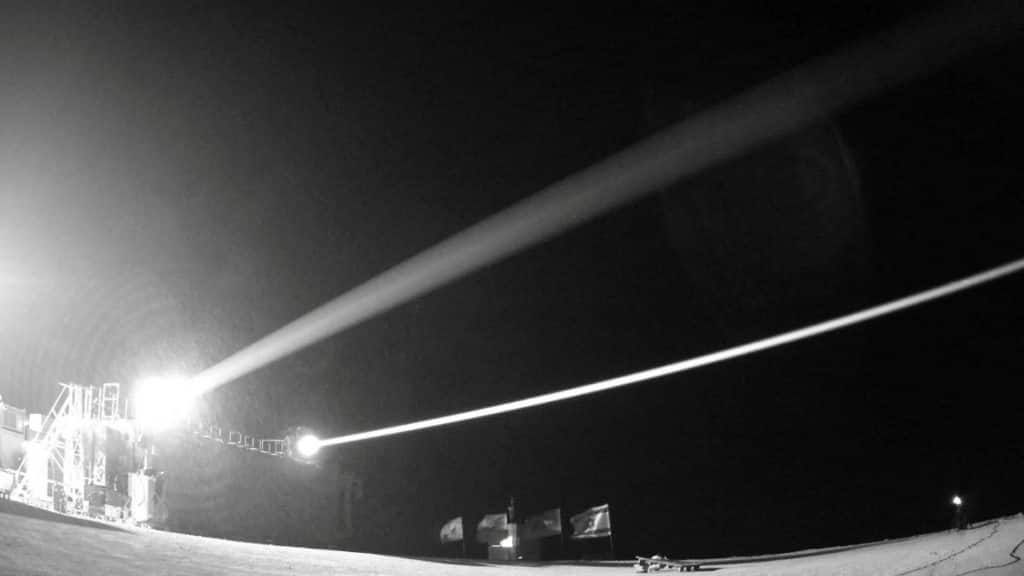
This approach reduces atmospheric distortion because each individual beam experiences less interference before combining into a single, more destructive focal point. Once sufficient energy is delivered, structural failure or critical component damage neutralises the threat.
Operationally, the system can disable a target within a few seconds of sustained contact, with an effective engagement range measured in several kilometres.
The latest iteration, Iron Beam 450, extends the reach and improves response times through upgraded optics and beam control.
Rafael has also diversified the platform into multiple variants to suit different operational contexts: a truck-mounted configuration for mobile ground forces, a lighter version for armoured vehicles and rapid-response teams, and a maritime variant intended to protect naval vessels from drones or missiles approaching at sea level.
The economic logic of laser interception underpins Iron Beam’s appeal.
The direct energy cost of each shot is minimal when compared with missile interceptors that can cost tens or hundreds of thousands of dollars per engagement.
Even when accounting for system maintenance and operational overheads, the per-engagement cost remains a fraction of that of kinetic interceptors. This creates a pathway to counter high-volume, low-cost threats without imposing disproportionate financial strain on defenders.
Some estimates put the direct operating cost as low as $3 to $5 per interception, while even accounting for all related expenses, a single engagement would total around $2,000.
However, Iron Beam is not without technical constraints. Laser performance depends on atmospheric clarity, meaning fog, dense cloud cover, heavy rainfall or sandstorms can degrade effectiveness.
Additionally, thermal blooming — the heating of air along the beam’s path — can disperse energy and reduce lethality over distance.
These limitations necessitate integration with conventional missile defences to ensure uninterrupted coverage across varying environmental conditions.
If inducted, Iron Beam would not function as a standalone shield but as a node within India’s broader Integrated Air Defence System.
The operational concept envisages seamless data-sharing between long-range radars, command-and-control centres and layered interceptors.
Sensors such as Swordfish and Arudhra would provide early warning of incoming salvos, whether composed of cruise missiles, rockets or swarms of unmanned aerial vehicles.
Within this networked framework, AI-assisted command nodes would allocate targets across layers based on threat characteristics and cost considerations.
High-speed or high-value threats would be assigned to medium- and long-range interceptors, while low-cost, high-volume projectiles would be channelled towards Iron Beam batteries positioned to protect critical nodes, urban centres or forward-deployed formations.
The laser system’s capacity to re-engage new targets almost immediately after a brief dwell period allows it to tackle multiple incoming objects in rapid succession, mitigating the risk of sensor saturation that can overwhelm missile launchers with finite reload capacities.
This integration would enable India to reserve expensive interceptors for aircraft, cruise missiles and other complex threats, while using directed-energy weapons to blunt massed attacks by drones and rockets.
The objective is not to replace kinetic interceptors but to introduce an additional defensive layer that alters the cost calculus for potential adversaries.
India has been developing its own directed-energy weapon under the DURGA-II (Directionally Unrestricted Ray-Gun Array) programme, aimed at fielding a 100-kilowatt-class laser system capable of countering drones, rockets and other short-range threats.
While indigenous development offers strategic autonomy and long-term sustainability, the technical hurdles associated with high-energy lasers — particularly in beam stability, adaptive optics and atmospheric compensation — have extended development timelines.
Discussions with Israel have therefore focused on a potential work-share arrangement that would integrate Israeli laser technologies with India’s domestic programme.
Access to Israeli expertise in beam jitter control and adaptive optics could accelerate the maturation of DURGA-II, compressing induction timelines and enhancing system reliability under diverse environmental conditions.
By pairing Iron Beam’s proven design elements with indigenous development, India aims to build a domestic directed-energy capability that can be scaled, upgraded and maintained without long-term dependence on external suppliers.
The Iron Beam discussions sit within a wider transformation of India-Israel defence ties from a discreet buyer-seller relationship into a co-development partnership anchored in industrial integration.
Several joint ventures illustrate this approach. Adani-Elbit Advanced Systems in Hyderabad manufactures Hermes-series unmanned aerial vehicles not only for Indian forces but also for export markets.
Kalyani Rafael Advanced Systems has emerged as a central hub for producing components of air-defence systems and missiles within India, supporting local supply chains for platforms such as SPYDER and Barak-8.
A collaboration with Israel Weapon Industries has enabled domestic production of small arms and light machine guns for Indian units, reducing reliance on imports for infantry equipment.
Early this year, India’s Defence Acquisition Council cleared a major package of Israeli systems following operational lessons from Operation Sindoor, where Israeli precision-guided munitions were credited with high mission effectiveness against fortified targets.
The procurement included a mix of air-to-surface missiles, stand-off munitions and long-range strike capabilities integrated onto Indian Air Force and Navy platforms.
Beyond hardware, the partnership encompasses intelligence-sharing, cyber cooperation and space-based surveillance.
Israel has emerged as a key partner in satellite imagery analysis and signals intelligence along sensitive frontiers, while Israeli-developed synthetic aperture radar technology has enhanced India’s space-based ISR capabilities, enabling all-weather, day-and-night surveillance.
Concerns over a potential escalation between the United States and Iran have heightened the strategic salience of missile and drone defences across West Asia and the broader Indo-Pacific.
Also Watch:
With inputs from agencies
Both governments have framed the trip as an opportunity to broaden cooperation across security, trade, advanced technologies and industrial partnerships, even as anxieties persist over the risk of a wider military escalation involving the United States and Iran.
The visit carries added diplomatic weight for Israel, which has seen ties with several traditional partners come under strain since the Gaza conflict erupted in October 2023.
India’s outreach to Israel is no longer episodic or transactional. Over the past decade, the relationship has evolved into a dense web of political engagement and defence co-development.
“Our nations share a robust and multifaceted Strategic Partnership,” Modi wrote on X. “Ties have significantly strengthened in the last few years.”
On the Israeli side, Prime Minister Benjamin Netanyahu described his rapport with Modi personally. “We are partners in innovation, security, and a shared strategic vision," Netanyahu said on X ahead of Modi’s arrival.
“Together, we are building an axis of nations committed to stability and progress.”
Beyond the veneer, the visit has been closely watched for concrete defence outcomes, particularly discussions around Israel’s offer to share advanced air-defence technologies with India.
Among these, the laser-based Iron Beam has drawn attention as a potential addition to India’s fast-evolving Integrated Air Defence System.
How is India overhauling its air defence architecture?
India’s air defence network is in the midst of its most consequential transformation since the last century.
The older emphasis on point defence — protecting discrete assets in isolation — has been supplanted by a layered, integrated construct that links sensors, shooters and command nodes into a single operational grid.
This architecture, often described within the Indian military as the “Sudarshan Chakra,” is designed to provide overlapping coverage from long-range strategic interceptors down to very short-range point-defence weapons.
At the outermost tier, India fields long-range systems intended to deter and intercept high-value aerial platforms and standoff threats.
The Russian-origin S-400 Triumf has already been inducted, with three regiments operational and the remaining two scheduled for full integration
This layer is complemented by India’s indigenous Project Kusha, conceived as a sovereign alternative to imported long-range air-defence systems.
A Russian soldier walks near Russia's air defence system S-400 Triumf launch vehicles outside Moscow. In 2018, India signed a deal with Russia for the S-400 air defence system. File Image/AFP
Early trials of the M1 interceptor, with an engagement envelope of around 150 km, have been completed, while subsequent variants with extended reach are planned over the next several years to create a sanction-resilient long-range shield.
Beneath this strategic tier sits the medium-range layer, anchored by the MR-SAM/Barak-8 system jointly developed by India’s Defence Research and Development Organisation and Israel Aerospace Industries.
This layer is crucial to protecting naval task forces and air bases from agile aircraft and cruise missiles, with coverage extending across wide swathes of airspace.
Closer to the frontline, short-range systems such as Akash-NG and QRSAM are tailored to protect mobile formations and forward-deployed units.
The final layer of very short-range air defence includes man-portable and vehicle-mounted systems designed to counter low-flying drones, helicopters and other close-in threats, especially in mountainous terrain along sensitive borders.
Despite this dense architecture, planners have identified a structural weakness in the economics of defence. Adversaries increasingly deploy inexpensive drones and unguided rockets in large numbers, forcing defenders to expend costly interceptor missiles.
This imbalance creates incentives for saturation attacks aimed not at breaching defences outright but at depleting stocks of high-value interceptors.
India’s doctrinal shift towards an Integrated Air Defence System seeks to close this gap by pairing expensive interceptors for high-end threats with cheaper, high-volume solutions for low-cost projectiles.
It is within this context that Iron Beam is being evaluated as a prospective bottom layer of the Sudarshan Chakra.
What exactly is Iron Beam and how does it work?
Iron Beam, known in Hebrew as Or Eitan (“Eitan’s light”), was first presented to the international defence community at the Singapore Airshow in 2014.
Developed by Rafael Advanced Defense Systems, the system represents a class of directed-energy weapons designed to neutralise short-range aerial threats that conventional missile defences struggle to intercept efficiently or economically.
At its core, Iron Beam employs high-power fibre lasers to project concentrated energy onto incoming targets. When a projectile, drone or mortar round is detected, the system tracks it and directs multiple smaller laser beams to converge on a single point on the target.
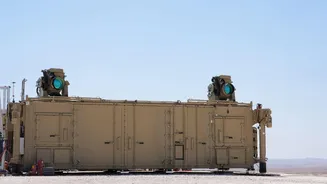
Iron Beam laser anti-missile interception system, developed by Israel, is seen in action in this handout image obtained by Reuters on September 17, 2025. Israel Defence Ministry/Handout
This approach reduces atmospheric distortion because each individual beam experiences less interference before combining into a single, more destructive focal point. Once sufficient energy is delivered, structural failure or critical component damage neutralises the threat.
Operationally, the system can disable a target within a few seconds of sustained contact, with an effective engagement range measured in several kilometres.
The latest iteration, Iron Beam 450, extends the reach and improves response times through upgraded optics and beam control.
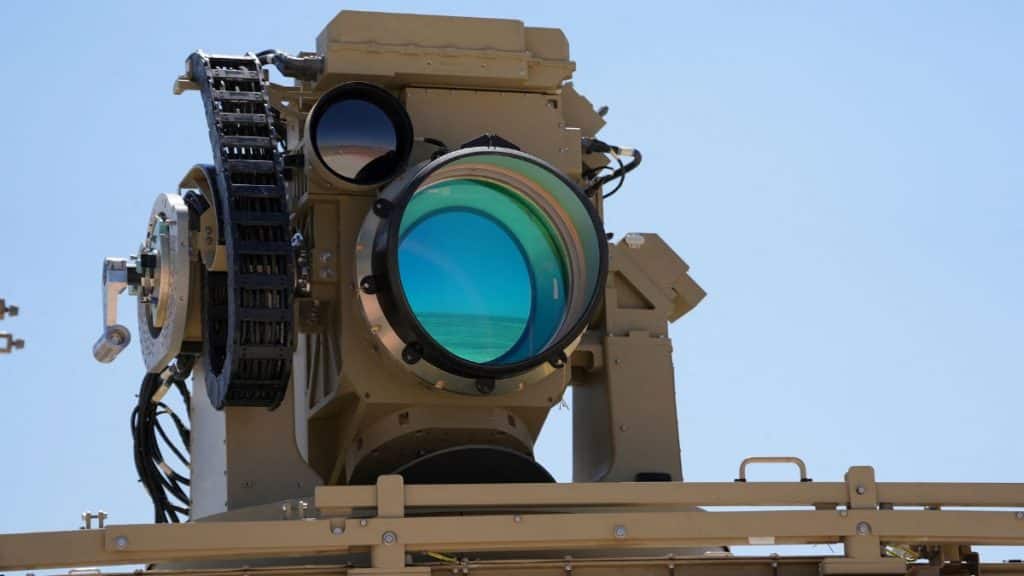
Rafael has also diversified the platform into multiple variants to suit different operational contexts: a truck-mounted configuration for mobile ground forces, a lighter version for armoured vehicles and rapid-response teams, and a maritime variant intended to protect naval vessels from drones or missiles approaching at sea level.
A detail of Iron Beam laser anti-missile interception system, developed by Israel, is seen in this handout image obtained by Reuters on September 17, 2025. Israel Defence Ministry/Handout
The economic logic of laser interception underpins Iron Beam’s appeal.
The direct energy cost of each shot is minimal when compared with missile interceptors that can cost tens or hundreds of thousands of dollars per engagement.
Even when accounting for system maintenance and operational overheads, the per-engagement cost remains a fraction of that of kinetic interceptors. This creates a pathway to counter high-volume, low-cost threats without imposing disproportionate financial strain on defenders.
Some estimates put the direct operating cost as low as $3 to $5 per interception, while even accounting for all related expenses, a single engagement would total around $2,000.
However, Iron Beam is not without technical constraints. Laser performance depends on atmospheric clarity, meaning fog, dense cloud cover, heavy rainfall or sandstorms can degrade effectiveness.
Additionally, thermal blooming — the heating of air along the beam’s path — can disperse energy and reduce lethality over distance.
These limitations necessitate integration with conventional missile defences to ensure uninterrupted coverage across varying environmental conditions.
How would Iron Beam fit into India’s “Sudarshan Chakra”?
If inducted, Iron Beam would not function as a standalone shield but as a node within India’s broader Integrated Air Defence System.
The operational concept envisages seamless data-sharing between long-range radars, command-and-control centres and layered interceptors.
Sensors such as Swordfish and Arudhra would provide early warning of incoming salvos, whether composed of cruise missiles, rockets or swarms of unmanned aerial vehicles.
Within this networked framework, AI-assisted command nodes would allocate targets across layers based on threat characteristics and cost considerations.
High-speed or high-value threats would be assigned to medium- and long-range interceptors, while low-cost, high-volume projectiles would be channelled towards Iron Beam batteries positioned to protect critical nodes, urban centres or forward-deployed formations.
The laser system’s capacity to re-engage new targets almost immediately after a brief dwell period allows it to tackle multiple incoming objects in rapid succession, mitigating the risk of sensor saturation that can overwhelm missile launchers with finite reload capacities.
This integration would enable India to reserve expensive interceptors for aircraft, cruise missiles and other complex threats, while using directed-energy weapons to blunt massed attacks by drones and rockets.
The objective is not to replace kinetic interceptors but to introduce an additional defensive layer that alters the cost calculus for potential adversaries.
How does Iron Beam complement India’s indigenous DURGA-II programme?
India has been developing its own directed-energy weapon under the DURGA-II (Directionally Unrestricted Ray-Gun Array) programme, aimed at fielding a 100-kilowatt-class laser system capable of countering drones, rockets and other short-range threats.
While indigenous development offers strategic autonomy and long-term sustainability, the technical hurdles associated with high-energy lasers — particularly in beam stability, adaptive optics and atmospheric compensation — have extended development timelines.
Discussions with Israel have therefore focused on a potential work-share arrangement that would integrate Israeli laser technologies with India’s domestic programme.
Access to Israeli expertise in beam jitter control and adaptive optics could accelerate the maturation of DURGA-II, compressing induction timelines and enhancing system reliability under diverse environmental conditions.
By pairing Iron Beam’s proven design elements with indigenous development, India aims to build a domestic directed-energy capability that can be scaled, upgraded and maintained without long-term dependence on external suppliers.
What next for Israel-India defence ties?
The Iron Beam discussions sit within a wider transformation of India-Israel defence ties from a discreet buyer-seller relationship into a co-development partnership anchored in industrial integration.
Several joint ventures illustrate this approach. Adani-Elbit Advanced Systems in Hyderabad manufactures Hermes-series unmanned aerial vehicles not only for Indian forces but also for export markets.
Kalyani Rafael Advanced Systems has emerged as a central hub for producing components of air-defence systems and missiles within India, supporting local supply chains for platforms such as SPYDER and Barak-8.
A collaboration with Israel Weapon Industries has enabled domestic production of small arms and light machine guns for Indian units, reducing reliance on imports for infantry equipment.
Early this year, India’s Defence Acquisition Council cleared a major package of Israeli systems following operational lessons from Operation Sindoor, where Israeli precision-guided munitions were credited with high mission effectiveness against fortified targets.
The procurement included a mix of air-to-surface missiles, stand-off munitions and long-range strike capabilities integrated onto Indian Air Force and Navy platforms.
Beyond hardware, the partnership encompasses intelligence-sharing, cyber cooperation and space-based surveillance.
Israel has emerged as a key partner in satellite imagery analysis and signals intelligence along sensitive frontiers, while Israeli-developed synthetic aperture radar technology has enhanced India’s space-based ISR capabilities, enabling all-weather, day-and-night surveillance.
Concerns over a potential escalation between the United States and Iran have heightened the strategic salience of missile and drone defences across West Asia and the broader Indo-Pacific.
Also Watch:
With inputs from agencies