







What is the story about?
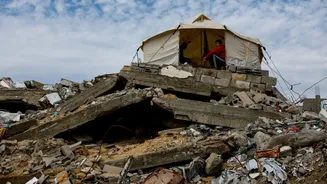
Years of conflict have left Gaza facing an enormous rebuilding task, with a new joint assessment by the European Union and the United Nations estimating that more than $71 billion will be needed over the next decade to restore the territory.
The Gaza Rapid Damage and Needs Assessment (RDNA), released on Monday, said the war has had a “catastrophic impact on human development” and highlighted the scale of immediate financial requirements. It estimated that $26 billion will be required in the first 18 months to restore basic services, rebuild infrastructure and support economic recovery.
“Physical infrastructure damages are estimated at $35.2 billion, with economic and social losses amounting to $22.7 billion,” a joint statement by the report’s sponsors said.
The territory remains under a fragile “ceasefire” agreed in October following two years of conflict that began after the October 7, 2023, Hamas-led attacks on southern Israel. Both parties accuse each other of repeatedly breaching the agreement.
According to Gaza’s Ministry of Health, more than 72,500 people have been killed. Since the ceasefire took effect, at least 777 people have died, including 32 since the start of April. Among those killed was Al Jazeera journalist Mohammed Wishah in a drone strike west of Gaza City on April 8.
Gaza’s Government Media Office said Israel has carried out 2,400 violations of the “ceasefire”, including killings, arrests, blockades and starvation policies.
The United Nations said the bombardment has left more than 61 million tonnes of rubble across the territory, burying entire neighbourhoods.
The assessment found that 371,888 homes have been destroyed or damaged, over 50 per cent of hospitals are no longer functional, and nearly all schools have suffered damage.
Gaza’s economy has contracted by 84 per cent, while 1.9 million people have been displaced, often multiple times. More than 60 per cent of residents have lost their homes.
The report identified housing, health, education, commerce and agriculture as the sectors most severely affected, adding that the conflict has pushed back human development in Gaza by 77 years.
The EU and UN said reconstruction should be “Palestinian-led” and support a transition of governance to the Palestinian Authority.
This stance contrasts with earlier remarks by US President Donald Trump suggesting Gaza could be redeveloped as a resort along the Mediterranean coast.
The Gaza Rapid Damage and Needs Assessment (RDNA), released on Monday, said the war has had a “catastrophic impact on human development” and highlighted the scale of immediate financial requirements. It estimated that $26 billion will be required in the first 18 months to restore basic services, rebuild infrastructure and support economic recovery.
“Physical infrastructure damages are estimated at $35.2 billion, with economic and social losses amounting to $22.7 billion,” a joint statement by the report’s sponsors said.
Ceasefire amid continuing violence
The territory remains under a fragile “ceasefire” agreed in October following two years of conflict that began after the October 7, 2023, Hamas-led attacks on southern Israel. Both parties accuse each other of repeatedly breaching the agreement.
Rising death toll
According to Gaza’s Ministry of Health, more than 72,500 people have been killed. Since the ceasefire took effect, at least 777 people have died, including 32 since the start of April. Among those killed was Al Jazeera journalist Mohammed Wishah in a drone strike west of Gaza City on April 8.
Gaza’s Government Media Office said Israel has carried out 2,400 violations of the “ceasefire”, including killings, arrests, blockades and starvation policies.
The United Nations said the bombardment has left more than 61 million tonnes of rubble across the territory, burying entire neighbourhoods.
The assessment found that 371,888 homes have been destroyed or damaged, over 50 per cent of hospitals are no longer functional, and nearly all schools have suffered damage.
Economic collapse and displacement
Gaza’s economy has contracted by 84 per cent, while 1.9 million people have been displaced, often multiple times. More than 60 per cent of residents have lost their homes.
The report identified housing, health, education, commerce and agriculture as the sectors most severely affected, adding that the conflict has pushed back human development in Gaza by 77 years.
The EU and UN said reconstruction should be “Palestinian-led” and support a transition of governance to the Palestinian Authority.
This stance contrasts with earlier remarks by US President Donald Trump suggesting Gaza could be redeveloped as a resort along the Mediterranean coast.