







What is the story about?
Imagine receiving a phone call from your mother. The caller ID says "Mum", the voice sounds exactly like hers, and she urgently asks you to transfer money because of an emergency. Except it isn't your mother at all.
That scenario is becoming increasingly plausible as cybercriminals turn to artificial intelligence tools capable of cloning voices and impersonating trusted contacts. Recognising the growing threat, Google has unveiled a new Android security feature designed to identify these scams before users fall victim to them.
Announced on Tuesday, the company's new fake call detection system is aimed at tackling AI-powered impersonation fraud, a category of scams that has expanded rapidly as voice cloning technology becomes more accessible and convincing.
The feature will be enabled by default and work automatically in the background, requiring no manual setup from users.
The idea behind the new system is relatively simple: verify that the person calling you is actually using the device they claim to be calling from.
Google describes the technology as a kind of digital verification process between smartphones. When someone in your contacts places a call and both parties are using Phone by Google, the caller's device sends a secure confirmation signal alongside the call.
Your phone then checks for that signal before treating the call as trustworthy.
If a fraudster attempts to impersonate a known contact by spoofing a phone number and using AI-generated audio, that verification signal will not be present. In such situations, Google's system performs an additional check with the legitimate device associated with that contact.
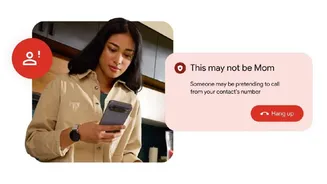
According to Google, if the real phone confirms that its owner is not actively making a call, Android will immediately display a warning advising users to end the conversation.
The feature has been designed specifically to address a growing challenge facing consumers. Many people have become cautious about answering calls from unfamiliar numbers, prompting scammers to evolve their tactics. Instead of cold-calling from unknown numbers, criminals increasingly spoof familiar contacts, businesses or authority figures while using AI-generated voices to build trust.
The company says the technology is built on Rich Communication Services (RCS), the modern messaging standard that underpins many Android communication features. By using RCS, Google hopes the verification system can eventually be adopted by additional apps, services and technology providers.
Google says fake call detection will begin rolling out globally this month through the Phone by Google application on devices running Android 12 and newer versions.
Pixel smartphones will be among the first devices to receive the feature before it expands more broadly across the Android ecosystem.
The announcement was part of a wider set of Android updates focused on artificial intelligence and user convenience.
Google Photos is receiving a new virtual wardrobe feature that can catalogue outfits appearing in a user's photo library. By identifying and organising clothing items, the tool allows users to browse outfits and virtually experiment with different combinations. The feature is scheduled to launch next week for eligible users in the United States, India and Brazil running Android 10 or later.
That scenario is becoming increasingly plausible as cybercriminals turn to artificial intelligence tools capable of cloning voices and impersonating trusted contacts. Recognising the growing threat, Google has unveiled a new Android security feature designed to identify these scams before users fall victim to them.
Announced on Tuesday, the company's new fake call detection system is aimed at tackling AI-powered impersonation fraud, a category of scams that has expanded rapidly as voice cloning technology becomes more accessible and convincing.
The feature will be enabled by default and work automatically in the background, requiring no manual setup from users.
Google's fake call detection tool: How does it work?
The idea behind the new system is relatively simple: verify that the person calling you is actually using the device they claim to be calling from.
Google describes the technology as a kind of digital verification process between smartphones. When someone in your contacts places a call and both parties are using Phone by Google, the caller's device sends a secure confirmation signal alongside the call.
Your phone then checks for that signal before treating the call as trustworthy.
If a fraudster attempts to impersonate a known contact by spoofing a phone number and using AI-generated audio, that verification signal will not be present. In such situations, Google's system performs an additional check with the legitimate device associated with that contact.
According to Google, if the real phone confirms that its owner is not actively making a call, Android will immediately display a warning advising users to end the conversation.
The feature has been designed specifically to address a growing challenge facing consumers. Many people have become cautious about answering calls from unfamiliar numbers, prompting scammers to evolve their tactics. Instead of cold-calling from unknown numbers, criminals increasingly spoof familiar contacts, businesses or authority figures while using AI-generated voices to build trust.
The company says the technology is built on Rich Communication Services (RCS), the modern messaging standard that underpins many Android communication features. By using RCS, Google hopes the verification system can eventually be adopted by additional apps, services and technology providers.
Availability and other Android updates
Google says fake call detection will begin rolling out globally this month through the Phone by Google application on devices running Android 12 and newer versions.
Pixel smartphones will be among the first devices to receive the feature before it expands more broadly across the Android ecosystem.
The announcement was part of a wider set of Android updates focused on artificial intelligence and user convenience.
Google Photos is receiving a new virtual wardrobe feature that can catalogue outfits appearing in a user's photo library. By identifying and organising clothing items, the tool allows users to browse outfits and virtually experiment with different combinations. The feature is scheduled to launch next week for eligible users in the United States, India and Brazil running Android 10 or later.