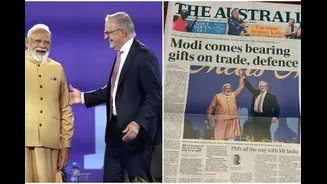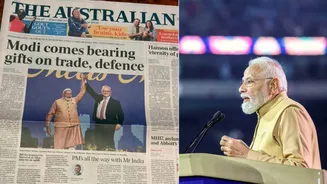








Turn on an Australian news channel or pick up a newspaper, and chances are you'll see Narendra Modi. The Indian Prime Minister's visit has dominated front pages, television bulletins and online news platforms across the country.
From broadsheets such as The Australian and The Age to major tabloids, the coverage has spanned everything from landmark defence and nuclear agreements to Modi's high-energy diaspora event alongside Australian Prime Minister Anthony Albanese. One prominent Australian columnist even summed up the visit by dubbing Modi the global stage's "Mr India".
'Mr India' takes centre stage
The nickname reflects how Modi has combined mass appeal among the Indian diaspora with an increasingly influential global diplomatic profile. According to the columnist, for many Australians, Modi has become the defining face of India's economic rise and growing strategic importance.
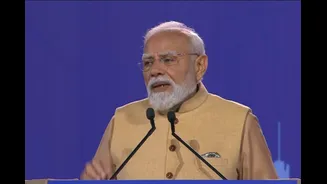
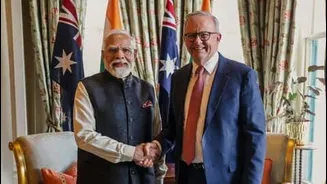
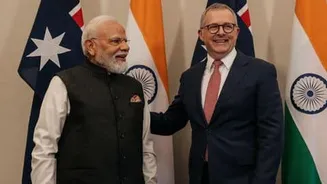
That attention peaked during a packed community event at Melbourne's Marvel Stadium. Sharing the stage with Albanese, Modi joked that he was completing a "hat-trick of visits" to Australia in the past 12 years. Newspapers splashed photographs of the two leaders across their front pages, highlighting the enthusiasm of Australia's Indian community and the growing warmth in bilateral ties.
Thank you for joining me in Melbourne tonight @narendramodi.
Our Indian community has contributed so much to the story of modern Australia.
And it’s made our country a better place.
Tonight we celebrated the special relationship between Australia and India. pic.twitter.com/slM3P33XBO
— Anthony Albanese (@AlboMP) July 9, 2026
18 agreements to deepen ties
Beyond the optics, the visit produced substantial outcomes. India and Australia signed 18 agreements covering nuclear energy, defence, maritime security, critical minerals, technology, cyber security, artificial intelligence, education and investment.
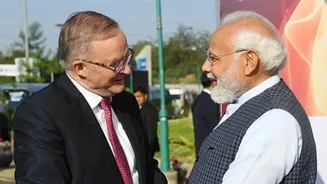
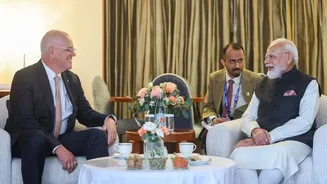
A landmark agreement clears the way for long-awaited Australian uranium exports to India for peaceful nuclear use. The two countries also unveiled a new Joint Declaration on Defence and Security Cooperation and a Maritime Security Collaboration Roadmap aimed at strengthening stability in the Indo-Pacific. AustralianSuper also announced fresh investments in India's infrastructure, while both leaders reaffirmed their commitment to a free, open and rules-based Indo-Pacific.
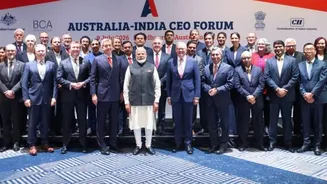
Australian newspapers also devoted significant attention to Modi's pitch to investors at the Australia-India CEOs Forum and the Economic Roadmap Business event.
Positioning India as a long-term investment destination, Modi urged Australian businesses to expand cooperation in critical minerals, rare earths, lithium, artificial intelligence, defence technology and resilient supply chains.
"India's scale and Australian expertise make for a win-win proposition," Modi told business leaders.
With bilateral trade exceeding $24 billion, Australian commentators noted that both governments are now keen to fast-track negotiations on the proposed Comprehensive Economic Cooperation Agreement (CECA), which would further deepen economic ties while reducing dependence on China-centric supply chains.
Modi has since departed for New Zealand, but his visit left a lasting mark on Australia's media landscape.