










What is the story about?
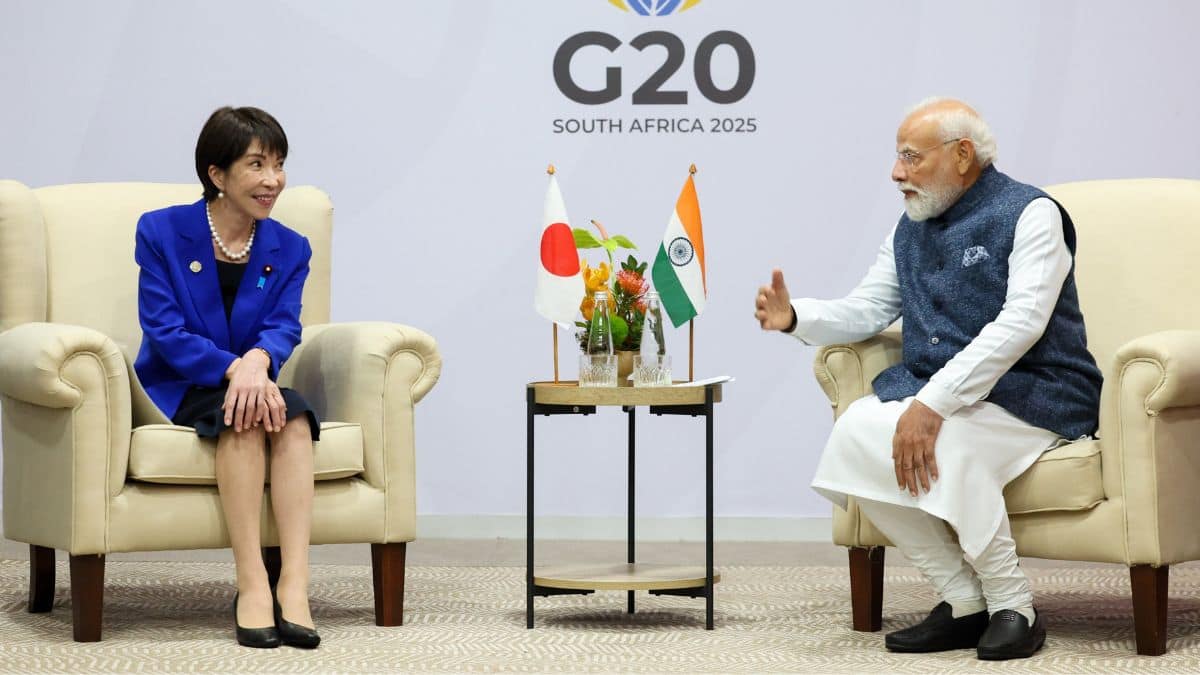
Japanese Prime Minister Sanae Takaichi arrives in New Delhi on Wednesday (July 1, 2026) for a three-day official visit.
The visit marks her first bilateral trip to India since assuming office and coincides with the 16th India-Japan Annual Summit, held alternately in both countries.
This year's discussions are expected to span trade, investment, advanced technology, artificial intelligence (AI), infrastructure, defence, supply-chain resilience and regional security.
The visit comes less than a year after Prime Minister Narendra Modi travelled to Tokyo, where Japan committed to more than doubling its investment in India to over $61 billion during the coming decade.
Since then, both governments have continued to deepen their engagement through multiple economic and strategic initiatives, reflecting the expanding scope of what both sides describe as their Special Strategic and Global Partnership.
Both leaders most recently met on the sidelines of the G7 Summit held last month in Évian-les-Bains, France.
We take a a detailed look at the key issues expected to dominate the summit.
For India and Japan, AI is increasingly being viewed as an essential component of economic competitiveness. Technology is therefore expected to occupy a prominent place during discussions between Modi and Takaichi.
Among the most anticipated outcomes of the summit is a Joint Statement on Cooperation in Artificial Intelligence. Alongside this, both leaders are also expected to release a Joint Declaration on Economic Safety Cooperation, signalling that technological collaboration will increasingly be viewed through the broader lens of economic security.
Both countries are also expected to focus on developing secure industrial AI systems capable of supporting advanced manufacturing and critical infrastructure.
Officials are expected to discuss frameworks governing data sharing, cybersecurity standards and common approaches to securing emerging digital technologies.
For both India and Japan, securing technology ecosystems has become closely linked to reducing vulnerabilities in global supply chains.
This explains why semiconductor cooperation is expected to feature prominently during the summit. Semiconductors remain indispensable for industries ranging from automobiles and telecommunications to defence equipment and consumer electronics.
India and Japan are therefore expected to continue implementing the long-term technology roadmap agreed during the leaders' engagement last year.
A major objective under this framework is strengthening semiconductor manufacturing ecosystems while diversifying access to critical raw materials required for advanced technology production.
Rare-earth minerals form another important element of these discussions. These minerals are essential for manufacturing electric vehicles, defence systems, electronics and renewable energy technologies.
Among the most closely watched economic initiatives expected to receive attention during the summit is the proposed framework for settling bilateral trade directly in yen and rupees. If implemented, the mechanism would represent one of the most significant structural changes in the financial relationship between India and Japan.
At present, a large share of trade between Indian and Japanese companies is settled through the US dollar. A typical commercial transaction involves multiple currency conversions.
For example, when a Japanese company exports industrial equipment or automotive components to India, the exporter generally converts Japanese yen into US dollars before payment is received.
The Indian importer then converts those dollars into Indian rupees to complete the transaction. Although this process has long served as the standard model for international trade, it introduces additional costs at every stage.
For large multinational corporations equipped with sophisticated financial hedging systems, these costs can often be managed effectively. Smaller and medium-sized businesses, however, typically have fewer resources to mitigate exchange-rate risks.
Under the framework being discussed, Japanese non-resident entities would be permitted to open accounts directly with commercial banks operating in India. This would enable financial institutions to settle cross-border invoices directly in Japanese yen and Indian rupees without routing payments through the US dollar.
The initiative also reflects a wider international trend in which countries are exploring greater use of local currencies for cross-border trade even as the US dollar remains the dominant global reserve currency.
The proposed framework builds upon an already existing financial foundation between the two countries. India and Japan currently maintain a bilateral currency swap agreement valued at $75 billion, which has been extended through 2026.
Such arrangements allow central banks to exchange currencies when necessary, helping provide liquidity during periods of financial stress and strengthening confidence in bilateral financial cooperation.
Japan's Ministry of Finance is also seeking to conclude a formal Memorandum of Cooperation with the Reserve Bank of India during fiscal year 2026 to advance local-currency settlement arrangements.
Another notable aspect of this year's summit is that cooperation on local-currency trade is expected to be formally incorporated into the leaders' joint statement for the first time.
According to the latest available figures for fiscal year 2025-26, bilateral merchandise trade between the two countries reached approximately $27.47 billion. However, the trade relationship remains heavily tilted in Japan's favour.
India exported goods worth approximately $6.04 billion to Japan during the period, while imports from Japan stood at about $21.43 billion, resulting in a trade deficit of $15.39 billion for India.
India's exports to Japan include organic chemicals, vehicles and automobile components, marine products, aluminium and aluminium-based products, electrical equipment and components associated with nuclear reactors.
Japanese exports to India are dominated by high-value industrial products, including heavy machinery, nuclear reactor equipment, electrical machinery, automotive parts, copper products, iron and steel, and inorganic chemicals.
The broader trade relationship continues to be anchored by the India-Japan Comprehensive Economic Partnership Agreement (CEPA), which entered into force in 2011.
The agreement established a long-term framework for progressively reducing or eliminating tariffs on more than 94 per cent of traded goods, facilitating greater market access for businesses in both countries.
While tariff liberalisation has helped expand commercial exchanges, trade continues to face structural challenges.
India's sizeable trade deficit with Japan reflects the country's dependence on high-value manufactured imports, while Japanese exporters continue to benefit from strong demand across India's industrial and manufacturing sectors.
Non-tariff barriers and stringent phytosanitary standards in Japan also continue to affect certain categories of Indian exports. Nevertheless, both governments continue to pursue deeper economic integration through increased investment and industrial cooperation.
Japan has emerged as one of India's largest foreign investors and currently ranks fifth in terms of cumulative foreign direct investment. Building on the successful completion of an earlier investment commitment of 5 trillion yen, both countries have now established an even more ambitious target.
Over the coming decade, they aim to facilitate approximately 10 trillion yen — equivalent to roughly $67-68 billion — in Japanese private-sector investment into India.
Indian government data shows that Japanese investment in India amounted to approximately $3.2 billion between April and December 2025 alone.
The investment relationship has also undergone a noticeable transformation. Where earlier Japanese engagement primarily centred on government-backed development projects, private corporations are now assuming a much larger role in driving bilateral economic ties.
Today, approximately 1,400 Japanese companies operate in India through nearly 5,000 business establishments, including manufacturing facilities, joint ventures, liaison offices and regional headquarters.
Nearly half of these companies are engaged in manufacturing activities as optimism among Japanese investors also appears to be strengthening.
According to the latest survey conducted by the Japan External Trade Organization (JETRO), 80.3 per cent of Japanese firms operating in India intend to expand their business operations over the next two years.
The survey also found that 77.7 per cent of these companies reported profitable operations in India, representing one of the strongest expansion outlooks recorded for Japanese businesses anywhere in the world.
One of the defining features of Takaichi's visit is the strong participation of Japan's private sector.
Accompanying her to New Delhi is a sizeable delegation with Toshihiro Suzuki, the president of Suzuki Motor Corporation, reportedly leading a coalition of over 50 prominent Japanese executives, industrial magnates, and startup founders.
Given Maruti Suzuki’s status as the historic anchor of Japanese manufacturing in India, Suzuki is spearheading the private-sector roundtables, including the India-Japan Business Forum scheduled for Thursday (July 2, 2026).
These meetings are intended to ensure that discussions held at the political level translate into tangible commercial outcomes.
Rather than focusing only on announcing new investment commitments, corporate leaders are also expected to identify practical obstacles that continue to affect businesses operating in India.
One area of concern relates to land acquisition and administrative procedures. Although India has established eight dedicated Japan Industrial Townships (JITs), including major industrial hubs such as Neemrana in Rajasthan and Sri City in Andhra Pradesh, companies continue to face delays arising from approvals at the state level.
Japanese companies are therefore expected to advocate for more streamlined approval processes, including a simplified single-window clearance mechanism that could reduce procedural delays for investors.
Another issue expected to feature during discussions concerns intellectual property protection. Japanese pharmaceutical companies and electronics manufacturers have reportedly expressed concerns about the length of patent litigation in India.
With legal proceedings in certain cases taking between four and six years, some firms remain cautious about transferring their most advanced proprietary technologies to their Indian subsidiaries.
The summit is also expected to examine efforts to overcome language barriers that can complicate commercial cooperation, particularly for Japan's small and medium-sized enterprises (SMEs).
To help address this challenge, both countries have been working through the Japan-India Institute for Manufacturing (JIM), which aims to produce approximately 30,000 industry-ready Indian professionals with Japanese language skills.
The programme is designed to strengthen workforce readiness while making it easier for Japanese companies to establish and expand operations in India.
Although the automotive industry continues to form an important pillar of India-Japan commercial relations, bilateral cooperation
has diversified significantly over the past few years.
Financial services, clean energy, semiconductor manufacturing, advanced technology and banking are now emerging as equally important areas of collaboration.
One of the most notable recent developments has been the growing interest of Japanese financial institutions in India's domestic banking sector. Traditionally, Japanese lenders concentrated primarily on financing industrial projects and infrastructure development.
A prominent example is the recently completed $1.6 billion transaction through which Japanese financial conglomerates acquired a 20 per cent strategic stake in Yes Bank.
Infrastructure cooperation also remains a defining feature of the bilateral relationship. The Japan International Cooperation Agency (JICA) continues to play a major role in financing large infrastructure projects across India.
Among the most visible examples is the Mumbai-Ahmedabad High-Speed Rail corridor, often referred to as India's bullet train project. Japan continues to provide both financial support and engineering expertise for the project, making it one of the flagship initiatives under the India-Japan partnership.
Beyond western India, Japanese investment is also contributing to connectivity projects in the country's northeast. These include the construction of road networks as well as the Dhubri-Phulbari bridge across the Brahmaputra River.
Once completed, the bridge is expected to become one of India's longest river bridges and is expected to improve connectivity across the region.
Under the bilateral Clean Energy Partnership (CEP), Japanese companies including Toyota and Suzuki are working with Indian partners to strengthen domestic supply chains for electric vehicles, hybrid battery technologies and green hydrogen.
Semiconductors represent another rapidly growing area of collaboration. As governments around the world seek to reduce dependence on concentrated chip manufacturing hubs, Japanese manufacturers of semiconductor equipment are increasingly looking to leverage India's Production Linked Incentive (PLI) schemes.
Japan continues to face a shrinking working-age population alongside an ageing society, creating labour shortages across multiple sectors. The technology industry has been particularly affected.
According to the available data, Japan is expected to face a shortage of approximately 790,000 information technology and software professionals by 2030.
India, meanwhile, produces around 1.5 million engineering graduates every year, creating opportunities for greater workforce collaboration between the two countries.
Recognising these complementary strengths, both governments have made talent mobility an increasingly important element of their bilateral agenda.
Indian technology companies including TCS, Infosys and Wipro have significantly expanded their operations in Japan, helping meet the country's growing demand for software professionals and digital services.
At the same time, Japanese corporations are increasingly establishing Global Capability Centres (GCCs) in India. These centres perform a wide range of functions, including software development, research, engineering support and business services for global operations.
As per latest data, approximately 60 Japanese GCCs now operate in India. That represents an increase of around 130 per cent over the past four years, highlighting the growing importance of India within the global operations of Japanese companies.
India and Japan have also established a Human Resource Exchange Action Plan with the objective of facilitating approximately 500,000 personnel exchanges over a five-year period. The initiative seeks to promote the movement of engineers, skilled workers and technical professionals between the two countries.
Language training also forms an important part of this effort.
The Japan-India Institute for Manufacturing is expected to play a key role by preparing thousands of Japanese-speaking Indian professionals capable of supporting manufacturing operations and business collaboration.
The two leaders are also expected to review ongoing defence cooperation while discussing developments across the Indo-Pacific. India and Japan have steadily strengthened security ties over recent years as both countries seek to promote what they describe as a free and open Indo-Pacific.
The two nations are also members of the Quad, alongside the United States and Australia, which has become an increasingly important platform for cooperation across maritime security, technology and regional stability.
Takaichi is also expected to brief Modi on Japan's updated Free and Open Indo-Pacific (FOIP) strategy. The revised framework was unveiled in Vietnam in May earlier this year.
Compared with the previous FOIP strategy introduced by former Japanese Prime Minister Fumio Kishida in 2023, the updated version places more focus on developments in the Western Pacific.
The earlier framework had devoted greater attention to the Bay of Bengal. The revised strategy reflects changes in the regional security environment and growing maritime tensions that have emerged since late last year.
Within this evolving strategic framework, Tokyo views India as a major regional partner capable of contributing to a rules-based international order while supporting stability across the wider Indo-Pacific.
Also Watch:
Originally, diplomatic planning had considered holding the summit in Guwahati, Assam.
However, parliamentary commitments and scheduling constraints within Japan's Diet ultimately resulted in the programme being consolidated in New Delhi, allowing both sides to conduct the full range of high-level discussions in the national capital.
With inputs from agencies
The visit marks her first bilateral trip to India since assuming office and coincides with the 16th India-Japan Annual Summit, held alternately in both countries.
This year's discussions are expected to span trade, investment, advanced technology, artificial intelligence (AI), infrastructure, defence, supply-chain resilience and regional security.
The visit comes less than a year after Prime Minister Narendra Modi travelled to Tokyo, where Japan committed to more than doubling its investment in India to over $61 billion during the coming decade.
Since then, both governments have continued to deepen their engagement through multiple economic and strategic initiatives, reflecting the expanding scope of what both sides describe as their Special Strategic and Global Partnership.
Both leaders most recently met on the sidelines of the G7 Summit held last month in Évian-les-Bains, France.
We take a a detailed look at the key issues expected to dominate the summit.
Why will AI-led tech dominate talks?
For India and Japan, AI is increasingly being viewed as an essential component of economic competitiveness. Technology is therefore expected to occupy a prominent place during discussions between Modi and Takaichi.
Among the most anticipated outcomes of the summit is a Joint Statement on Cooperation in Artificial Intelligence. Alongside this, both leaders are also expected to release a Joint Declaration on Economic Safety Cooperation, signalling that technological collaboration will increasingly be viewed through the broader lens of economic security.
Both countries are also expected to focus on developing secure industrial AI systems capable of supporting advanced manufacturing and critical infrastructure.
Officials are expected to discuss frameworks governing data sharing, cybersecurity standards and common approaches to securing emerging digital technologies.
For both India and Japan, securing technology ecosystems has become closely linked to reducing vulnerabilities in global supply chains.
This explains why semiconductor cooperation is expected to feature prominently during the summit. Semiconductors remain indispensable for industries ranging from automobiles and telecommunications to defence equipment and consumer electronics.
India and Japan are therefore expected to continue implementing the long-term technology roadmap agreed during the leaders' engagement last year.
A major objective under this framework is strengthening semiconductor manufacturing ecosystems while diversifying access to critical raw materials required for advanced technology production.
Rare-earth minerals form another important element of these discussions. These minerals are essential for manufacturing electric vehicles, defence systems, electronics and renewable energy technologies.
What's the agenda behind yen-rupee settlements?
Among the most closely watched economic initiatives expected to receive attention during the summit is the proposed framework for settling bilateral trade directly in yen and rupees. If implemented, the mechanism would represent one of the most significant structural changes in the financial relationship between India and Japan.
At present, a large share of trade between Indian and Japanese companies is settled through the US dollar. A typical commercial transaction involves multiple currency conversions.
For example, when a Japanese company exports industrial equipment or automotive components to India, the exporter generally converts Japanese yen into US dollars before payment is received.
The Indian importer then converts those dollars into Indian rupees to complete the transaction. Although this process has long served as the standard model for international trade, it introduces additional costs at every stage.
For large multinational corporations equipped with sophisticated financial hedging systems, these costs can often be managed effectively. Smaller and medium-sized businesses, however, typically have fewer resources to mitigate exchange-rate risks.
Under the framework being discussed, Japanese non-resident entities would be permitted to open accounts directly with commercial banks operating in India. This would enable financial institutions to settle cross-border invoices directly in Japanese yen and Indian rupees without routing payments through the US dollar.
The initiative also reflects a wider international trend in which countries are exploring greater use of local currencies for cross-border trade even as the US dollar remains the dominant global reserve currency.
The proposed framework builds upon an already existing financial foundation between the two countries. India and Japan currently maintain a bilateral currency swap agreement valued at $75 billion, which has been extended through 2026.
Such arrangements allow central banks to exchange currencies when necessary, helping provide liquidity during periods of financial stress and strengthening confidence in bilateral financial cooperation.
Japan's Ministry of Finance is also seeking to conclude a formal Memorandum of Cooperation with the Reserve Bank of India during fiscal year 2026 to advance local-currency settlement arrangements.
Another notable aspect of this year's summit is that cooperation on local-currency trade is expected to be formally incorporated into the leaders' joint statement for the first time.
How is trade between India-Japan faring?
According to the latest available figures for fiscal year 2025-26, bilateral merchandise trade between the two countries reached approximately $27.47 billion. However, the trade relationship remains heavily tilted in Japan's favour.
India exported goods worth approximately $6.04 billion to Japan during the period, while imports from Japan stood at about $21.43 billion, resulting in a trade deficit of $15.39 billion for India.
India's exports to Japan include organic chemicals, vehicles and automobile components, marine products, aluminium and aluminium-based products, electrical equipment and components associated with nuclear reactors.
Japanese exports to India are dominated by high-value industrial products, including heavy machinery, nuclear reactor equipment, electrical machinery, automotive parts, copper products, iron and steel, and inorganic chemicals.
The broader trade relationship continues to be anchored by the India-Japan Comprehensive Economic Partnership Agreement (CEPA), which entered into force in 2011.
The agreement established a long-term framework for progressively reducing or eliminating tariffs on more than 94 per cent of traded goods, facilitating greater market access for businesses in both countries.
While tariff liberalisation has helped expand commercial exchanges, trade continues to face structural challenges.
India's sizeable trade deficit with Japan reflects the country's dependence on high-value manufactured imports, while Japanese exporters continue to benefit from strong demand across India's industrial and manufacturing sectors.
Non-tariff barriers and stringent phytosanitary standards in Japan also continue to affect certain categories of Indian exports. Nevertheless, both governments continue to pursue deeper economic integration through increased investment and industrial cooperation.
Japan has emerged as one of India's largest foreign investors and currently ranks fifth in terms of cumulative foreign direct investment. Building on the successful completion of an earlier investment commitment of 5 trillion yen, both countries have now established an even more ambitious target.
Over the coming decade, they aim to facilitate approximately 10 trillion yen — equivalent to roughly $67-68 billion — in Japanese private-sector investment into India.
Indian government data shows that Japanese investment in India amounted to approximately $3.2 billion between April and December 2025 alone.
The investment relationship has also undergone a noticeable transformation. Where earlier Japanese engagement primarily centred on government-backed development projects, private corporations are now assuming a much larger role in driving bilateral economic ties.
Today, approximately 1,400 Japanese companies operate in India through nearly 5,000 business establishments, including manufacturing facilities, joint ventures, liaison offices and regional headquarters.
Nearly half of these companies are engaged in manufacturing activities as optimism among Japanese investors also appears to be strengthening.
According to the latest survey conducted by the Japan External Trade Organization (JETRO), 80.3 per cent of Japanese firms operating in India intend to expand their business operations over the next two years.
The survey also found that 77.7 per cent of these companies reported profitable operations in India, representing one of the strongest expansion outlooks recorded for Japanese businesses anywhere in the world.
What role are Japanese businesses playing during Takaichi's visit?
One of the defining features of Takaichi's visit is the strong participation of Japan's private sector.
Accompanying her to New Delhi is a sizeable delegation with Toshihiro Suzuki, the president of Suzuki Motor Corporation, reportedly leading a coalition of over 50 prominent Japanese executives, industrial magnates, and startup founders.
Given Maruti Suzuki’s status as the historic anchor of Japanese manufacturing in India, Suzuki is spearheading the private-sector roundtables, including the India-Japan Business Forum scheduled for Thursday (July 2, 2026).
These meetings are intended to ensure that discussions held at the political level translate into tangible commercial outcomes.
Rather than focusing only on announcing new investment commitments, corporate leaders are also expected to identify practical obstacles that continue to affect businesses operating in India.
One area of concern relates to land acquisition and administrative procedures. Although India has established eight dedicated Japan Industrial Townships (JITs), including major industrial hubs such as Neemrana in Rajasthan and Sri City in Andhra Pradesh, companies continue to face delays arising from approvals at the state level.
Japanese companies are therefore expected to advocate for more streamlined approval processes, including a simplified single-window clearance mechanism that could reduce procedural delays for investors.
Another issue expected to feature during discussions concerns intellectual property protection. Japanese pharmaceutical companies and electronics manufacturers have reportedly expressed concerns about the length of patent litigation in India.
With legal proceedings in certain cases taking between four and six years, some firms remain cautious about transferring their most advanced proprietary technologies to their Indian subsidiaries.
The summit is also expected to examine efforts to overcome language barriers that can complicate commercial cooperation, particularly for Japan's small and medium-sized enterprises (SMEs).
To help address this challenge, both countries have been working through the Japan-India Institute for Manufacturing (JIM), which aims to produce approximately 30,000 industry-ready Indian professionals with Japanese language skills.
The programme is designed to strengthen workforce readiness while making it easier for Japanese companies to establish and expand operations in India.
Which sectors are driving the next phase of India-Japan cooperation?
Although the automotive industry continues to form an important pillar of India-Japan commercial relations, bilateral cooperation
Financial services, clean energy, semiconductor manufacturing, advanced technology and banking are now emerging as equally important areas of collaboration.
One of the most notable recent developments has been the growing interest of Japanese financial institutions in India's domestic banking sector. Traditionally, Japanese lenders concentrated primarily on financing industrial projects and infrastructure development.
A prominent example is the recently completed $1.6 billion transaction through which Japanese financial conglomerates acquired a 20 per cent strategic stake in Yes Bank.
Infrastructure cooperation also remains a defining feature of the bilateral relationship. The Japan International Cooperation Agency (JICA) continues to play a major role in financing large infrastructure projects across India.
Among the most visible examples is the Mumbai-Ahmedabad High-Speed Rail corridor, often referred to as India's bullet train project. Japan continues to provide both financial support and engineering expertise for the project, making it one of the flagship initiatives under the India-Japan partnership.
Beyond western India, Japanese investment is also contributing to connectivity projects in the country's northeast. These include the construction of road networks as well as the Dhubri-Phulbari bridge across the Brahmaputra River.
Once completed, the bridge is expected to become one of India's longest river bridges and is expected to improve connectivity across the region.
Under the bilateral Clean Energy Partnership (CEP), Japanese companies including Toyota and Suzuki are working with Indian partners to strengthen domestic supply chains for electric vehicles, hybrid battery technologies and green hydrogen.
Semiconductors represent another rapidly growing area of collaboration. As governments around the world seek to reduce dependence on concentrated chip manufacturing hubs, Japanese manufacturers of semiconductor equipment are increasingly looking to leverage India's Production Linked Incentive (PLI) schemes.
Can India's workforce help address Japan's demographic challenges?
Japan continues to face a shrinking working-age population alongside an ageing society, creating labour shortages across multiple sectors. The technology industry has been particularly affected.
According to the available data, Japan is expected to face a shortage of approximately 790,000 information technology and software professionals by 2030.
India, meanwhile, produces around 1.5 million engineering graduates every year, creating opportunities for greater workforce collaboration between the two countries.
Recognising these complementary strengths, both governments have made talent mobility an increasingly important element of their bilateral agenda.
Indian technology companies including TCS, Infosys and Wipro have significantly expanded their operations in Japan, helping meet the country's growing demand for software professionals and digital services.
At the same time, Japanese corporations are increasingly establishing Global Capability Centres (GCCs) in India. These centres perform a wide range of functions, including software development, research, engineering support and business services for global operations.
As per latest data, approximately 60 Japanese GCCs now operate in India. That represents an increase of around 130 per cent over the past four years, highlighting the growing importance of India within the global operations of Japanese companies.
India and Japan have also established a Human Resource Exchange Action Plan with the objective of facilitating approximately 500,000 personnel exchanges over a five-year period. The initiative seeks to promote the movement of engineers, skilled workers and technical professionals between the two countries.
Language training also forms an important part of this effort.
The Japan-India Institute for Manufacturing is expected to play a key role by preparing thousands of Japanese-speaking Indian professionals capable of supporting manufacturing operations and business collaboration.
How will the Indo-Pacific play into the visit?
The two leaders are also expected to review ongoing defence cooperation while discussing developments across the Indo-Pacific. India and Japan have steadily strengthened security ties over recent years as both countries seek to promote what they describe as a free and open Indo-Pacific.
The two nations are also members of the Quad, alongside the United States and Australia, which has become an increasingly important platform for cooperation across maritime security, technology and regional stability.
Takaichi is also expected to brief Modi on Japan's updated Free and Open Indo-Pacific (FOIP) strategy. The revised framework was unveiled in Vietnam in May earlier this year.
Compared with the previous FOIP strategy introduced by former Japanese Prime Minister Fumio Kishida in 2023, the updated version places more focus on developments in the Western Pacific.
The earlier framework had devoted greater attention to the Bay of Bengal. The revised strategy reflects changes in the regional security environment and growing maritime tensions that have emerged since late last year.
Within this evolving strategic framework, Tokyo views India as a major regional partner capable of contributing to a rules-based international order while supporting stability across the wider Indo-Pacific.
Also Watch:
Originally, diplomatic planning had considered holding the summit in Guwahati, Assam.
However, parliamentary commitments and scheduling constraints within Japan's Diet ultimately resulted in the programme being consolidated in New Delhi, allowing both sides to conduct the full range of high-level discussions in the national capital.
With inputs from agencies